With the rapid growth of artificial intelligence applications, GPU computing has become increasingly critical for both model training and inference. In traditional cloud computing systems, however, users cannot directly verify how computations are performed. As a result, trust in the output depends largely on the platform’s reputation rather than on any technical verification mechanism.
Against this backdrop, WorldLand introduces a new computing paradigm, one that uses blockchain technology to verify the computation process itself. By combining GPU computing with a Proof of Compute mechanism, WorldLand creates a verifiable workflow where results can be confirmed without relying on trusted intermediaries. This approach gives it significant relevance in the fields of decentralized computing and Web3 cloud infrastructure.
Overview of the WorldLand Workflow: From Task Submission to On-Chain Settlement
WorldLand’s operation can be understood as a multi-stage process that begins with a user submitting a computing task and ends with on-chain confirmation and settlement. Throughout this process, computation, verification, and consensus are integrated into a continuous system.
The full workflow includes task submission, GPU execution, proof generation, validation checks, on-chain confirmation, and final token settlement. This transforms computation from a “black box” into a transparent, traceable, and verifiable on-chain activity.
In essence, this can be seen as a “verifiable computing pipeline,” designed to ensure that every step of computation can be tracked and validated.
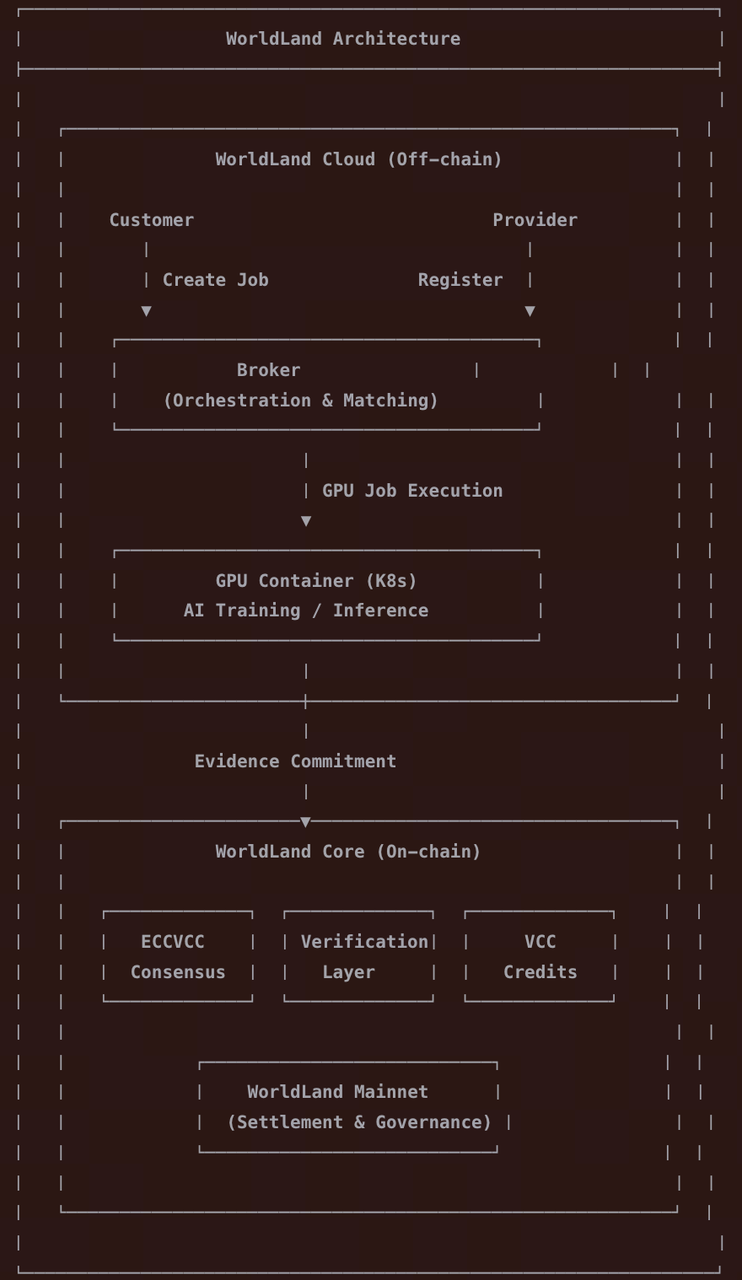 Source: WorldLand Official Documentation
Core Roles in the WorldLand Ecosystem: Task Initiators, GPU Providers, Validation Nodes, and Consensus Layer
WorldLand relies on coordination between multiple participants. Task initiators are typically users who require AI computation or other processing power; they submit tasks and pay associated fees. GPU providers carry out the actual computations and form the backbone of the network’s computing capacity.
At the same time, validation nodes are responsible for checking whether the computation process and results meet the required standards, ensuring the integrity of the Proof. The network’s consensus layer, based on Proof of Work, records results and establishes final agreement, making the data tamper-resistant.
Together, these roles form a complete decentralized computing system where tasks can be executed without reliance on a centralized platform.
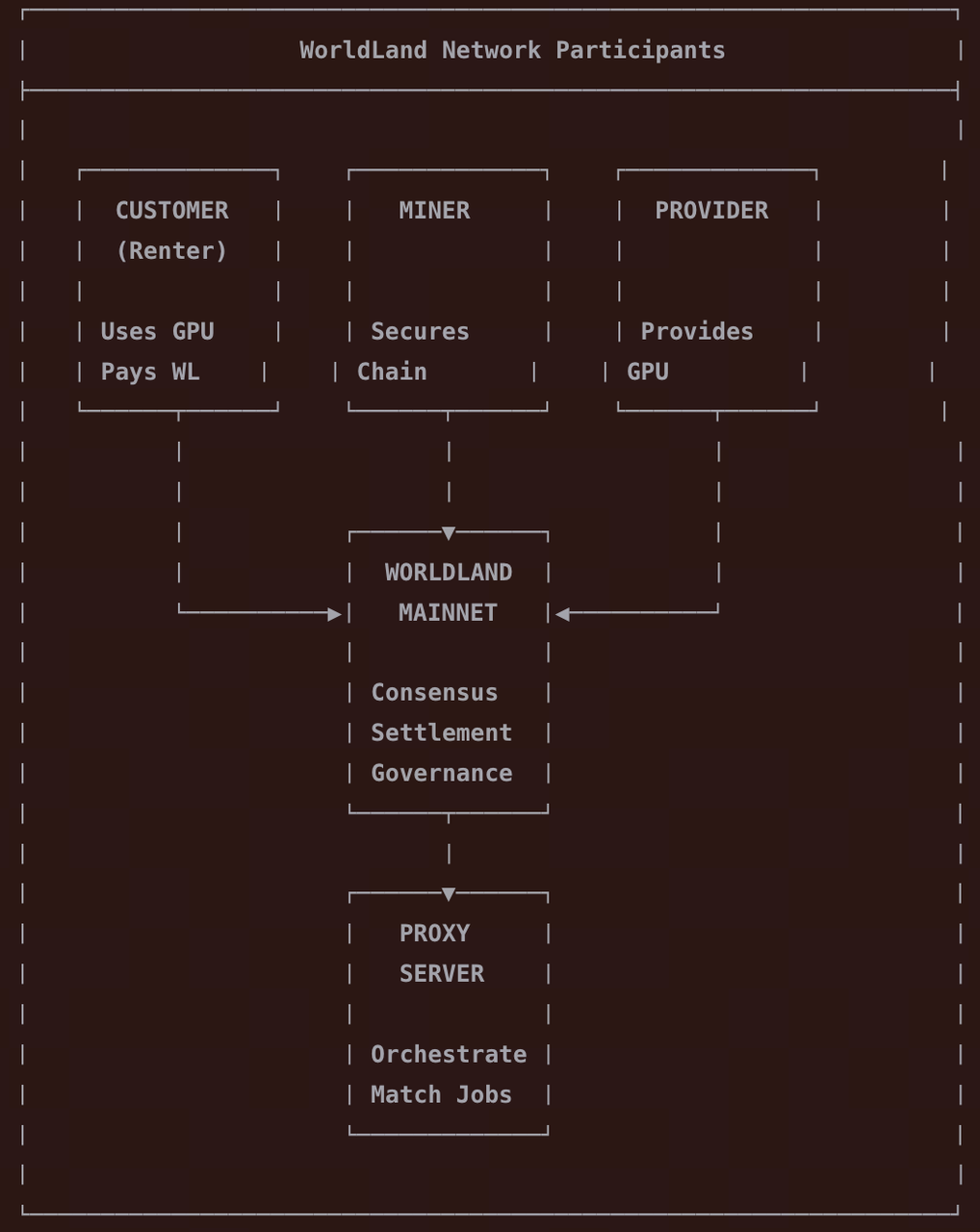 Source: WorldLand Official Documentation
Step 1: Submitting a GPU Computing Task
The process begins when a user submits a computing task. This may involve AI model training, inference services, or other workloads requiring GPU resources. The user defines parameters such as computational scale, input data, and execution requirements.
Once submitted, the task is packaged and broadcast to the network, where it awaits assignment to a suitable GPU node. While this step resembles traditional cloud computing, the key difference is that the task will later enter an on-chain verification process.
Step 2: GPU Providers Execute the Task
After the task is published, GPU providers in the network take on the job based on their available resources. These nodes form a decentralized supply layer that handles the actual computational workload.
Unlike traditional systems, the main challenge here is ensuring that nodes genuinely perform computation rather than submitting fabricated results. This is precisely why the Proof of Compute mechanism is essential.
Step 3: Generating Proof of Compute
During execution, GPU nodes generate a Proof of Compute. This proof contains details such as the computation path, summaries of execution data, and cryptographic information that describes how the task was processed.
The purpose of this Proof is to convert computational activity into verifiable data, allowing validation nodes to confirm whether the task was genuinely executed. This step marks the system’s shift from a trust-based model to a verification-based one.
In simple terms, Proof of Compute acts like a “receipt” for computation, confirming that the work actually took place.
Step 4: Verification Layer Validates the Proof
Once the Proof is generated, validation nodes examine it. This may involve sampling results, verifying proof data, and checking consistency in execution logic. By distributing verification across multiple nodes, the system reduces the risk of malicious behavior and improves overall security.
Through this mechanism, invalid or fabricated results can be detected and rejected, ensuring the reliability of final outputs. Compared to traditional cloud systems that rely on platform trust, this approach replaces trust with technical verification.
Step 5: On-Chain Confirmation and Network Consensus (ECCPoW Mechanism)
After passing validation, the computation results and their corresponding Proof are submitted to the blockchain and confirmed through a Proof of Work consensus mechanism. WorldLand’s ECCPoW approach enhances efficiency and resource utilization while maintaining security.
This stage ensures that data cannot be altered and provides final confirmation, turning the results into trusted on-chain records.
Step 6: Task Settlement and WL Token Distribution
Once the results are confirmed, the system settles the task based on execution outcomes. The WL tokens paid by users are distributed to GPU providers and other participating nodes as rewards for their computing and validation services.
This completes the full cycle from computation to value distribution, enabling supply and demand for computing resources to be coordinated through token incentives.
Workflow Summary: From “Computation Task” to “Trusted Result”
Overall, WorldLand’s operation can be summarized in six steps: task submission, execution, proof generation, validation, on-chain confirmation, and token settlement.
The core idea is to transform computation into verifiable data and record it on the blockchain, enabling a shift from simple task execution to trusted, verifiable results.
Key Features of the WorldLand Mechanism: Decentralization, Verifiability, and Incentive Alignment
WorldLand’s design highlights several key characteristics. First, decentralization, as tasks are executed by distributed nodes rather than a single platform. Second, verifiability, enabled by Proof of Compute, which allows results to be independently checked. Third, incentive alignment, where token rewards encourage participation from network nodes.
Together, these elements create a distinctive approach to decentralized computing.
Conclusion
By integrating GPU computing, Proof of Compute, and blockchain consensus, WorldLand establishes a complete verifiable computing framework. Its core innovation lies in transforming computation from an invisible execution process into verifiable, recorded on-chain data.
This model not only reshapes how trust is established in computing but also offers a new architectural foundation for decentralized AI cloud infrastructure.
FAQs
How does WorldLand differ from traditional cloud computing?
WorldLand converts computation into verifiable on-chain data, while traditional cloud computing relies on platform trust.
What role does Proof of Compute play?
It proves that GPU nodes have actually executed the computation and serves as the core of the verification mechanism.
Can GPU nodes fake computation results?
The Proof verification mechanism can detect and reject invalid or fabricated results.
Why is on-chain confirmation necessary?
It ensures data immutability and provides final consensus.
How are WL tokens used in the workflow?
They are used to pay for computation and to incentivize GPU providers and validation nodes to participate in the network.







