RWA (Real World Assets) refers to an innovation model that digitally represents traditional financial or physical assets such as real estate, bonds, and commodities through blockchain technology, allowing them to be traded on-chain in tokenized form. RWA has attracted growing attention from institutions and capital because it promises improved asset liquidity, reduced intermediary costs, and broader investor participation. Recent market developments show that institutions in China and globally are actively exploring practical RWA tokenization, while regulatory frameworks are also being refined.
Technically, RWA relies on decentralized ledgers and smart contracts to achieve asset ownership confirmation, transparent transactions, and automated execution. This cross-domain integration introduces new requirements for both traditional financial systems and blockchain architecture. Financial institutions, blockchain platforms, and compliance bodies jointly participate in building the RWA ecosystem, forming a complex and interconnected system spanning legal frameworks, asset valuation, on-chain trading, and settlement.
This article aims to comprehensively explain the definition, core architecture, and operating mechanisms of RWA, and to analyze its role as a bridge between the real world and the on-chain world, helping readers understand how RWA works from technical, financial, and regulatory perspectives, as well as its opportunities and risks.
What Is Asset Tokenization
Asset tokenization refers to the process of converting ownership or income rights of real-world assets into tradable digital tokens using blockchain technology. These tokens can represent full or partial ownership interests and can be transferred and traded on blockchain networks. Compared with traditional assets, tokenized assets offer higher liquidity, more transparent transaction records, and lower transaction friction.
The basic steps of asset tokenization generally include asset identification and valuation, legal structure design, creation of tokens representing asset rights, and the use of smart contracts to manage transactions and distribution mechanisms. The decentralized ledger ensures transparent and tamper-resistant ownership records, while smart contracts automate complex business rules and significantly reduce intermediary costs.
Introduction to RWA
RWA represents the practical application of asset tokenization in real-world assets, including real estate, bonds, artworks, commodity inventories, and accounts receivable. Once these assets are wrapped in legal structures and tokenized, they can be traded, transferred, or used for financing on blockchain networks. The core value of RWA lies in connecting traditional finance with blockchain markets, enabling digital trading and global circulation of traditional assets.
The main objectives of RWA tokenization include improving asset liquidity, broadening the investor base, and enabling automated management and settlement of asset rights, allowing traditional assets to benefit from the efficiency and transparency of blockchain technology.
The Three-Layer Core Architecture of Bringing RWA On-Chain
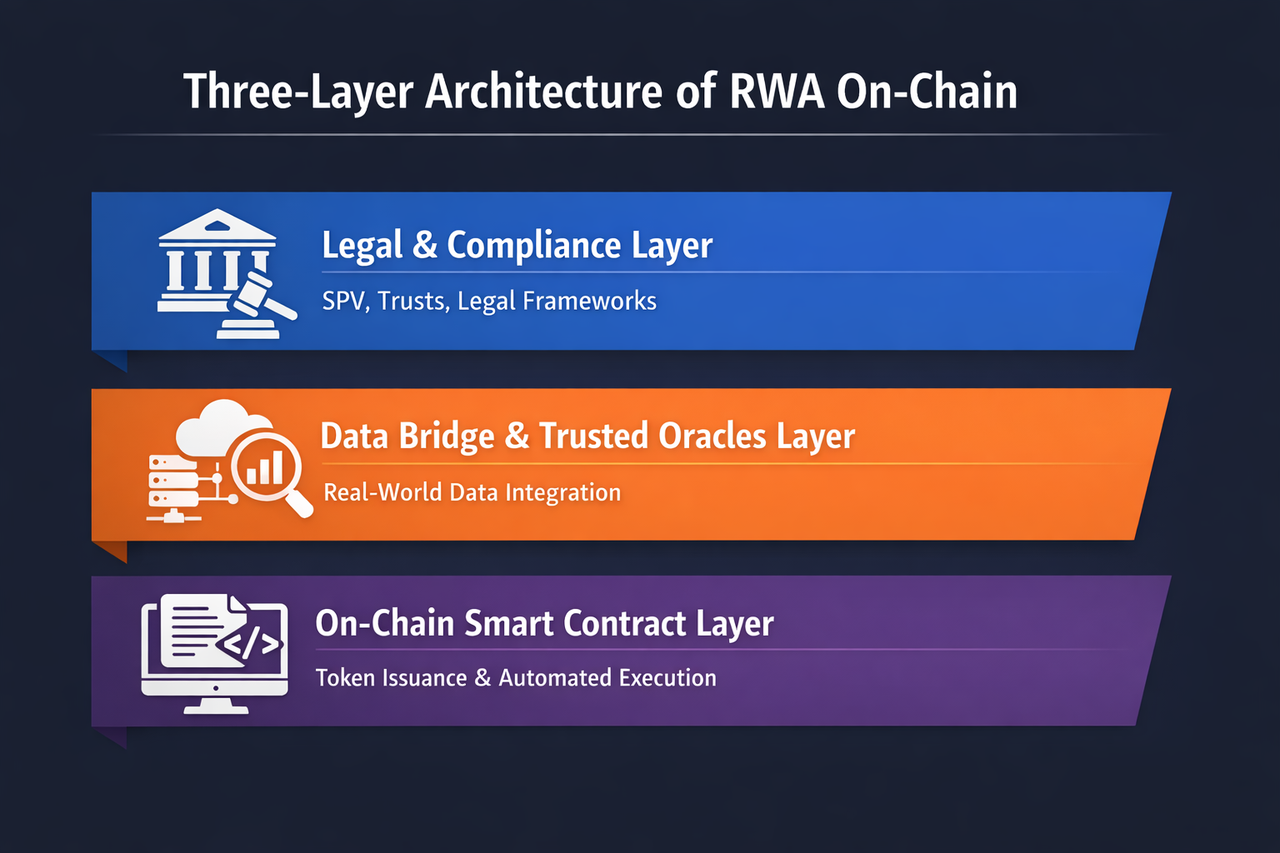
RWA asset onboarding typically involves three core layers:
- Legal and compliance layer: This layer ensures asset legality and the validity of rights. Special purpose vehicles (SPVs), trusts, or fund structures are established to clearly define asset ownership and issuer rights, providing legal support for tokenized assets.
- Data bridging and trusted intermediary layer: Real-world asset information must be transmitted to blockchain smart contracts through trusted data sources such as oracles, ensuring that on-chain tokens accurately reflect off-chain asset conditions, including valuation, income, and legal status.
- On-chain smart contract layer: This is the core of token issuance and transaction execution. Token standards define how asset rights are represented, while smart contracts automate token minting, transfers, income distribution, and compliance logic.
Core Operating Processes of RWA
How Are Assets Brought On-Chain?
Bringing assets on-chain begins with off-chain preparation, including asset identification, valuation, and confirmation of legal enforceability. Issuers typically establish SPV or trust structures to isolate assets and place them under custody with trusted third parties. Legal documentation and regulatory approvals are then obtained to establish a compliant framework for token issuance.
Asset information is subsequently transmitted to smart contracts through data bridges such as oracles. RWA tokens of equivalent value are issued based on the legal structure, representing ownership or income rights and enabling on-chain trading.
How Are Return Distribution Mechanisms Designed?
Return distribution mechanisms are usually executed automatically by smart contracts. Based on predefined rules, smart contracts distribute asset-generated income such as rent or interest proportionally to token holders. Fees, taxes, and intermediary costs can be deducted automatically, with all transactions recorded transparently on-chain to improve efficiency and traceability.
Settlement and Default Handling Mechanisms
Settlement mechanisms are triggered when assets are liquidated or reach maturity, such as distributing proceeds after property sales or settling principal and interest at bond maturity. Default handling mechanisms often require coordination with off-chain legal processes. Smart contracts can trigger protective logic under specific conditions, such as freezing tokens, initiating compensation mechanisms, or seeking legal remedies, to safeguard holder interests.
Key Participants in the RWA Ecosystem
- Asset issuers: Responsible for asset identification, valuation, and legal structuring.
- Legal and compliance institutions: Design compliant frameworks and ensure lawful token issuance.
- Blockchain platforms and developers: Provide smart contracts and blockchain infrastructure.
- Investors and trading markets: Purchase, trade, and manage RWA tokens.
- Intermediaries and custodians: Handle asset custody, data bridging, and compliance audits.
Similarities and Differences Between RWA and Stablecoin Structures
Both RWA tokens and stablecoins rely on blockchain and smart contracts at a technical level, but they differ in purpose and value backing. Stablecoins are typically pegged to fiat currencies to maintain price stability, while RWA tokens are backed by ownership or income rights of real-world assets. Both enhance liquidity, but RWA emphasizes legal rights and asset value backing, whereas stablecoins focus on payments and value storage.
Challenges and Risk Analysis of RWA
Despite its potential, RWA faces several challenges:
- Legal and compliance risks: Regulatory requirements vary across jurisdictions.
- Asset authenticity and valuation risks: Off-chain asset data may be incomplete or subject to valuation fluctuations.
- Liquidity and market acceptance: Some RWA tokens still have low trading volumes.
- Technical complexity: Coordinating compliance logic, cross-chain settlement, and data bridging remains challenging.
In addition, regulatory authorities in some countries have recently strengthened oversight and registration requirements for RWA activities, highlighting the need for cautious risk management.
Conclusion
RWA represents a significant innovation in integrating blockchain with traditional assets. Through tokenization, it enables assets to move on-chain, improves liquidity, and reduces transaction friction, offering substantial technical and financial value. It opens access to institutional-grade assets for a wider investor base and encourages traditional financial institutions to explore new financing and trading models. However, successful RWA implementation requires coordinated progress across legal, technical, and market domains, with further development of compliance frameworks and infrastructure being essential.
FAQs
Q1: What types of assets can become RWA?
A1: Almost any valuable and measurable real-world asset, such as real estate, bonds, commodity inventories, and intellectual property, can be tokenized.
Q2: Is RWA safer than traditional investment?
A2: RWA is not inherently safer. Its security depends on legal compliance, asset valuation, and market liquidity.
Q3: How does RWA improve liquidity?
A3: By fractionalizing assets into smaller tokens and enabling on-chain trading, more investors can participate, increasing liquidity.
Q4: Is RWA suitable for individual investors?
A4: Some RWA projects offer low participation thresholds, but investors should assess compliance and market risks.
Q5: What is the future outlook for RWA?
A5: As regulation improves and technology matures, the RWA market is expected to expand further and deepen the integration between traditional finance and blockchain.







