As the blockchain ecosystem shifts toward a multi-chain paradigm, demand for asset transfers and data interoperability across networks is surging. However, due to differences in consensus mechanisms, virtual machine environments, and security models among chains, cross-chain communication has remained a fundamental challenge within blockchain infrastructure. In recent years, frequent bridge attacks have brought cross-chain security to the forefront of industry concerns.
From an architectural standpoint, [LayerZero](https://www.gate.com/learn/articles/what-is-layerzero-a-comprehensive-guide-to-the-working-principles-and-ecosystem-of-the-omnichain-interoperability-protocol/16970) is engineered to balance security, decentralization, and efficiency. Through innovations like the Ultra Light Node (ULN), a separated validation mechanism for oracles and relayers, and a composable security model, LayerZero introduces a new paradigm for cross-chain communication in Omnichain Applications. It has progressively become foundational infrastructure enabling DeFi, NFT, and Web3 applications to achieve seamless cross-chain interoperability.
## The Core Challenges of Cross-Chain Communication
Cross-chain communication fundamentally involves **verifying and transmitting information across disparate blockchains**. This process presents several major technical hurdles:
**1. State Verification.** Each blockchain maintains its own state database and consensus mechanism. When one chain needs to validate transactions or state changes on another, it must obtain trustworthy verification data. Weak verification mechanisms can result in forged messages or unauthorized asset minting.
**2. Cost.** Full node validation often requires synchronizing substantial amounts of block data, imposing significant computational and storage overhead on cross-chain protocols. If every chain ran full nodes for others, scalability would be virtually impossible.
**3. Security.** Bridge attacks in recent years have shown that centralized validators, single-signature setups, or even multisig validation can serve as entry points for exploits. Once a validation mechanism is breached, attackers can siphon assets in moments.
**4. Scalability.** As the number of blockchains grows, cross-chain protocols must support more networks. Deploying complex validation logic for each new chain causes systemic complexity to escalate rapidly.
LayerZero directly addresses these issues by enabling cross-chain communication through a lightweight, modular validation framework.
## LayerZero Architecture Evolution: V1 to V2
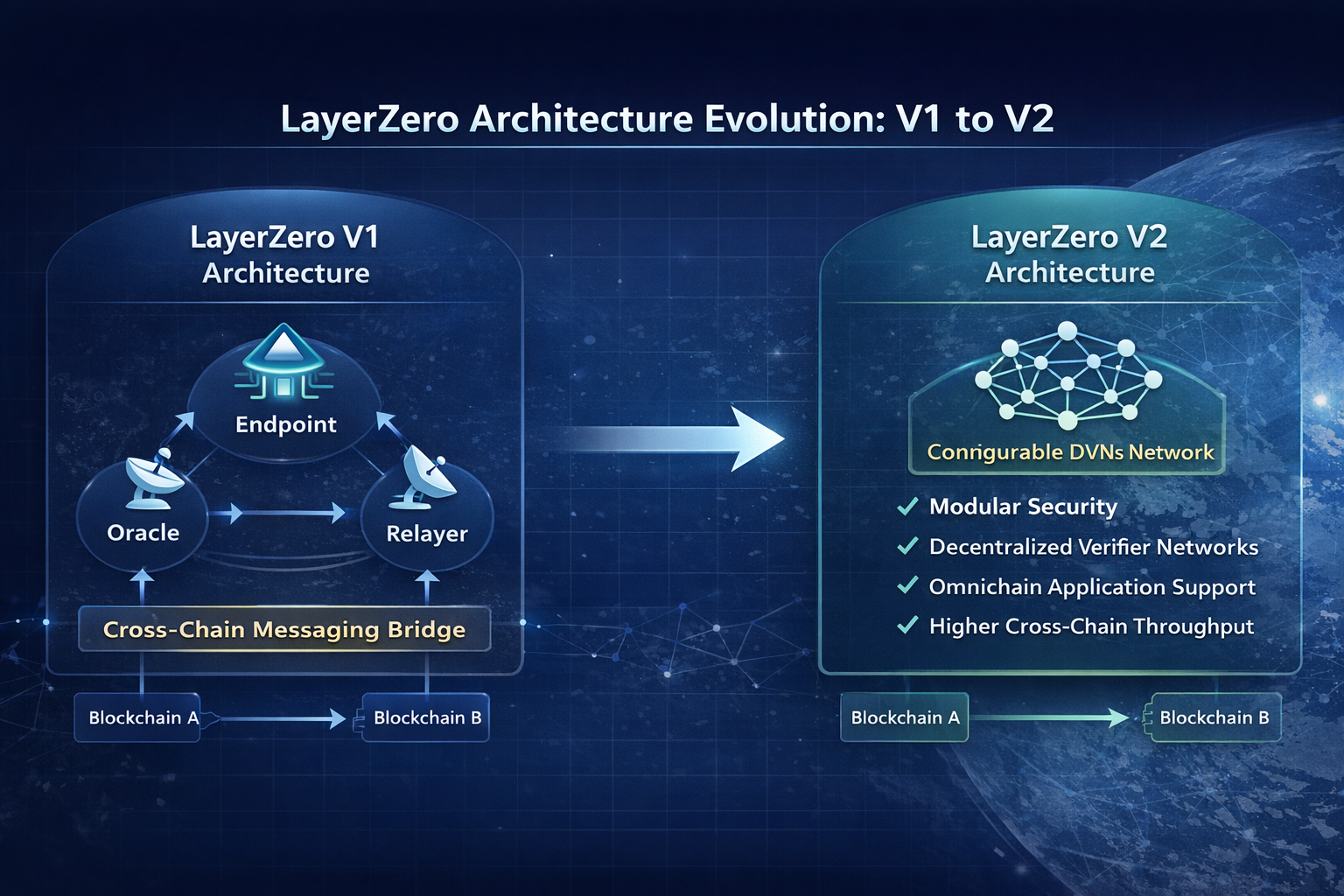
LayerZero’s core design is a **“light client + separated validation”** model for cross-chain messaging. In V1, three primary components manage cross-chain messages:
- Endpoint
- Oracle
- Relayer
When an application initiates a cross-chain message, the Endpoint logs the message and generates transaction proof. The Oracle provides block header data, while the Relayer supplies transaction proof; together, they complete the cross-chain validation. The critical innovation is **the separation of roles between Oracle and Relayer**—an attacker would need to control both, making forgery far more difficult.
LayerZero V2 introduces the **Decentralized Verifier Network (DVN)**, a modular validation mechanism that lets applications tailor their security profile by selecting different verifier network combinations.
Key V2 upgrades include:
- Support for multiple verification networks
- Configurable security policies
- Increased cross-chain throughput
- Greater flexibility in application deployment
This evolution transforms LayerZero from a mere bridge to a **Cross-chain Messaging Protocol**.
## How Ultra Light Node (ULN) Drives Cost Efficiency
ULN (Ultra Light Node) is LayerZero’s signature technical innovation.
Traditional cross-chain protocols require running full light nodes to validate block data from other chains, necessitating synchronization of vast block headers and complex logic—driving up costs.
ULN’s philosophy is to **minimize on-chain validation logic**.
Within the ULN framework:
1. Oracles deliver block header data
2. Relayers provide transaction proof
3. Smart contracts verify message integrity
By validating only essential data, not full chain state, ULN drastically reduces computational overhead.
Benefits include:
- Lower gas fees
- Greater cross-chain efficiency
- Reduced on-chain storage requirements
- Support for more blockchain networks
Thus, ULN is considered the cornerstone of LayerZero’s ability to scale cross-chain communication.
## Oracle and Relayer Collaboration
LayerZero’s cross-chain validation relies on **the coordinated efforts of Oracles and Relayers**.
Their distinct roles:
**Oracle:** Sends block header data from the source chain to the destination chain. The header contains the transaction Merkle Root, confirming transaction existence.
**Relayer:** Submits concrete transaction proofs, such as Merkle Proofs, to verify that a cross-chain message truly exists.
The destination chain only accepts a cross-chain message when:
- Block header data matches
- Transaction proof matches
The key advantage is **trust separation**: attackers must compromise both the Oracle and the Relayer, substantially raising the difficulty. Projects can mix and match components, such as:
- Chainlink Oracles
- Third-party Relayers
- Custom validation nodes
This modularity boosts system flexibility.
## LayerZero’s Multi-Layer Validation Security Model
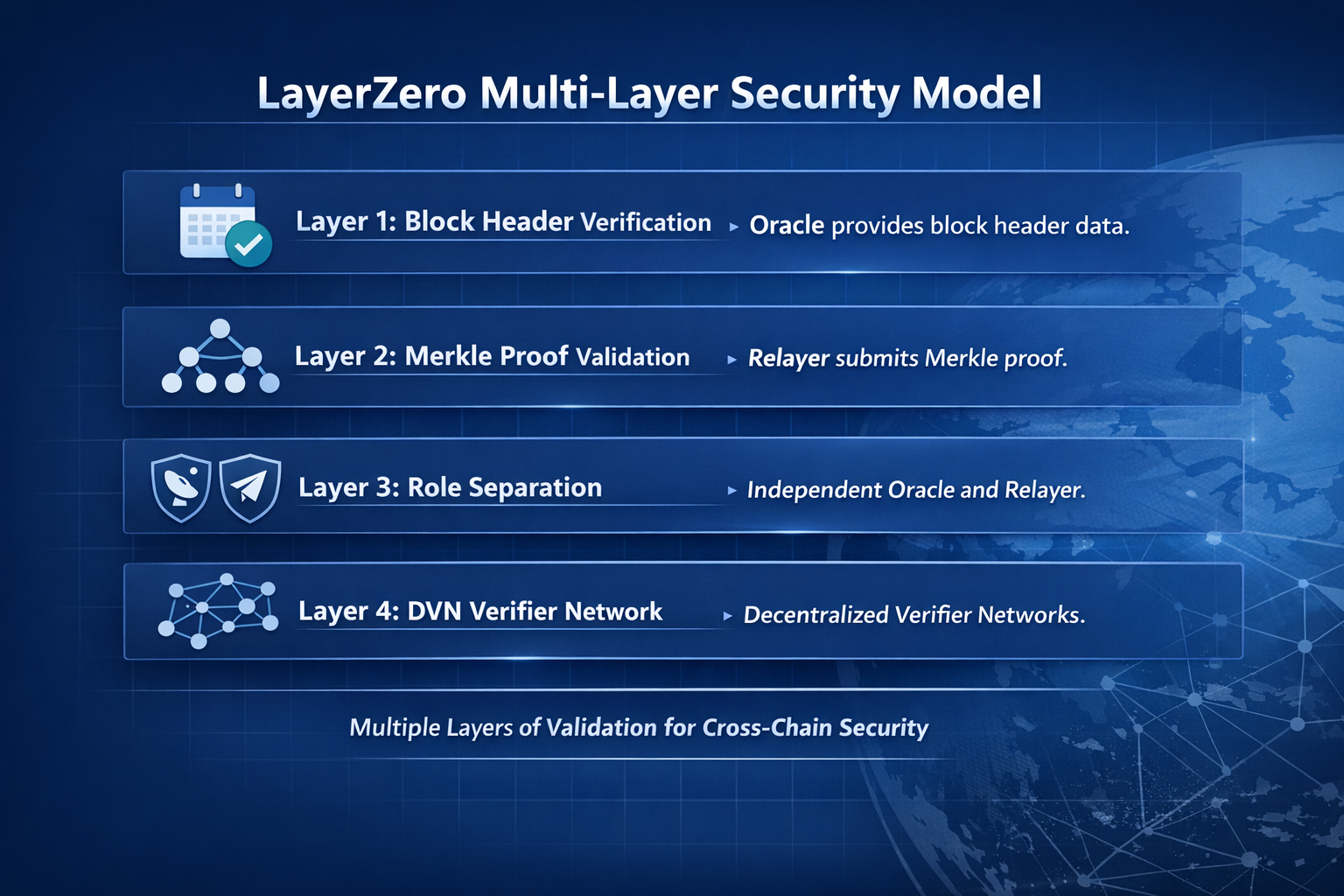
Security is paramount in cross-chain protocol design. LayerZero leverages several layers of validation to maximize safety:
**Layer 1: Block Header Validation**
Oracles provide block header data to confirm transaction inclusion.
**Layer 2: Merkle Proof Validation**
Relayers submit transaction proofs, and contracts verify transaction existence.
**Layer 3: Role Separation**
Oracles and Relayers operate independently, minimizing single-point-of-failure risks.
**Layer 4: DVN Validation Network**
V2 allows multiple verification networks to participate, increasing redundancy and resilience.
This multi-layered approach helps LayerZero achieve a balance between security and efficiency.
## LayerZero vs. Traditional Cross-Chain Solutions
The market’s main cross-chain approaches are:
- **Lock-Mint Bridges**
- **Multisig Bridges**
- **Light Client Bridges**
LayerZero, by contrast, is a **Cross-chain Messaging Protocol**.
td {white-space:nowrap;border:0.5pt solid #dee0e3;font-size:10pt;font-style:normal;font-weight:normal;vertical-align:middle;word-break:normal;word-wrap:normal;}
| Technical Solution | Core Mechanism | Security | Cost | Scalability |
| Multisig Bridge | Multi-node signature validation | Medium | Low | Medium |
| Light Client Bridge | On-chain block data validation | High | High | Low |
| LayerZero | ULN + dual-component validation | High | Medium | High |
LayerZero’s advantages over legacy bridging solutions include:
- Lower on-chain validation costs
- Superior cross-chain scalability
- Support for cross-chain messaging, not just asset bridging
These characteristics make LayerZero a strong candidate for the foundational communication layer of multi-chain apps.
## LayerZero Technical Roadmap
As the [multi-chain ecosystem](https://www.gate.com/learn/articles/layerzero-ecosystem-landscape-which-protocols-are-building-omnichain-applications/16987) expands, LayerZero continues to enhance its architecture.
Likely future directions:
1. **Greater decentralization:** The DVN network will continue to grow, reducing reliance on individual validators.
2. **Higher throughput:** Optimizing message validation to increase cross-chain capacity.
3. **Omnichain application ecosystem:** LayerZero is advancing the “Omnichain Application” concept, enabling state sharing across chains.
4. **Broader blockchain support:** Already integrated with many major networks, LayerZero expects to support more Layer1 and Layer2 chains.
As these upgrades roll out, cross-chain communication will evolve from simple asset bridging to **the infrastructure for interchain information interoperability**.
## Conclusion
LayerZero, through its Ultra Light Node (ULN), Oracle-Relayer collaborative mechanism, and multi-layer security model, offers a novel technical strategy for cross-chain communication.
Compared to traditional bridges, LayerZero achieves an equilibrium among security, efficiency, and scalability by lowering validation costs and separating trust. The protocol has matured from basic bridge infrastructure to a cross-chain messaging protocol, underpinning multi-chain application ecosystems.
With the continued development of LayerZero V2 and decentralized validation networks, cross-chain infrastructure will likely evolve from single-purpose bridges to a core protocol layer enabling advanced Web3 interoperability.







