Gate TradFi: A Unified Gateway to Multi-Asset and Cross-Market Trading

Last Updated 2026-04-03 14:15:08
Reading Time: 4m
As global investment markets evolve and diversify, a growing number of investors are turning their attention to cross-market asset allocation. Opportunities in cryptocurrency, forex, equities, and commodities are becoming ever more intertwined. Gate TradFi unifies traditional finance and digital asset trading within a single platform, allowing users to engage with multiple asset markets seamlessly. This approach boosts trading efficiency and broadens the scope of investment opportunities.

In recent years, investors’ attitudes toward asset allocation have evolved. Single-market strategies often fall short when it comes to balancing risk management with return opportunities, leading to an increased focus on cross-market investing.

Beyond the cryptocurrency marketplace, forex, equities, and commodities are now essential elements in many investors’ strategic layouts. Historically, cross-market investing required opening accounts on multiple platforms and managing assets across different systems—a cumbersome process that complicated capital allocation. This has fueled demand for platforms that integrate multi-market trading.

Gate TradFi: Connecting Crypto and Traditional Financial Markets
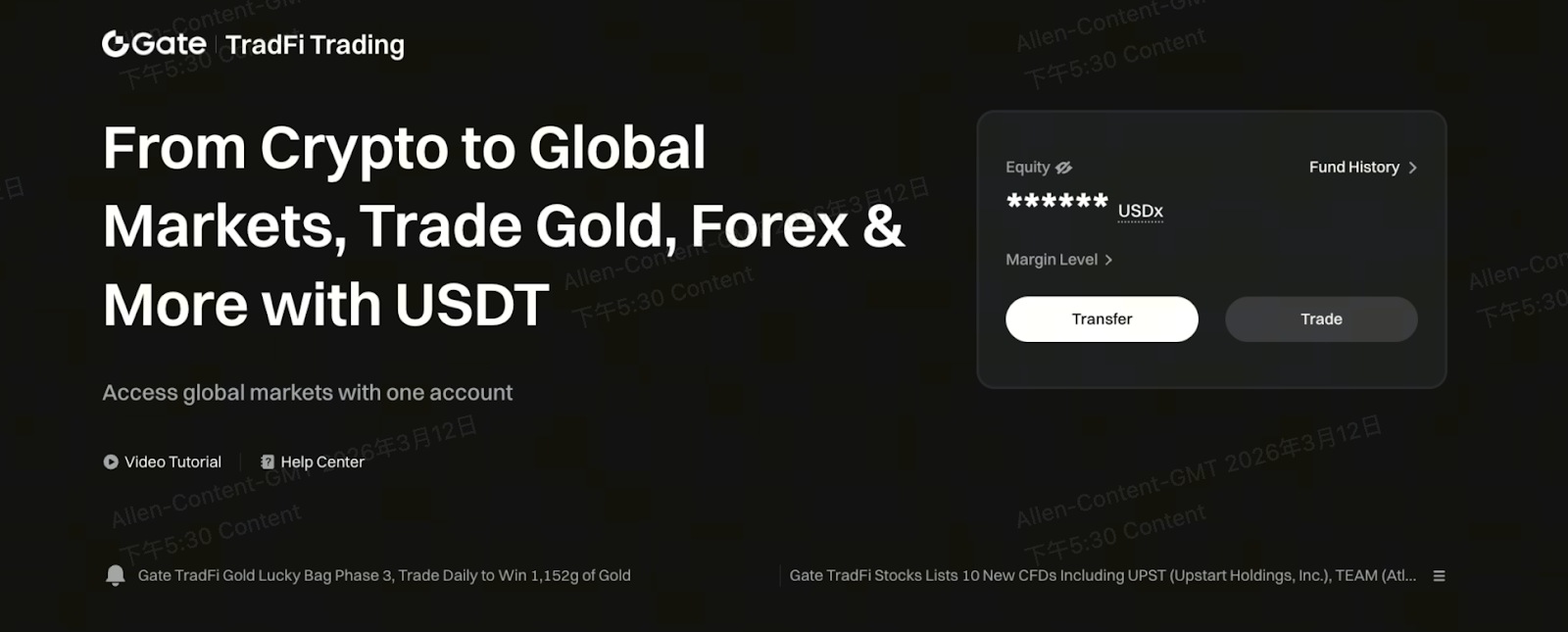
Gate TradFi: Connecting Crypto and Traditional Financial Markets

To make cross-market trading more seamless, Gate introduced the TradFi trading module. This system brings traditional financial products into Gate’s existing trading environment, allowing investors to access diverse asset classes within a unified account structure.

With this design, users can manage multi-asset trades without toggling between platforms. The result: a simplified trading process and greater overall investment efficiency.

Start trading on Gate TradFi now: https://www.gate.com/tradfi

Broaden Your Investment Horizons with Diverse Markets

Gate TradFi offers a wide range of financial markets, empowering investors to tailor their asset allocation strategies.

  1. Precious Metals Market

Assets like gold and silver often serve as safe havens during periods of heightened market uncertainty and are staples in long-term asset allocation.

  1. Forex Trading

The forex market encompasses major global currency pairs, giving traders access to international currency price movements.

  1. Equity-Related Products (CFDs)

With contracts for difference, investors can track international stock price movements and participate in equity market trends.

  1. Indices Products

Market indices provide insight into overall economic or sector performance and serve as valuable indicators for market trends.

  1. Commodities

Energy and industrial raw materials markets help further diversify investment portfolios.

These options enable investors to build comprehensive asset allocations—all on a single platform.

Integrated Model for Greater Trading Efficiency

Compared to traditional multi-platform approaches, Gate TradFi’s integrated design delivers significant advantages.

  • Manage assets across markets with a single account, reducing the complexity of account administration.

  • Move funds seamlessly within the system, eliminating frequent transfers and ensuring a smoother trading experience.

The platform also features leverage and a competitive fee rate structure, allowing traders to optimize capital allocation and refine their strategies.

Getting Started with Cross-Market Trading

For first-time users of the TradFi module, the process is designed to be straightforward.

  1. Register and complete identity verification to activate TradFi features.

  2. Transfer funds (such as USDT) to your designated account.

  3. Choose your target market and asset to begin cross-market trading.

With this streamlined process, even newcomers to multi-market trading can get started quickly.

Key Risks in Cross-Asset Trading

While multi-market trading expands opportunities, risk profiles differ across asset types. For example, forex markets are influenced by macroeconomic trends and interest rate policies, while commodities are closely tied to supply-demand dynamics and geopolitical events.

Volatility patterns also vary significantly between markets. Leverage can boost capital efficiency but also magnifies exposure to market swings. As such, disciplined capital management and robust risk control are crucial for successful cross-market investing.

Conclusion

As financial markets converge, multi-asset and cross-market strategies are becoming increasingly mainstream. Gate TradFi integrates crypto assets with traditional financial markets, offering investors a more efficient trading environment. With forex, commodities, equities, and indices trading all available on one platform, investors benefit from lower barriers to entry and greater capital flexibility. For those looking to expand their investment horizons and enhance trading efficiency, this integrated trading model is quickly emerging as a key market trend.

Author:  Allen
Disclaimer
* The information is not intended to be and does not constitute financial advice or any other recommendation of any sort offered or endorsed by Gate.
* This article may not be reproduced, transmitted or copied without referencing Gate. Contravention is an infringement of Copyright Act and may be subject to legal action.

Related Articles

Gold Price Forecast for the Next Five Years: 2026–2030 Trend Outlook and Investment Implications, Could It Reach $6,000?
Beginner

Gold Price Forecast for the Next Five Years: 2026–2030 Trend Outlook and Investment Implications, Could It Reach $6,000?

Analyze current gold price trends alongside authoritative five-year forecasts, integrating an evaluation of market risks and opportunities. This gives investors insight into the potential trajectory of gold prices and the main drivers expected to shape the market over the next five years.
2026-03-25 18:13:30
AI-Native Settlement Layers: How United Stables Is Building the Next Financial Rail
Beginner

AI-Native Settlement Layers: How United Stables Is Building the Next Financial Rail

Stablecoins were originally designed as dollar substitutes within exchanges, primarily used for asset pricing and trade settlement. As on-chain financial ecosystems have matured, their role has expanded beyond simple payments to include collateral assets, cross-chain liquidity mediums, and unified settlement units. In particular, as AI systems and automated agents begin to participate directly in economic activity, demand has risen sharply for programmable value units capable of instant settlement. This shift is pushing stablecoins toward the role of foundational financial infrastructure.
2026-03-25 03:16:17
Aster vs Hyperliquid: Which Perp DEX Will Prevail?
Beginner

Aster vs Hyperliquid: Which Perp DEX Will Prevail?

Aster and Hyperliquid are the two representative protocols of the "purpose-built L1 path" within the current decentralized perpetual exchange (Perp DEX) sector. As a pioneer in the field, Hyperliquid has built a deep liquidity moat through its highly mature order book architecture and strong community consensus. Conversely, Aster, as a rising challenger, seeks to leapfrog the competition in high-performance trading through more aggressive multi-chain aggregation logic, private transaction modules, and an underlying execution environment optimized for 2026 market demands.
2026-03-24 11:58:33
DePIN Identity Network and Real World Applications: How Humanity Protocol Brings on-chain Identity Into the Physical World
Beginner

DePIN Identity Network and Real World Applications: How Humanity Protocol Brings on-chain Identity Into the Physical World

Most Web3 identity systems remain confined to on-chain environments and struggle to achieve meaningful adoption in real world settings. Through a DePIN architecture and physical verification hardware, Humanity Protocol aims to bring decentralized identity into access control systems, hospitality, public services, and offline events, allowing on-chain identity to function not just as a digital credential, but as foundational infrastructure for real world access.
2026-03-25 07:40:53
Aerodrome Tokenomics: How ve(3,3) Powers Base's Most Profitable DEX
Beginner

Aerodrome Tokenomics: How ve(3,3) Powers Base's Most Profitable DEX

AERO is the native token of Aerodrome Finance, a core decentralized exchange and liquidity protocol in the Base ecosystem. It is primarily used for liquidity incentives and ecosystem operations. veAERO is a governance NFT that users receive by locking AERO, representing both voting power and the right to share protocol revenue. Through a dual track structure of AERO as a utility token and veAERO as a governance credential, Aerodrome separates liquidity usage value from long term governance power, allowing participants to act as liquidity providers, governance decision makers, and revenue sharers within the same system.
2026-03-25 06:40:31
How Does Kite Work? An In-Depth Look at Kite's Identity and Programmable Permission Architecture
Beginner

How Does Kite Work? An In-Depth Look at Kite's Identity and Programmable Permission Architecture

Kite is an EVM compatible Layer 1 blockchain network that runs on proof of stake. It is designed to give AI agents verifiable identity, programmable permissions, and real time settlement in an on-chain execution environment. In Kite's design, AI is no longer only a tool that follows instructions. It becomes an economic participant with independent on-chain identity and direct control over assets. Within secure and auditable infrastructure, an AI agent can complete payments, call services, and coordinate tasks autonomously, making Kite a foundational layer for the emerging agent economy.
2026-03-25 06:02:34