Navigating Uncertainty: Macroeconomic Shifts and Capital Flows
In recent years, the global economy has become increasingly fragmented. Inflation, shifting interest rate policies, and evolving geopolitical risks have fueled persistent swings in financial market sentiment. As investors reassess risk, capital frequently moves toward asset classes with tangible value—metals being a prime example.
Metals continue to attract attention across economic cycles due to their diverse functions. Some serve as defensive assets during market turmoil, while others are closely linked to periods of economic growth. This diversity enables the sector to offer distinct investment rationales in varying macro environments.
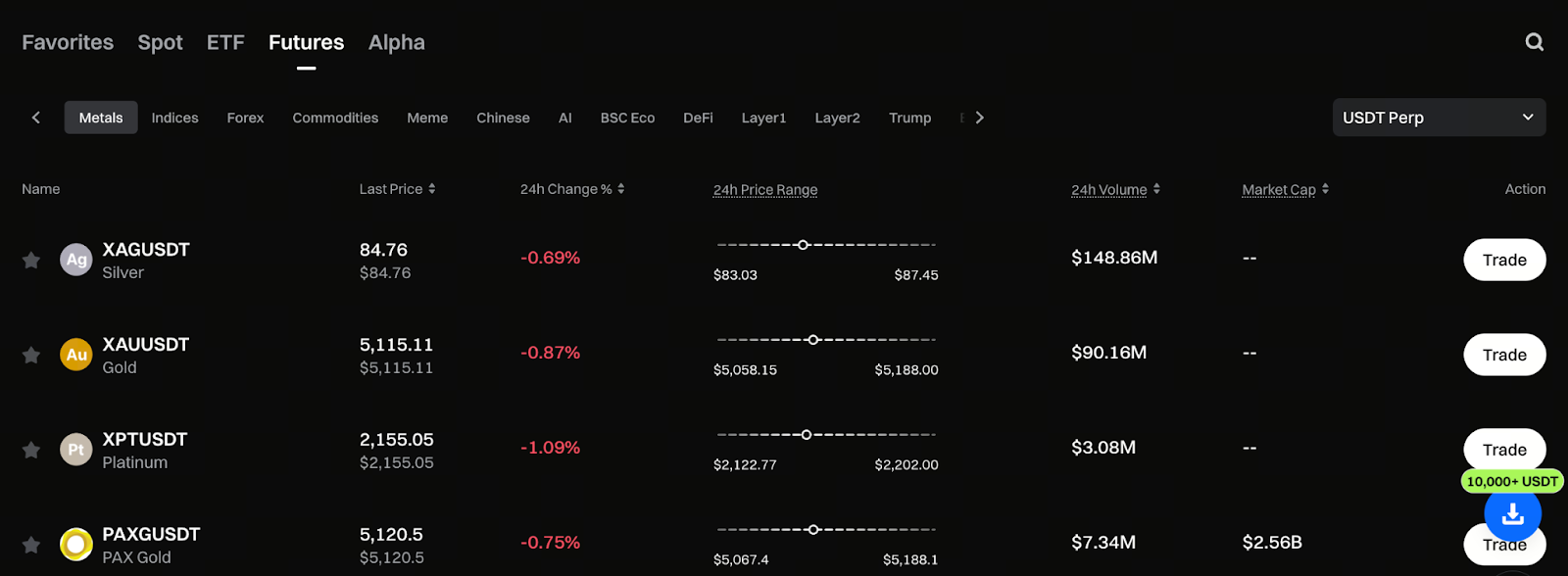
The metals market consists of two main categories: precious metals and industrial metals. Each plays a unique role in investment and the broader economy.
Precious metals are typically associated with value preservation. Gold, for instance, has long been considered a key hedge against inflation and financial risk. It often attracts safe-haven flows during market instability or shifts in monetary policy. Silver combines investment appeal with industrial utility, so its price reflects not only market sentiment but also real-world manufacturing demand.
Industrial metals, by contrast, are directly tied to the real economy. Copper is often called the “thermometer of economic activity” because its demand tracks infrastructure and manufacturing trends. Aluminum is widely used in transportation and construction, with prices often responding early when markets anticipate economic recovery.
Explore the Gate Metals Section to trade metals: https://www.gate.com/price/futures/category-metals/usdt
Metal prices have seen heightened volatility recently, typically driven by a combination of factors rather than single events.
Frequent revisions to global economic data shape expectations for future demand, resulting in ongoing price adjustments. Fluctuations in energy and logistics costs also reshape the overall cost structure for mining and smelting.
Policy signals and interest rate changes further influence capital allocation. When large institutions and quantitative strategies respond rapidly to market developments, price reactions can be amplified, leading to pronounced short-term swings.
Trading Dynamics in Volatile Markets
As volatility rises, the pace of metals trading changes significantly. Price ranges form and break more rapidly, with trends reversing multiple times in short periods. Capital rotates faster between different types of metals, with funds moving swiftly between precious and industrial categories.
In this environment, market participants must monitor information and price movements in real time to maintain decision-making efficiency in rapidly shifting markets.
The ongoing digitization of financial markets is transforming commodity trading. Integrated platforms now enable investors to monitor markets and execute trades within a single interface—eliminating the need to juggle multiple systems.
Gate, for example, consolidates metals trading products into a dedicated section, allowing users to track the performance and trading opportunities of various metals clearly. When sudden events occur, a stable trading system and transparent information structure support rapid strategy adjustments.
Digital trading also extends market access hours. Investors can react in real time to international policy changes or major events, even outside traditional trading sessions, without waiting for markets to reopen.
Despite ongoing innovation in trading tools, metals continue to serve as a core component in investment portfolios. Some metals offer protection against inflation, helping preserve value when purchasing power declines. Their correlations with equities and crypto assets are not perfectly aligned, allowing metals to diversify portfolio risk.
Because industrial metals are closely tied to economic activity, they are also used to gauge global economic cycles. By allocating metals strategically, investors can balance defensive positions with opportunities for growth.
Conclusion
In a constantly evolving macroeconomic landscape, the metals market stands out for its dual role as a safe-haven and a barometer of growth. Precious and industrial metals each respond to different economic scenarios, keeping the market active throughout various cycles. As trading becomes increasingly digital, investors gain real-time access to price changes and greater flexibility in market participation. Whether for long-term portfolio allocation or to capture cyclical opportunities, metals remain a key component in diversified investment strategies.