From Contract-Centric to Product-Centric Thinking
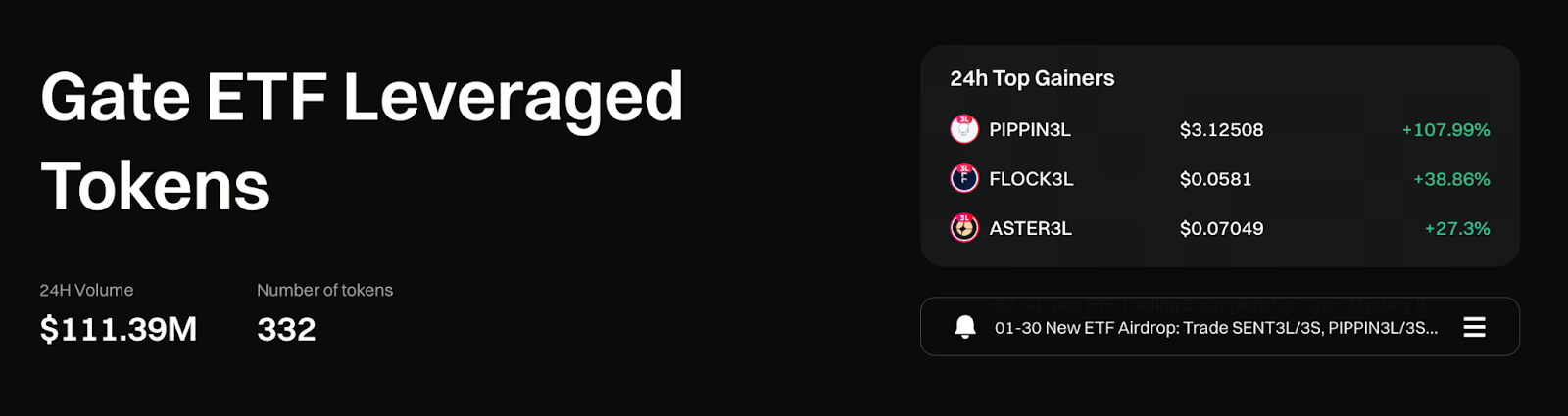
Traditional leveraged trading revolves around margin operations. Investors must open contract accounts, manage their margin ratios, and constantly monitor the risk of forced liquidation. While this model is well-established, it has a high barrier to entry and brings considerable psychological stress.
Gate Leveraged ETFs fundamentally change this approach. Users no longer need to maintain leverage ratios themselves or face the pressure of liquidation. Instead, they can participate in leveraged market opportunities simply by trading, just as they would with any other token. The leverage effect is now packaged as a product that can be directly bought and sold, rather than a position requiring active management. This marks a shift from leverage as a technical operation to leverage as a product innovation.
Start trading Gate Leveraged ETFs now: https://www.gate.com/leveraged-etf
How Fixed Multiples Are Structured
Every leveraged ETF is backed by a set proportion of perpetual contract positions, with a professional team maintaining the designated leverage multiple (such as 3x or 5x). When market movements cause the actual leverage to deviate from its target, the system triggers a daily rebalancing mechanism to readjust position sizes and restore the preset multiple.
This mechanism is not intended to increase risk, but rather to keep leverage within a controlled range. With this structure, investors do not need to constantly adjust positions or calculate margin maintenance rates. Risk management is embedded within the product itself.
Why Is There No Liquidation Mechanism?
The main difference between leveraged ETFs and traditional contracts is the absence of forced liquidation.
Here’s why:
- Investors do not directly borrow tokens or open margin positions
- Leverage risk is contained within the product’s net asset value
- The rebalancing mechanism adjusts positions before extreme scenarios occur
Users are exposed to fluctuations in the product’s net asset value, not the risk of account liquidation. While price swings still amplify gains and losses, the risk profile is fundamentally different from traditional contracts.
How the Rebalancing Mechanism Interacts With Market Trends
Daily position adjustments serve not only as a risk management tool but can also create compounding effects in trending markets. When the market shows a clear direction, profits are added to the new position base, producing a compounding effect. This means that in sustained uptrends or downtrends, leveraged ETFs may outperform simple multiple calculations. However, in highly volatile or range-bound markets, repeated adjustments can erode net asset value, making these products better suited for markets with clear trends.
Capital Efficiency and Liquidity Benefits
In contract trading, some funds must be locked as margin, reducing available liquidity. Leveraged ETFs, on the other hand, use a spot trading model—no additional collateral or borrowing is required, and your invested amount directly participates in the leverage effect. This design is especially attractive for users who want to retain capital flexibility while capturing leveraged market opportunities.
Additionally, the management fee (0.1% daily) primarily covers contract hedging, funding rates, and position adjustment costs, ensuring the product operates smoothly.
The Nature of Leverage Remains
While the structure reduces operational complexity and eliminates liquidation risk, leveraged ETFs are still instruments that amplify volatility. Gains accelerate as prices rise, and losses increase as prices fall. Understanding the product’s mechanics, selecting suitable market conditions, and managing position sizes remain essential for using these products effectively.
Summary
Gate Leveraged ETFs provide a more intuitive way to access leverage, transforming what was once a complex professional operation into a product that can be directly bought and sold. With fixed leverage multiples and daily rebalancing, users can participate in amplified market moves without opening margin accounts. This is not just about lowering the entry barrier—it’s about repackaging leverage into a more transparent and manageable financial tool. When investors understand the risk structure and plan their capital allocation well, these products can deliver real value.