From Spot to Futures: How to Properly Understand Futures Trading Features — A Gate Exchange Case Study

Beginner
Quick Reads
Last Updated 2026-03-26 19:58:52
Reading Time: 1m
As investors become more experienced with spot trading, many turn their attention to contract trading. This article uses Gate as a case study to systematically outline the key mindset shifts needed when moving from spot to contract trading. It also offers a detailed analysis of the core mechanics of contract trading features, providing beginners with the guidance they need for a seamless transition.

Why Spot Traders Are Turning Their Attention to Futures Trading
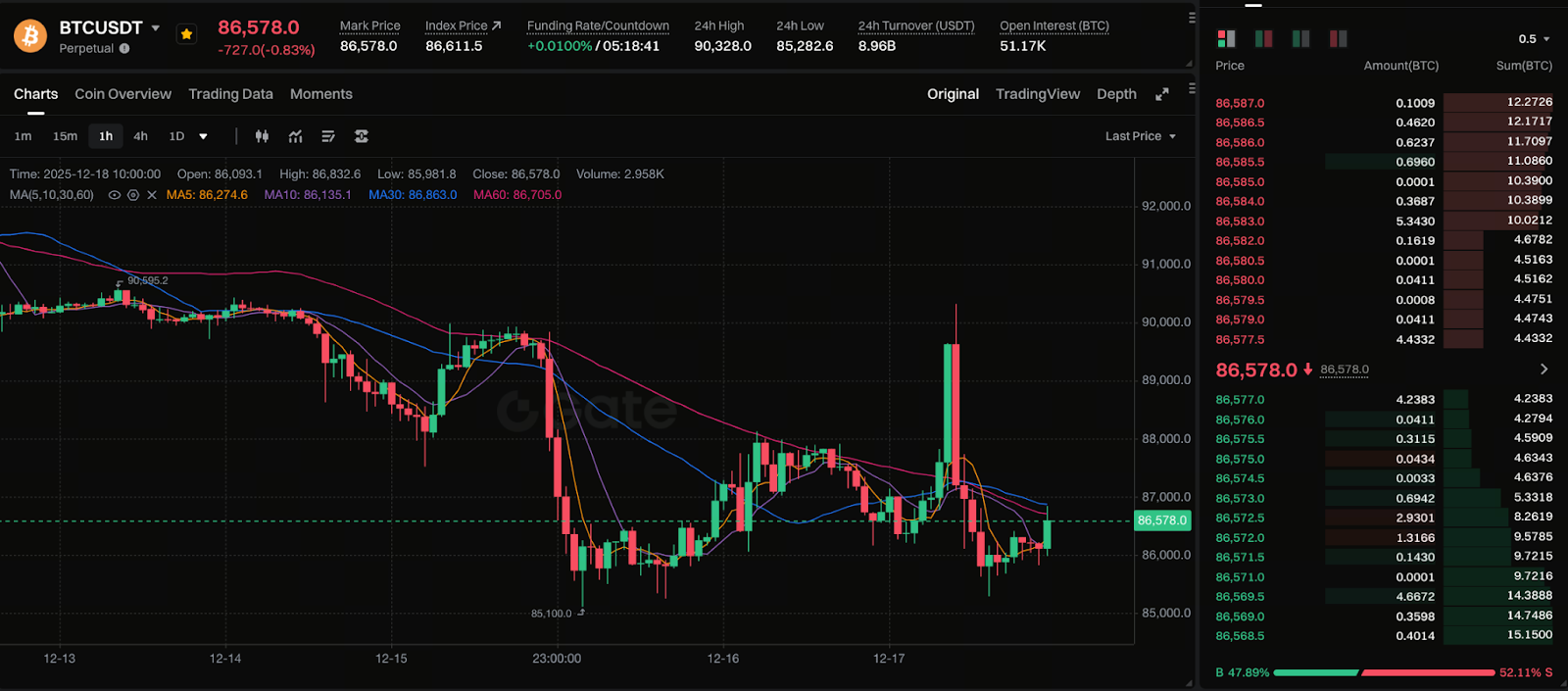

Image source: https://www.gate.com/futures/USDT/BTC_USDT

In the cryptocurrency market, most investors initially start with spot trading. As the market matures, users encounter several practical challenges:

  • Spot capital utilization remains low during volatile conditions
  • In downtrends, investors can only passively hold or cut losses
  • Spot trading struggles to fully capture short-term opportunities

At this stage, futures trading features come into focus. Futures are not designed to replace spot trading, but rather to provide more ways to implement trading strategies.

Key Differences Between Futures and Spot Trading

Spot trading is fundamentally about buying and holding assets. In contrast, the core of futures trading is managing price direction and risk exposure. The main differences include:

  • Futures do not involve asset ownership
  • You can go long or short
  • P&L depends on position size and leverage
  • Emphasis on risk control and position management

As a result, futures trading functions operate more like a comprehensive financial toolset, not simply a buy-sell interface.

Core Structure of Gate Futures Trading

Using Gate as an example, the futures trading interface consists of several key components:

  • Contract selection area
  • Leverage and margin settings
  • Position information and risk ratio display
  • Liquidation price and margin changes
  • Take-profit and stop-loss modules

These functions are interconnected, together forming a robust position management system.

From “Trading” to “Position Management”: A Mindset Shift

Spot traders typically focus on two questions:

  • When to buy
  • When to sell

In futures trading, the focus shifts to:

  • Is my position size appropriate?
  • Does my leverage match current market volatility?
  • Is my risk within a controllable range?

This shift means that effective use of futures features relies less on frequent trades and more on continuous position monitoring.

Three Critical Functional Insights for Futures Trading

1. Leverage Is a Capital Efficiency Tool—Not Just a Profit Multiplier

Within Gate’s futures system, leverage primarily determines the proportion of margin required. Using low leverage prudently can actually enhance position stability.

2. Liquidation Mechanism Is a Rule—Not an Accident

The liquidation price is not a “system risk,” but an integral part of contract rules. Understanding how liquidation prices are determined is fundamental to using futures features effectively.

3. Take-Profit and Stop-Loss Are Essential to Every Position

In futures trading, any position lacking a stop-loss is inherently incomplete. Gate’s automated take-profit and stop-loss features are designed precisely for this reason.

How Beginners Can Transition from Spot to Futures

If you’re already comfortable with spot trading, you can approach the futures market step by step:

  • Select major trading pairs you know well
  • Use the lowest available leverage
  • Start with minimal position sizes to gain experience
  • Focus on monitoring your risk ratio and liquidation price
  • Don’t chase profits—just ensure you understand the process

The goal at this stage is to master the operation of futures trading features, not to generate quick profits.

Summary: Futures Are Not an Upgrade to Spot, but a Distinct Tool

Many beginners mistakenly view futures as a “more advanced form of spot trading,” which is a common misconception. In reality, futures trading offers a wholly different trading logic.

On established platforms like Gate, the futures system is equipped with robust risk controls. Ultimately, what determines your results is whether you understand and respect these features. For beginners, using futures trading features safely is far more important than short-term gains or losses.

Author: Max
Disclaimer
* The information is not intended to be and does not constitute financial advice or any other recommendation of any sort offered or endorsed by Gate.
* This article may not be reproduced, transmitted or copied without referencing Gate. Contravention is an infringement of Copyright Act and may be subject to legal action.

Related Articles

What is Fartcoin? All You Need to Know About FARTCOIN
Intermediate

What is Fartcoin? All You Need to Know About FARTCOIN

Fartcoin (FARTCOIN) is a representative meme coin within the Solana ecosystem based on an AI-driven narrative. Its core concept originated from an experiment aimed at exploring the "boundaries between AI Agents and humor." More than just a digital asset with social attributes, the project deeply couples absurd humor culture with on-chain financial logic by integrating autonomous AI interaction models.
2026-04-04 22:01:19
Gold Price Forecast for the Next Five Years: 2026–2030 Trend Outlook and Investment Implications, Could It Reach $6,000?
Beginner

Gold Price Forecast for the Next Five Years: 2026–2030 Trend Outlook and Investment Implications, Could It Reach $6,000?

Analyze current gold price trends alongside authoritative five-year forecasts, integrating an evaluation of market risks and opportunities. This gives investors insight into the potential trajectory of gold prices and the main drivers expected to shape the market over the next five years.
2026-03-25 18:13:30
Aster vs Hyperliquid: Which Perp DEX Will Prevail?
Beginner

Aster vs Hyperliquid: Which Perp DEX Will Prevail?

Aster and Hyperliquid are the two representative protocols of the "purpose-built L1 path" within the current decentralized perpetual exchange (Perp DEX) sector. As a pioneer in the field, Hyperliquid has built a deep liquidity moat through its highly mature order book architecture and strong community consensus. Conversely, Aster, as a rising challenger, seeks to leapfrog the competition in high-performance trading through more aggressive multi-chain aggregation logic, private transaction modules, and an underlying execution environment optimized for 2026 market demands.
2026-03-24 11:58:33
AI-Native Settlement Layers: How United Stables Is Building the Next Financial Rail
Beginner

AI-Native Settlement Layers: How United Stables Is Building the Next Financial Rail

Stablecoins were originally designed as dollar substitutes within exchanges, primarily used for asset pricing and trade settlement. As on-chain financial ecosystems have matured, their role has expanded beyond simple payments to include collateral assets, cross-chain liquidity mediums, and unified settlement units. In particular, as AI systems and automated agents begin to participate directly in economic activity, demand has risen sharply for programmable value units capable of instant settlement. This shift is pushing stablecoins toward the role of foundational financial infrastructure.
2026-03-25 03:16:17
ASTER Tokenomics: Buybacks, Burns, and Staking as the Value Foundation of ASTER in 2026
Beginner

ASTER Tokenomics: Buybacks, Burns, and Staking as the Value Foundation of ASTER in 2026

ASTER is the native equity and governance token of the Aster ecosystem, with its core value built upon a radical "Deflationary Engine." Beyond serving as a governance tool, ASTER integrates multiple utilities including staking rewards, trading fee discounts, and liquidity incentives. Through its deep integration with the upcoming dedicated Layer 1 mainnet, it enables direct value capture from protocol cash flow to token holders.
2026-03-25 07:38:07
2026 Silver Price Forecast: Bull Market Continuation or High-Level Pullback? In-Depth Analysis of Silver Candlestick Chart
Beginner

2026 Silver Price Forecast: Bull Market Continuation or High-Level Pullback? In-Depth Analysis of Silver Candlestick Chart

2026 Silver Price Forecast: Latest Outlook This article integrates current market trends, silver candlestick chart analysis, and momentum factors to assess the potential key support and resistance levels, upside targets, and pullback risks for silver prices. The goal is to help investors make informed, rational decisions.
2026-03-25 16:08:59