Against the backdrop of rapid AI development and the gradual maturation of Web3 infrastructure, traditional internet models are increasingly facing dual constraints in efficiency and trust. On the one hand, centralized platforms control data and traffic, limiFetch.aiting the free flow of resources. On the other hand, most AI services still rely on API or subscription based models, lacking an open mechanism for value exchange. The multi-agent system (MAS) and on-chain settlement framework proposed by Fetch.ai introduced a new approach, enabling AI not only to compute but also to participate in economic activity.
 Image source: Fetch.ai official website
From a technological evolution perspective, Fetch.ai represents a foundational shift in how AI and blockchain can be integrated. Through autonomous agents, protocol level interactions, and token based incentive structures, the network brings data, computing power, and services into a unified on-chain economy. This architecture enables automatic resource matching and value distribution, extending the scope of DeFi while also providing new infrastructure for areas such as IoT, data marketplaces, and automated financial systems.
How Fetch.ai Uses AI To Improve The Efficiency Of Decentralized Services
One of Fetch.ai’s core goals is to improve the efficiency of decentralized systems through artificial intelligence. In traditional blockchain networks, users must manually execute transactions, choose protocols, and manage assets, which become inefficient in complex scenarios.
With the introduction of Autonomous Economic Agents, the system can achieve a higher level of automation:
-
Automatic decision execution: Agents perform actions based on predefined goals or algorithmic strategies
-
Dynamic resource matching: AI predicts supply and demand to optimize allocation
-
Reduced interaction costs: Agents handle complex processes, minimizing the need for user intervention
For example, in DeFi scenarios, agents can automatically select the most efficient liquidity pools and dynamically adjust asset allocation based on market conditions. This approach shifts the model from human driven decision making to machine executed strategies, significantly reducing both time and cognitive costs.
Fetch.ai’s Intelligent Agents And Automated Protocols
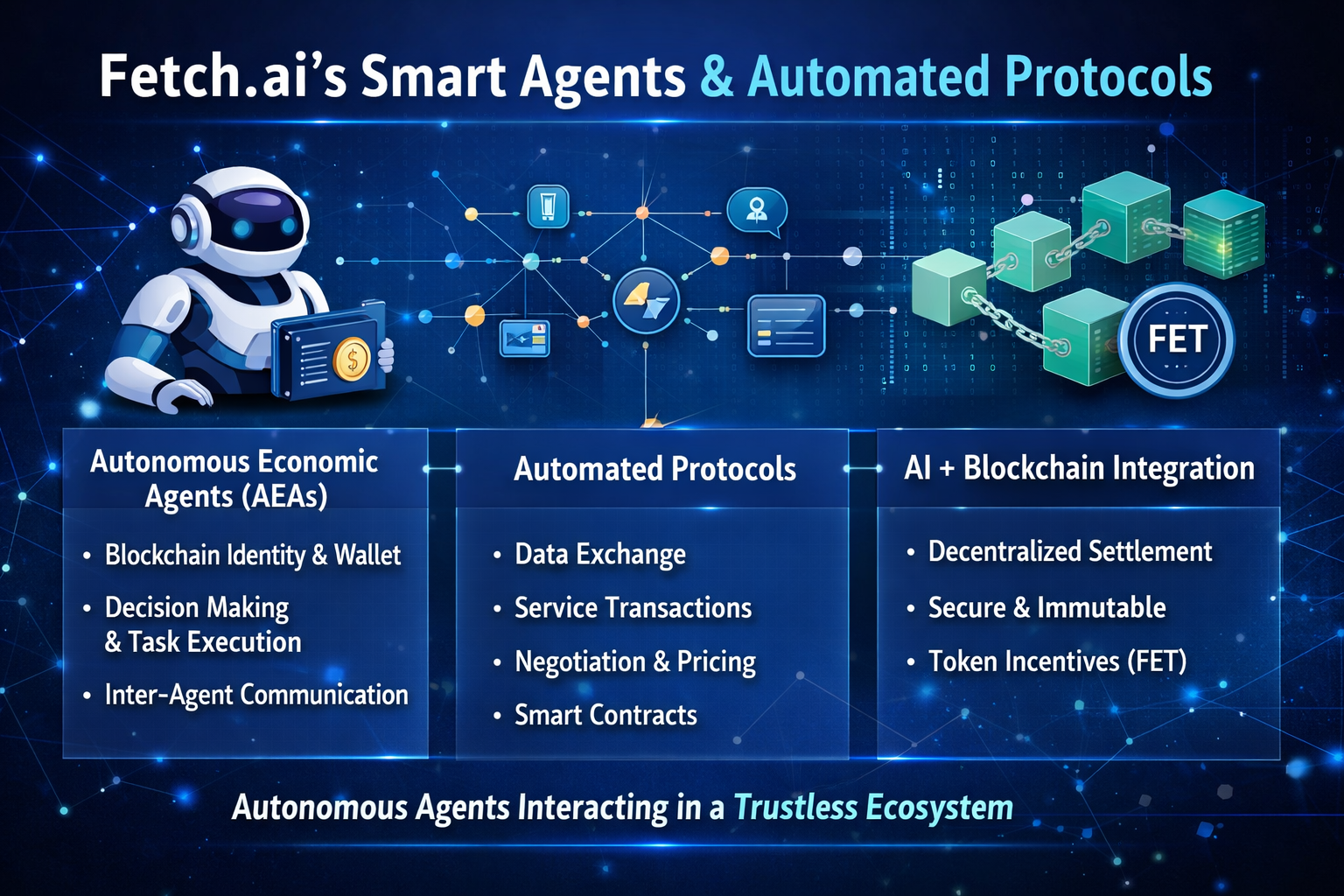
Fetch.ai’s core technology is built around Autonomous Economic Agents (AEA), which function as software entities capable of economic behavior. A complete AEA typically has an on-chain identity and wallet, allowing it to communicate with other agents through defined protocols, execute tasks, make independent decisions, and directly participate in transactions and value exchange.
These agents interact through standardized protocols, forming a Multi-Agent System (MAS). Within this system, agents can exchange data, purchase services, negotiate terms, and determine pricing, while also executing transactions automatically. This enables the network to operate continuously without direct human intervention.
In this architecture, blockchain serves as the settlement and trust layer, ensuring transparency and immutability of transactions. AI, on the other hand, acts as the decision making and execution layer, allowing agents to adapt their behavior dynamically based on changing conditions. Together, they create a complementary structure where trust and intelligence are integrated into a unified system.
Advantages And Innovations Of Combining AI With Blockchain
Fetch.ai’s architecture highlights several key advantages of integrating artificial intelligence with blockchain:
-
Decentralized trust mechanism: Blockchain ensures that transactions and data are immutable, allowing agents to interact and collaborate without relying on trust between parties.
-
Automated economic behavior: AI enables agents to make decisions based on changing conditions, allowing for dynamic optimization of actions and outcomes.
-
Composability: Different agents and protocols can be combined to create more complex and flexible application scenarios.
-
Open market structure: Developers can deploy agents or services freely, participating in a competitive and permissionless network environment.
Together, these elements position Fetch.ai not only as a technology platform but also as a new model for organizing economic activity.
Fetch.ai’s Data Marketplace And Tokenized Services
Within the Fetch.ai network, data is treated as a tradable resource that can be exchanged directly between participants.
Its data marketplace operates with several key characteristics:
-
Data pricing: Value is measured and settled using FET
-
Peer to peer exchange: Transactions occur without centralized data platforms
-
Real time supply and demand matching: Agents automatically coordinate transactions
For example, a weather data agent can sell information to other agents, while a traffic agent can purchase that data to optimize route planning.
In addition, services themselves can be tokenized within the network:
These services are accessed through agents and settled using FET, forming a complete on-chain service marketplace.
Applications Of Fetch.ai In Prediction Markets And IoT
Fetch.ai’s multi-agent architecture shows strong potential across multiple real world scenarios.
Prediction Market:
Internet of Things (IoT):
Devices can act as agents within the network, enabling:
-
Electric vehicles to automatically find optimal charging stations
-
Smart grids to manage energy distribution dynamically
-
Logistics systems to coordinate operations autonomously
In these scenarios, machines are able to transact and collaborate directly, reducing the need for human intervention and improving overall system efficiency.
Comparison With Traditional Finance: Advantages Of A Decentralized Smart Economy
Compared to traditional financial systems, the smart economy model represented by Fetch.ai introduces several structural differences:
Traditional model:
-
Relies on centralized institutions
-
Human driven decision making
-
Significant information asymmetry
-
Lower transaction efficiency
Fetch.ai model:
-
Decentralized architecture
-
AI driven automated decision making
-
Transparent and verifiable data
-
Real time execution and settlement
This shift reflects a transition from institution driven systems to models powered by protocols and autonomous agents.
Future Prospects Of Fetch.ai In AI And Finance
In the long term, Fetch.ai’s development potential depends on several key factors:
-
The adoption level of AI agents
-
The real world implementation of multi-agent systems
-
The growth speed of the developer ecosystem
-
The ability to connect with real world data
If these conditions continue to mature, Fetch.ai could evolve into a foundational layer for the emerging AI economy. As the concept of an agent driven economy develops, automated collaboration and transactions between machines may become a new growth paradigm.
Conclusion
Fetch.ai represents more than a standalone AI or blockchain project. It introduces a smart economic system centered around Autonomous Economic Agents. By integrating AI agents into on-chain economic structures and combining them with decentralized settlement and incentive mechanisms, the network aims to enable autonomous collaboration and value exchange between machines.
Within this framework, AI is no longer just a tool but is gradually becoming an active economic participant. At the same time, decentralized finance expands beyond traditional boundaries, evolving into a more automated and intelligent system.







