Can “Bankrupt Tokens” Bounce Back? LUNA / LUNC / USTC / FTT Unexpected Rally — Opportunity or Bull Trap?

Beginner
Quick Reads
Last Updated 2026-03-27 03:37:15
Reading Time: 1m
Despite bankruptcy, LUNA, LUNC, USTC, and FTT have all seen significant rebounds this week. This article explores the factors driving their recent gains, the risks involved, and possible future trajectories—can these tokens truly make a comeback?

Following the tumultuous collapse and ecosystem breakdown in 2022, former flagship crypto assets like LUNA, LUNC, USTC, and FTT earned the “bankruptcy cryptocurrency” label—few investors dared to touch them. Yet, in a surprising turn, several of these bankruptcy tokens have recently staged notable rebounds.

Background Review: From Peak to Collapse

LUNA and UST (later renamed USTC) were once the backbone of the Terra ecosystem, developed by Terraform Labs. UST maintained a peg to the US dollar, while LUNA supported its stability and liquidity. In May 2022, UST lost its peg and investor confidence collapsed, triggering a rapid depreciation in LUNA that nearly wiped out its value. LUNC, the legacy chain token, and USTC (formerly UST) both plunged into obscurity. FTT also became synonymous with bankruptcy after the FTX exchange imploded. Most believed these tokens had no chance of recovery.

Recent Rally — Data and Catalysts
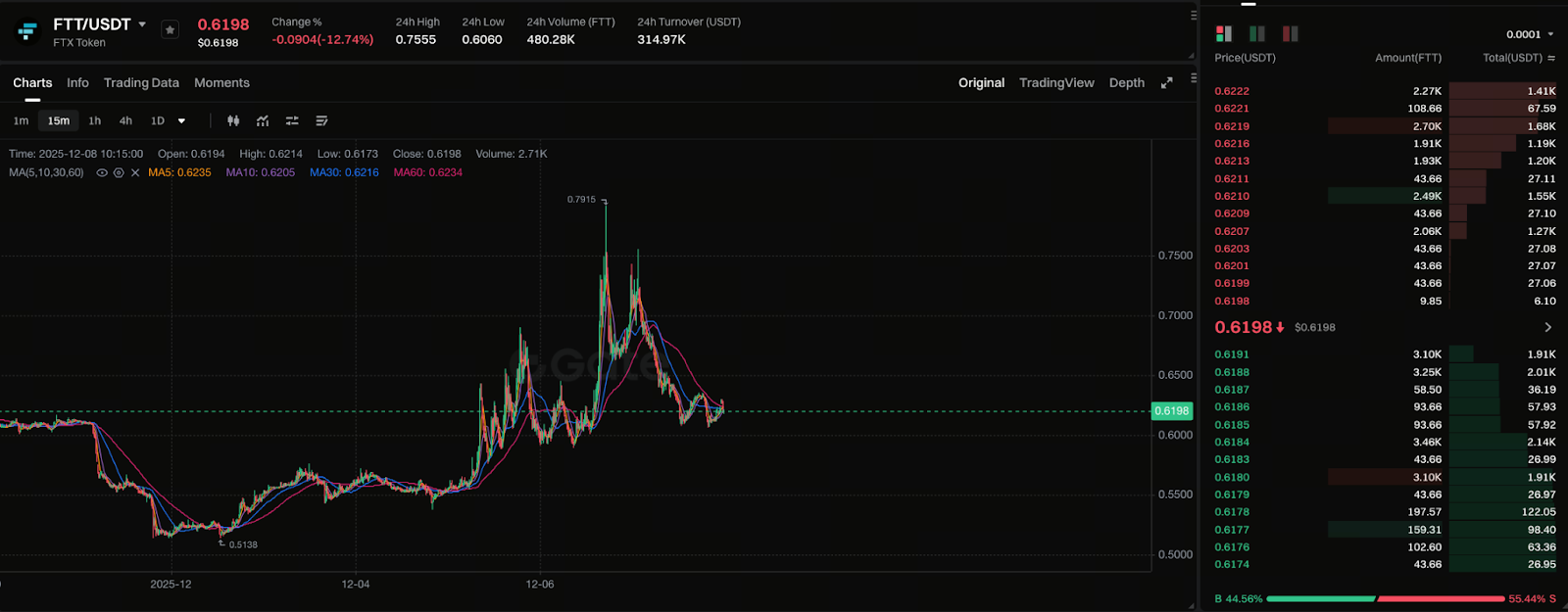

Chart: https://www.gate.com/trade/FTT_USDT

Market activity has surged recently. In just 24 hours during early December 2025:

  • LUNC soared by roughly 88.88%
  • LUNA jumped nearly 43%
  • USTC climbed about 29.6%
  • FTT advanced approximately 15%

Some reports indicated LUNA’s single-day gain reached 39%. Analysts attribute this momentum to speculation around “bankruptcy concept tokens,” despite no fundamental improvements. For USTC and LUNC, token supply reductions via large-scale community-driven burns have been executed to decrease circulation and create scarcity.

Underlying Drivers: What’s Fueling the Rally?

This rally stems from several key factors:

  • Speculation and sentiment: Many traders treat these bankruptcy tokens as “cheap bets,” hoping to profit from synchronized sentiment or community-driven hype. On social media and crypto forums, narratives like “bankruptcy token revival” and “rebuilding from ruins” spread quickly.
  • Supply-side dynamics: Ongoing token burns reduce circulating supply, theoretically increasing scarcity and supporting price appreciation. For the USTC and LUNC communities, this represents a “rebirth” strategy.
  • Market mechanisms: Some exchanges have relisted or resumed support for these tokens, and launched futures or derivatives trading. These moves can drive short-term capital inflows and trading volume spikes, boosting prices.

Hidden Risks and Red Flags

Despite the rally, significant risks persist:

  • Absence of fundamental support. Unlike healthy growth drivers such as new protocol launches, partnerships, or technical upgrades, these tokens currently lack mechanisms for real value creation. Their rise is fueled by speculation and market expectations, not substance. Many analysts remain skeptical about LUNA’s surge.
  • Extreme volatility. Impressive gains today can be erased by sharp declines tomorrow. For risk-averse investors, these assets resemble gambling rather than investing.
  • Uncertain community and governance. Proposals to re-peg USTC to LUNC, for example, face technical, trust, and regulatory hurdles—even if supported internally. The prospects for a near-term “peg revival” are slim.
  • Market sentiment is highly vulnerable to hype and rumors. This “community-driven speculation” model results in unstable prices, and when enthusiasm fades, severe price drops can follow.

Investor Decisions: Buy, Short, or Wait?

If you have a high risk tolerance, sufficient capital to absorb major swings, and can accept the worst-case outcome, you may treat LUNA, LUNC, USTC, and FTT as “high-risk speculative assets.” Allocating a small portion for short-term trading could yield outsized returns. However, always set strict stop-losses and never consider these tokens as “long-term value investments.”

If you prefer stability and prioritize fundamentals and sustainable growth, these tokens currently lack compelling logic, and long-term holding carries substantial uncertainty. Waiting on the sidelines may be the wiser choice.

Conclusion and Recommendations

Bankrupt crypto assets have staged a dramatic comeback, which may seem miraculous. However, do not be swayed by short-term price surges and community hype. These tokens lack sustainable ecosystems and genuine value support—their rallies are temporary, driven by sentiment and artificial scarcity.

If you choose to enter this extremely high-risk market, treat it as you would a gamble—commit only what you can afford to lose, and never view it as a “sure win” or “safe investment.” Do your own research and exercise maximum caution.

Author: Max
Disclaimer
* The information is not intended to be and does not constitute financial advice or any other recommendation of any sort offered or endorsed by Gate.
* This article may not be reproduced, transmitted or copied without referencing Gate. Contravention is an infringement of Copyright Act and may be subject to legal action.

Related Articles

Gold Price Forecast for the Next Five Years: 2026–2030 Trend Outlook and Investment Implications, Could It Reach $6,000?
Beginner

Gold Price Forecast for the Next Five Years: 2026–2030 Trend Outlook and Investment Implications, Could It Reach $6,000?

Analyze current gold price trends alongside authoritative five-year forecasts, integrating an evaluation of market risks and opportunities. This gives investors insight into the potential trajectory of gold prices and the main drivers expected to shape the market over the next five years.
2026-03-25 18:13:30
AI-Native Settlement Layers: How United Stables Is Building the Next Financial Rail
Beginner

AI-Native Settlement Layers: How United Stables Is Building the Next Financial Rail

Stablecoins were originally designed as dollar substitutes within exchanges, primarily used for asset pricing and trade settlement. As on-chain financial ecosystems have matured, their role has expanded beyond simple payments to include collateral assets, cross-chain liquidity mediums, and unified settlement units. In particular, as AI systems and automated agents begin to participate directly in economic activity, demand has risen sharply for programmable value units capable of instant settlement. This shift is pushing stablecoins toward the role of foundational financial infrastructure.
2026-03-25 03:16:17
Aster vs Hyperliquid: Which Perp DEX Will Prevail?
Beginner

Aster vs Hyperliquid: Which Perp DEX Will Prevail?

Aster and Hyperliquid are the two representative protocols of the "purpose-built L1 path" within the current decentralized perpetual exchange (Perp DEX) sector. As a pioneer in the field, Hyperliquid has built a deep liquidity moat through its highly mature order book architecture and strong community consensus. Conversely, Aster, as a rising challenger, seeks to leapfrog the competition in high-performance trading through more aggressive multi-chain aggregation logic, private transaction modules, and an underlying execution environment optimized for 2026 market demands.
2026-03-24 11:58:33
DePIN Identity Network and Real World Applications: How Humanity Protocol Brings on-chain Identity Into the Physical World
Beginner

DePIN Identity Network and Real World Applications: How Humanity Protocol Brings on-chain Identity Into the Physical World

Most Web3 identity systems remain confined to on-chain environments and struggle to achieve meaningful adoption in real world settings. Through a DePIN architecture and physical verification hardware, Humanity Protocol aims to bring decentralized identity into access control systems, hospitality, public services, and offline events, allowing on-chain identity to function not just as a digital credential, but as foundational infrastructure for real world access.
2026-03-25 07:40:53
Aerodrome Tokenomics: How ve(3,3) Powers Base's Most Profitable DEX
Beginner

Aerodrome Tokenomics: How ve(3,3) Powers Base's Most Profitable DEX

AERO is the native token of Aerodrome Finance, a core decentralized exchange and liquidity protocol in the Base ecosystem. It is primarily used for liquidity incentives and ecosystem operations. veAERO is a governance NFT that users receive by locking AERO, representing both voting power and the right to share protocol revenue. Through a dual track structure of AERO as a utility token and veAERO as a governance credential, Aerodrome separates liquidity usage value from long term governance power, allowing participants to act as liquidity providers, governance decision makers, and revenue sharers within the same system.
2026-03-25 06:40:31
How Does Kite Work? An In-Depth Look at Kite's Identity and Programmable Permission Architecture
Beginner

How Does Kite Work? An In-Depth Look at Kite's Identity and Programmable Permission Architecture

Kite is an EVM compatible Layer 1 blockchain network that runs on proof of stake. It is designed to give AI agents verifiable identity, programmable permissions, and real time settlement in an on-chain execution environment. In Kite's design, AI is no longer only a tool that follows instructions. It becomes an economic participant with independent on-chain identity and direct control over assets. Within secure and auditable infrastructure, an AI agent can complete payments, call services, and coordinate tasks autonomously, making Kite a foundational layer for the emerging agent economy.
2026-03-25 06:02:34