With rising R&D costs in biotechnology and AI, traditional scientific research funding mechanisms often struggle with lengthy cycles, lack of transparency, and complex attribution of results. The key technical contribution of Bio Protocol is its effort to shift research decision-making from a handful of institutions to a model of community and protocol co-governance, aligning long-term contributors’ incentives with project success through tokenomics.
From a Web3 and digital assets perspective, Bio Protocol’s extended value lies in unbundling and standardizing data rights, IP rights, and governance rights, making value distribution throughout the research process more traceable and auditable. The following sections break down the protocol’s governance structure, BioDAO mechanism, IP rights mapping, privacy compliance, and risk boundaries.
Bio Protocol Governance Structure: From Protocol Layer to BioDAO Layer
Bio Protocol employs a two-layer governance model—combining protocol governance and vertical thematic governance—rather than relying on single-layer DAO voting.
The structure includes:
- Protocol Layer: Handles the rules framework, incentive parameters, emission mechanisms, and ecosystem-level resource allocation.
- BioDAO Layer: Manages project filtering, milestone tracking, and community collaboration for specific research domains.
This dual-layer structure separates “general issues” from “specialized issues” for targeted management:
- The protocol layer addresses general issues, ensuring consistency across the mechanism.
- BioDAO focuses on specialized issues, providing deep, track-specific evaluation.
Relying solely on protocol governance risks distorting professional assessments, while project-level governance alone can weaken cross-ecosystem collaboration. The dual-layer model is designed to resolve these inherent conflicts.
How BioDAO Drives Project Selection and Resource Allocation
BioDAO serves as the community unit within Bio Protocol, dedicated to specific research directions such as longevity, neuroscience, women’s health, and synthetic biology.
Its primary value lies not in community discussion, but in transforming community consensus into actionable resource allocation.
A typical project onboarding process includes:
- Project teams submit research directions and objectives.
- The community or governance members conduct an initial review.
- The governance process determines whether the project is added to the support list.
- Funds and resources are released in phases, tied to milestones.
- Research progress and data outputs are fed back to the community for review.
Compared to traditional research funding, BioDAO offers three main advantages:
- Faster execution: On-chain fund organization and community decisions are more flexible.
- Broader participation: Researchers, patients, developers, and investors collaborate on a unified platform.
- Greater transparency: Key decisions and fund flows are fully traceable.
However, scientific evaluation is highly specialized, and community governance must continually balance open participation with expert judgment.
IP Token and IP-NFT: Mapping Data Rights and Research Returns
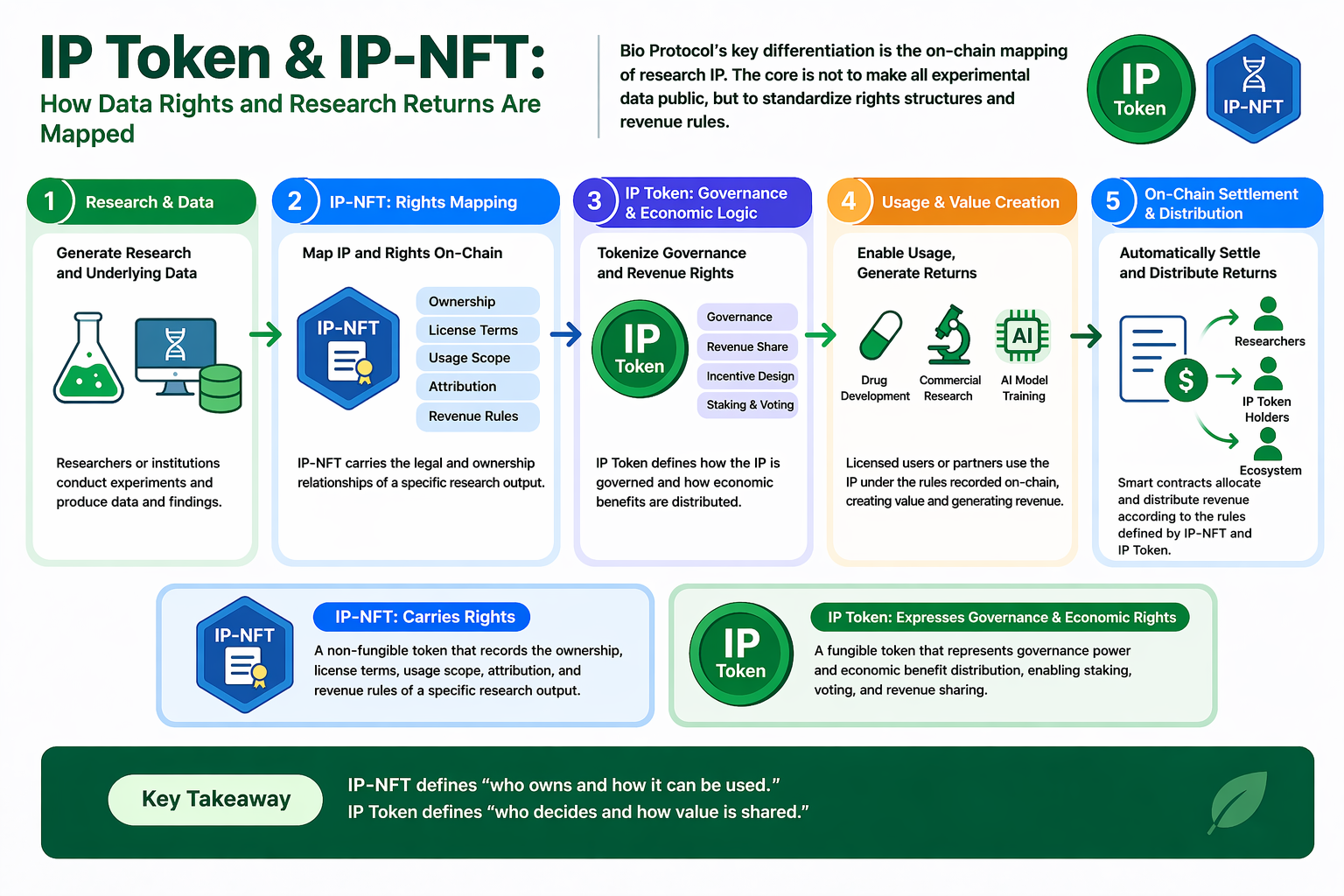
A defining feature of Bio Protocol is its on-chain mapping of research IP (intellectual property).
The focus here is not to disclose all experimental data, but to standardize rights structures and return mechanisms.
Within this framework, typical asset forms include:
- IP-NFT: Represents ownership and legal mapping of specific research outcomes.
- IP Token (IPT): Encodes governance and economic equity distribution for research assets.
This approach yields several direct benefits:
- Research result ownership boundaries become clearer.
- Participants gain greater clarity regarding return paths.
- Licensing, commercialization, and distribution processes are easier to standardize.
For DeSci projects, the most challenging questions are not about generating results, but about ownership, return distribution, and oversight.
IP tokenization addresses these questions up front at the mechanism level, eliminating the need for post-hoc negotiation.
Privacy Protection and Compliance in On-Chain Research Collaboration
Due to the highly sensitive nature of biological data, decentralized collaboration does not equate to full data disclosure.
Bio Protocol’s practical approach is “on-chain ownership and governance + off-chain data processing and permission control.”
This is guided by four principles:
- Minimum exposure: Only key credentials and decisions are recorded on-chain; unnecessary sensitive raw data remains off-chain.
- Verifiability: Disclose verifiable abstracts, milestone proofs, and ownership rules.
- Hierarchical authorization: Different participants receive different data access permissions based on their roles.
- Compliance-first: Governance rules must balance privacy and regulatory requirements, especially in cross-border scenarios.
Key challenges include:
- Regulatory standards for health data vary across jurisdictions.
- There is inherent tension between on-chain transparency and privacy.
- Legal costs for cross-institutional data collaboration are high.
Bio Protocol’s competitive edge lies not only in technology, but also in legal structure design and compliance execution.
Incentive Design: Governance, Contribution, and Value Feedback
In the BIO ecosystem, incentives are not based on one-off airdrops, but on a system that combines governance participation, contribution tracking, and project admission. The core loop in the latest mechanism consists of veBIO, BioXP, and Ignition Sales:
- Stake BIO to earn
veBIO, increasing governance influence.
- Accumulate
BioXP through staking and ecosystem participation.
- Use
BioXP to secure higher allocations in new project launches.
The strategic aim is to reward long-term participants with early opportunities, strengthening ecosystem engagement.
From a protocol perspective, value feedback typically comes from:
- Fees related to ecosystem trades and liquidity.
- Protocol service and tool usage fees.
- Governance and ecosystem value generated by project asset growth.
Complex incentive systems raise the user learning curve. Without effective education and user experience, even the best-designed mechanisms may underperform.
Compared to traditional funding, Bio Protocol fundamentally restructures decision-making, capital flows, and equity distribution.
A simplified comparison:
- Traditional model: Institution-led review, lengthy funding cycles, delayed rights allocation, limited retail participation.
- Bio Protocol model: Community and protocol jointly filter projects, funds are released in stages, rights are mapped up front, and participation is more diverse.
This does not mean the traditional system will disappear; instead, the two models are likely to complement each other:
- Early-stage, high-risk research is incubated by the community and protocol.
- Later-stage commercialization is managed by institutions, enterprises, and regulatory bodies.
If successful, Bio Protocol will serve not just as an on-chain funding platform, but as a collaborative layer for biological innovation.
Key Risks for Investors and Participants
Bio Protocol operates in a high-innovation sector where risk and return go hand in hand.
Key risks to monitor include:
- Research translation risk: Scientific projects are inherently high-failure and long-term.
- Governance efficiency risk: Community governance may suffer from low participation or excessive noise.
- Token structure risk: Circulation dynamics, unlocking schedules, and sentiment-driven trading can heighten volatility.
- Compliance risk: Regulatory requirements for biological data, cross-border funds, and tokens are complex.
- Mechanism complexity risk: New users may not fully understand the rules, reducing participation efficiency.
A robust monitoring framework might track, on a monthly basis:
- BioDAO proposal approval and execution rates.
- Milestone achievement rates for funded projects.
- Net ecosystem capital flows and liquidity depth.
veBIO distribution and changes in active governance addresses.- Compliance disclosures and progress with institutional partners.
Summary
Bio Protocol’s governance and data rights mechanisms mark a significant step for the DeSci sector, moving from the conceptual stage to institutional implementation.
By leveraging BioDAO for project selection, IP Tokens for rights clarity, and on-chain mechanisms for greater transparency, Bio Protocol offers a new model for research collaboration and value distribution.
Long-term success depends on three core factors:
- The ability of governance to consistently deliver high-quality decisions.
- The continual production of verifiable research outcomes.
- The scalability of rights mapping and data compliance.
If these three pillars reinforce each other, BIO could evolve from a representative token to foundational infrastructure for DeSci.
FAQs
Q1: How does BioDAO differ from a standard DAO?
BioDAO prioritizes specialized project selection and milestone management in scientific research, going beyond general community governance.
Q2: What are the roles of IP Token and IP-NFT?
Both map the rights structure and governance rules of research outcomes, clarifying paths for return distribution and approval.
Q3: Does Bio Protocol put all biological data on-chain?
Generally, no. The typical model records ownership and governance credentials on-chain, while sensitive data is accessed in tiers under a compliance framework.
Q4: How should the governance value of BIO be assessed?
Key factors include proposal quality, implementation rates, breadth of participation, and project milestone achievement.
Q5: What is the main risk of participating in the BIO ecosystem?
The primary risk is the combination of scientific uncertainty, mechanism complexity, and compliance constraints, requiring continuous data-driven monitoring rather than one-off assessments.