Figma’s Stock Drop: What Is the Market Really Pricing In?
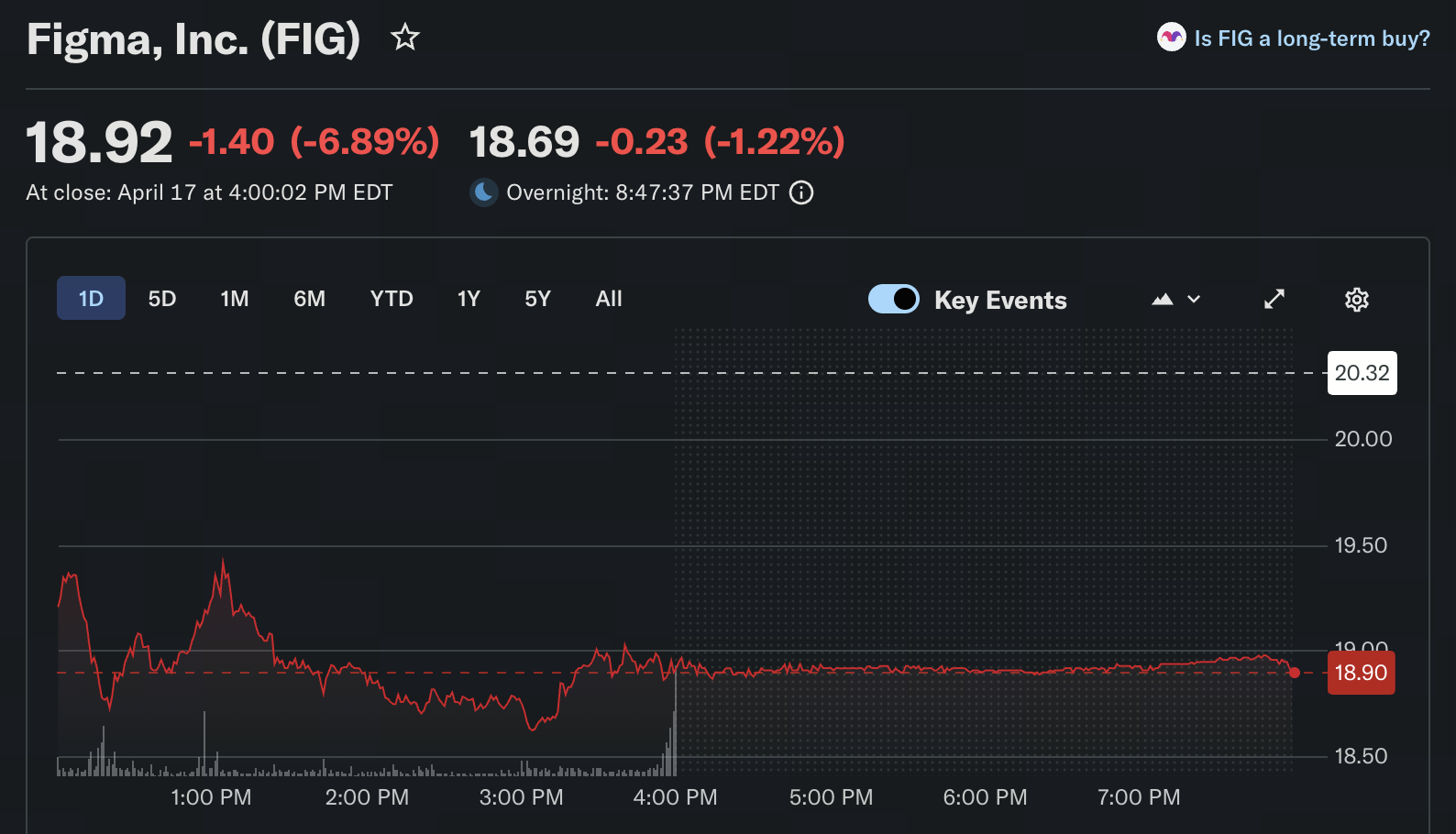
Image source: https://finance.yahoo.com/quote/FIG/
The recent decline in Figma (FIG) shares is often explained by a direct cause-and-effect: “Claude Design launched, so Figma’s price fell.” While this is partially true, it’s not the whole picture. The market rarely prices in a single headline; instead, it reassesses multiple variables at once:
- Shifting competitive boundaries: Are AI-native design tools moving the “design entry point” from professional software to natural language interfaces?
- Pressure on profit models: Will seat-based subscriptions be eroded by “pay-for-results” or “pay-for-output” models?
- Adjusted growth trajectories: Will enterprise client expansion slow as AI alternatives offer lower costs?
- Valuation discounting changes: High-growth SaaS companies are seeing their valuations contract due to rising interest rates, shifting risk appetites, and expectations of tech disruption.
Stock price, then, isn’t “the fact itself”—it’s “the market’s discounted view of future cash flow and competitive positioning.” With this in mind, we can more precisely discuss how AI is transforming the design industry.

Image source: Anthropic Official Documentation
For the past decade, design software’s core value has been boosting “visual output efficiency.” With AI in the mix, the value center is shifting toward “problem modeling and solution filtering.” This has driven three major tool evolutions:
- From drawing tools to generative tools: Designers no longer start from a blank canvas—they begin with prompts, reference styles, and component constraints.
- From generative tools to orchestration tools: The real bottleneck isn’t “making a picture,” but “generating a systematic, deployable solution under multiple constraints.”
- From orchestration tools to decision tools: AI not only provides options, but also sets priorities, experiment paths, and resource allocation.
Key industry impacts include:
- A rapid expansion of low-complexity visual work, driving prices lower.
- Higher value for high-context decision tasks—brand consistency, complex interactions, compliance, cross-platform alignment.
- The focus shifts from “can you draw” to “can you define standards and ensure system reliability?”
How Design Roles Will Evolve: What Gets Replaced, What Gets Amplified
AI doesn’t mean “designers disappear”—it means “job functions are rewritten.” Here’s a practical framework for understanding the shift.
Roles Most Likely to Be Automated
- Batch asset and size adaptation
- Simple landing page variants
- Template-based social media visuals
- Standardized marketing and basic ops graphics
These jobs share clear goals, limited context, fast feedback, and are easily templated. AI will replace these quickly.
Roles That Will Be Amplified
- Problem definition: Turning vague business goals into actionable design objectives.
- System governance: Building design systems, tokens, and standards frameworks.
- Multilateral collaboration: Working with PMs, engineers, data, and legal to manage trade-offs and risks.
- Outcome ownership: Responsible not just for interfaces, but for conversion, retention, and experience metrics.
In short: AI reduces the value of “manual production” and increases the value of “systems thinking and judgment.”
Career Stratification in Practice
Going forward, design talent will fall into three layers:
- AI operators: Tool-savvy and efficient, but with limited bargaining power.
- System designers: Build rules, components, and processes, with greater bargaining power.
- Business strategists: Connect design to growth and business goals—the rarest skill set.
Industry Reshuffle: Figma, Adobe, Anthropic, and Ecosystem Competition
If you only look at product features, you’ll underestimate the competition. The real contest is over “who controls the workflow entry point.”
Three Player Archetypes and Their Strategies
- Traditional design platforms (Figma, Adobe) excel at team collaboration, component systems, enterprise deployment, and plugins—but risk being “upstream intercepted” by AI-native tools.
- AI-native platforms (like Claude Design) offer low barriers and fast output, but face challenges in enterprise governance, traceability, and stable deliverables.
- Vertical workflow integrators unify “demand – design – code – release – iteration,” vying for process control.
Four Critical Success Factors in the Next Two Years
- Enterprise-grade control: Permissions, audits, brand consistency, compliance.
- Design-to-code integration: Beyond code export, it’s about maintainability, collaboration, and rollbacks.
- Data flywheel: More real project data means more reliable AI outputs.
- Ecosystem lock-in: Plugins, templates, and component marketplaces integrated with organizational workflows.
Bottom line: Similar features don’t mean equal competitive standing. Long-term share depends on getting into the enterprise’s core workflows.
The issue for many teams isn’t “do we have AI,” but “is AI stuck as a personal toy?” To truly boost design productivity with AI, pursue transformation on three levels.
Organizational Layer: Redefine Roles, Don’t Just Downsize
- Create joint Design Ops + AI Ops mechanisms.
- Clearly define “human vs. machine” task boundaries and manual approval points.
- Shift senior designers from execution to standard-setting and review.
Process Layer: Embed AI Into Standard Delivery
Recommended steps:
- Structure requirements (goals, constraints, audience, style limits)
- AI generates multiple solutions (including variants and risk annotations)
- Human review and A/B testing
- Update the design system (add components and standards)
- Post-launch data review (conversion, engagement time, rework rate)
The key isn’t “how many images you generate,” but “did rework decrease, launches speed up, and business metrics improve?”
Track at least these six metrics:
- Time to first visual (TTV)
- Cycle from requirement to launch
- Design rework rate
- Component reuse rate
- Post-launch defect rate
- Business outcomes (conversion, retention, click depth)
When these metrics are visible, AI’s value shifts from “feels faster” to “proven better.”
Common Pitfalls: Why Some Teams Get More Chaotic With AI
Four frequent missteps:
- Mistake 1: Treating AI as an outsourcing substitute—chasing low-cost output while ignoring brand consistency and long-term asset building.
- Mistake 2: Buying tools but not changing processes—no review or standardization, so output is “fast but not reusable.”
- Mistake 3: Focusing on speed, not quality—large output variance, and no quality gates drags down later development.
- Mistake 4: Using short-term stock moves to draw long-term industry conclusions—markets react fast, but building organizational capability is a slow process.
AI Execution Roadmap: 90-Day Checklists for Individuals, Teams, and Enterprises
For Individual Learners
- Pick one real scenario (poster, landing page, product prototype) and work on it for 30 days straight—don’t switch tools daily.
- Build a reusable prompt template library, covering objectives, audience, style constraints, output formats, and evaluation criteria.
- A/B test every output, track what works and why, and turn those lessons into your own methodology.
- Strengthen core skills: information architecture, visual hierarchy, interaction logic—AI accelerates output, but judgment is still yours.
For Content Creators, Self-Media, and Indie Developers
- Use AI to connect “idea – visual – page – release” in the shortest path—focus on launch, not perfection.
- Standardize your brand elements (fonts, colors, tone, layout) so AI iterates for consistency instead of reinventing each time.
- Track three key metrics: output speed, rework frequency, and conversion (clicks, leads, subscriptions).
- Turn “viral inspiration” into standard processes—break top-performing pieces into templates and checklists.
For Team Managers
- Don’t buy a bunch of tools up front—pilot one or two high-frequency processes (like marketing assets, prototypes, or event pages).
- Build a “generate – human review – write back” loop: AI drafts, humans select, and the best results become templates and standards.
- Shift KPIs from “how many images” to “cycle times, quality stability, and business impact.”
- Establish risk controls: copyright sources, commercial licensing, sensitive content review, external publishing accountability.
For Enterprise Decision-Makers
- Treat AI as an organizational capability investment, not a one-off purchase—budget for tools, processes, and training.
- Set up cross-functional teams (product, design, engineering, legal, ops) to avoid siloed AI adoption.
- Start with quarterly pilots before scaling—let measurable results guide your pace.
- Build compliance and copyright strategies in advance, not as afterthoughts.
Conclusion: Figma’s Drop Is Just the Start—Design Is Entering a “Capability Reassessment” Era
Figma’s declining stock price matters not for its day-to-day moves, but for what it reveals: the industry’s value anchor is shifting. In the future, true scarcity won’t be “who can draw faster,” but “who can integrate AI into a controllable organizational system and consistently deliver measurable business results.”
AI’s impact on design isn’t about “how big”—it’s about “how far it’s already gone.” For individuals, this means reinventing your skill set; for companies, it means rewriting the production function; for the market, it means valuation logic is moving from tool premiums to system efficiency premiums.