Timeline of Events and Key Facts
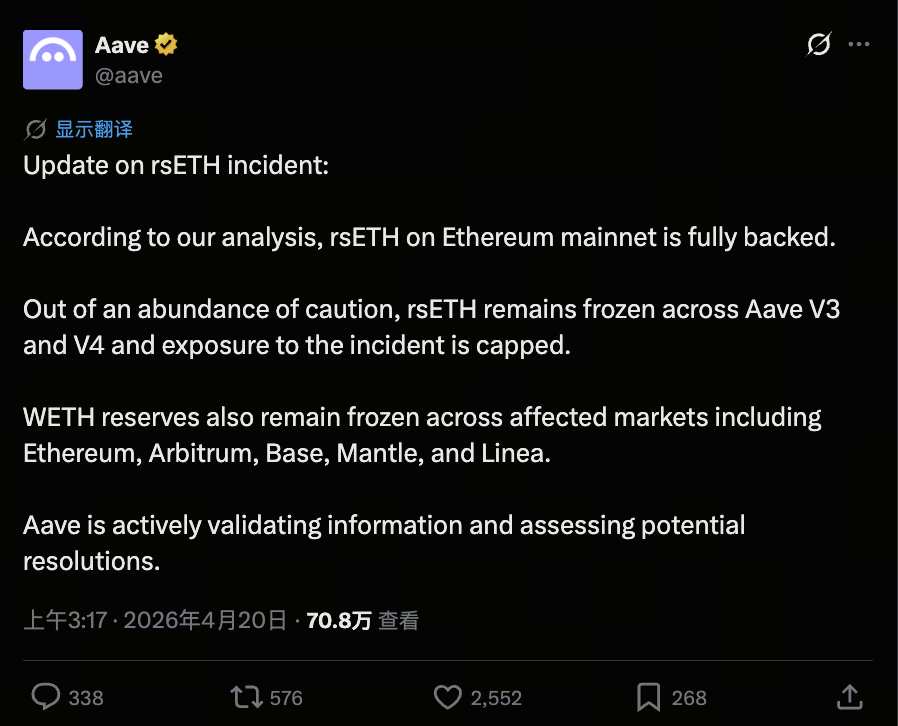
Image source: AAVE Official X Post
Between April 18 and April 20, 2026, KelpDAO and components related to cross-chain message verification experienced anomalies, enabling attackers to acquire large amounts of rsETH and swiftly enter the secondary market and DeFi portfolio strategies. Market focus then shifted to Aave V3 (with some reports referencing V4 testing/deployment) concerning the rsETH collateralized lending pathway, with various figures cited such as “approximately $177 million to $236 million in bad debt” and “about $290 million in stolen assets.” At the same time, shifts in TVL, WETH pool utilization rate, and withdrawal experience became central topics on social media and data dashboards.
Attack Path: From “Bridge Asset Credit Enhancement Failure” to “Lending Protocol Balance Sheet Stress”
When DeFi risk is dissected into “code risk / economic risk / operational risk / portfolio risk,” this incident most closely exemplifies a portfolio risk event:
-
Upstream credit enhancement failure: Issues with cross-chain bridges or message verification paths undermined the integrity of rsETH-type LST/LRT assets, breaking the linkage to their underlying assets.
-
Midstream collateral enters the money market: Attackers used compromised assets as collateral on Aave, borrowing WETH and other more liquid liability-side assets.
-
Downstream real asset outflow: If liquidation and price discovery cannot occur within the same timeframe, a gap emerges between the liability side (assets claimable by depositors) and the asset side (recoverable collateral value), commonly referred to as bad debt—an unsurprising topic for market discussion.
The critical point in this chain is that the money market does not absorb the “bridge itself,” but rather the “collateral symbol credited by the bridge.” Once this symbol decouples from its underlying peg, the lending protocol’s risk model shifts from “volatility risk” to “authenticity risk” (counterfeiting/unbacked minting), which is typically outside the scope of standard stress tests.
Why Aave Became the Loss-Bearing End: Collateral Parameters, Correlation, and Liquidation Boundaries
Aave’s core strengths as a general-purpose money market are composability and parameterized risk management; however, under extreme conditions, these features can also concentrate systemic exposure. Key mechanisms frequently discussed include:
-
Collateral factor and borrowing capacity: Higher collateral efficiency reduces the safety margin; when collateral is not merely “depreciated” but “counterfeit,” the definition of safety margin fundamentally changes.
-
E‑Mode (Efficiency Mode): Within highly correlated asset portfolios, E‑Mode boosts capital efficiency but may compress “homogeneous risk” into a thinner buffer. If collateral and risk sources share an event window, correlation risk can manifest as liquidation delays or insufficient liquidation proceeds.
-
Caps: Caps constrain “scale,” but a scale cap does not automatically equate to an “authenticity cap.” When abnormal minting circumvents real-world asset constraints, caps may inadvertently allow risk to accumulate rapidly within a single protocol.
-
Oracles and liquidity: Liquidations depend on price and liquidity. If price paths break before or after event disclosure, or if pool depth is insufficient to absorb liquidation sales, discussions of bad debt move from model assumptions to the microstructure of the market.
With open collateral lists and efficiency parameters in play, the system makes the tail risk of cross-chain assets explicit as borrowable liquidity.
Market-Level Second-Order Effects: TVL, Utilization Rate, and Withdrawal Constraints
Following such a shock, three market phenomena typically emerge and reinforce each other:
-
Information shock: Users reprice whether collateral remains trustworthy.
-
Increased liquidity preference: Risk aversion prompts withdrawal of WETH/ETH and similar assets from the protocol.
-
Utilization rate and interest rate mechanisms: When borrowing activity coincides with deposit withdrawals, utilization rates rise, altering lending dynamics. In extreme scenarios, this results in “those who want to exit can’t do so quickly.” While this is not necessarily insolvency from an engineering perspective, it equates to a liquidity crisis in terms of user experience.
Protocol Response and Public Goods Considerations: Freezing Markets, Backstop Funds, and Transparency
According to public information, the industry’s “standard emergency actions” typically include:
-
Freezing or suspending specific collateral markets to block new risk exposure;
-
Communicating debt gaps and resolution strategies (buybacks, reserves, insurance modules, governance grants, etc.) to reduce information asymmetry;
-
Coordinating with audit, legal, and inter-protocol teams to avoid fragmented statements that could cause secondary harm.
If the protocol introduces backstop funds or risk buffer modules (with names like Umbrella, as referenced in media reports, belonging to product narratives), three engineering questions arise:
-
What are the trigger conditions—automatic or governance-driven?
-
What is the order of coverage—how are depositors, token holders, and ecosystem treasuries prioritized?
-
Can post-mortem reviews lead to executable parameter changes and collateral admission frameworks?
DeFi’s sense of “professionalism” is not in slogans but in breaking down uncertainty into verifiable checklists.
Conclusion: Not a Single-Point Vulnerability, but a Repricing of Systemic Coupling Risk
Reducing the event to “Aave was hacked” overlooks the more critical industry issue: as LST/LRT and cross-chain bridges become mainstream collateral in money markets, these markets are underwriting credit for the entire stack. A failure at the bridge layer can manifest as bad debt, surging utilization rates, and withdrawal friction in the money market.
For researchers and practitioners, the key takeaway is a checklist of critical questions—not just a sentiment:
-
Collateral admission: Which credit enhancement assumptions must be codified in onboarding clauses and stress tests?
-
Parameter governance: How can the trade-off between efficiency and resilience be transparently explained?
-
Crisis communication: How can digital figures be aligned with on-chain evidence to prevent “headline numbers” from driving the market?







