Render Network is a decentralized GPU computing infrastructure built on Solana, addressing the inefficiency of centralized rendering services since its 2017 launch by OTOY. This comprehensive guide explores Render's technical architecture, market performance, and ecosystem applications for 3D rendering, AI computing, and GPU-intensive workloads. With over 113,000 token holders and a circulating market cap of $1.23 billion, Render demonstrates significant adoption in the decentralized computing space. The article covers key milestones, on-chain metrics, strategic partnerships, and community engagement on platforms like X. Whether for content creators, GPU providers, or cryptocurrency investors, Render offers compelling opportunities through its peer-to-peer compute marketplace, available on Gate and other exchanges, with strong growth potential despite competitive challenges and market volatility.
Render Network's Positioning and Significance
In 2017, OTOY launched Render Network (RENDER), aiming to address the growing demand for GPU computing power and the inefficiency of traditional centralized rendering services.
As a decentralized GPU rendering network, Render Network plays a key role in 3D rendering, AI computing, and emerging GPU-intensive applications.
As of 2026, Render Network has become a prominent player in the decentralized computing infrastructure space, with over 113,000 holders and an active developer community.
This article will provide an in-depth analysis of its technical architecture, market performance, and future potential.
Origin and Development History
Birth Background
Render Network was created by OTOY in 2017, aiming to solve the inefficiency and high costs of GPU rendering services and the underutilization of idle GPU resources.
It emerged during the blockchain technology boom and the increasing demand for high-performance computing in industries such as visual effects, gaming, and AI, with the goal of democratizing access to GPU computing power through a decentralized marketplace.
Render Network's launch brought new possibilities for content creators, developers, and GPU owners seeking efficient and cost-effective rendering solutions.
Key Milestones
- 2020: Migration to blockchain infrastructure, enabling decentralized GPU rendering transactions.
- 2023: Migration from Ethereum to Solana, significantly improving transaction speed and reducing costs.
- 2024: Price reached an all-time high of approximately $13.60 on March 18, driven by growing adoption in AI and rendering applications.
- 2025-2026: Ecosystem expansion with increasing integration of GPU computing services and emergence of new use cases in AI and machine learning.
With the support of the Render Foundation and the broader community, Render Network continues to optimize its technology, security, and real-world applications.
How Render Network Works?
Decentralized Architecture
Render Network operates on a decentralized network of GPU nodes distributed globally, eliminating reliance on centralized rendering farms or cloud providers.
These nodes collaborate to process rendering jobs submitted by users, ensuring transparency, resilience, and efficient utilization of computing resources.
This architecture grants users direct access to GPU power while rewarding node operators for contributing their hardware.
Blockchain Foundation
Render Network's blockchain, currently built on Solana, serves as a transparent and immutable ledger for recording rendering transactions and resource allocation.
Each rendering job is recorded on-chain, creating a verifiable history of computational work.
Anyone can verify transactions without intermediaries, establishing trust in the system.
Solana's high throughput and low latency further enhance performance, enabling near real-time rendering capabilities.
Ensuring Fairness
Render Network utilizes Solana's Proof of Stake (PoS) consensus mechanism to validate transactions and prevent fraudulent activities such as double-spending.
GPU providers and network validators maintain network security through staking tokens and processing rendering jobs, earning RENDER token rewards.
The innovation lies in efficiently matching rendering demand with available GPU supply while maintaining low transaction costs and high speed.
Secure Transactions
Render Network employs public-private key cryptography to protect transactions:
- Private keys (similar to secret passwords) are used to authorize rendering jobs and token transfers
- Public keys (similar to account numbers) are used to verify ownership and authenticate participants
This mechanism ensures fund security while transactions maintain pseudonymity.
Additional security features include smart contract-based payment escrow and reputation systems for node operators.
Circulation Overview
As of January 14, 2026, Render Network has a circulating supply of 518,673,261.01 tokens, with a total supply of 532,219,654 tokens. The maximum supply is capped at 532,219,654 tokens, establishing a fixed supply model. The circulation ratio stands at approximately 97.45%, indicating that the majority of tokens have already entered the market. This high circulation rate suggests a mature token distribution phase, which may contribute to reduced inflationary pressure on the token price. The network's tokenomics are designed to reward GPU providers who contribute their idle computing resources to the decentralized rendering infrastructure, creating an incentive structure that aligns network growth with token utility.
Price Volatility
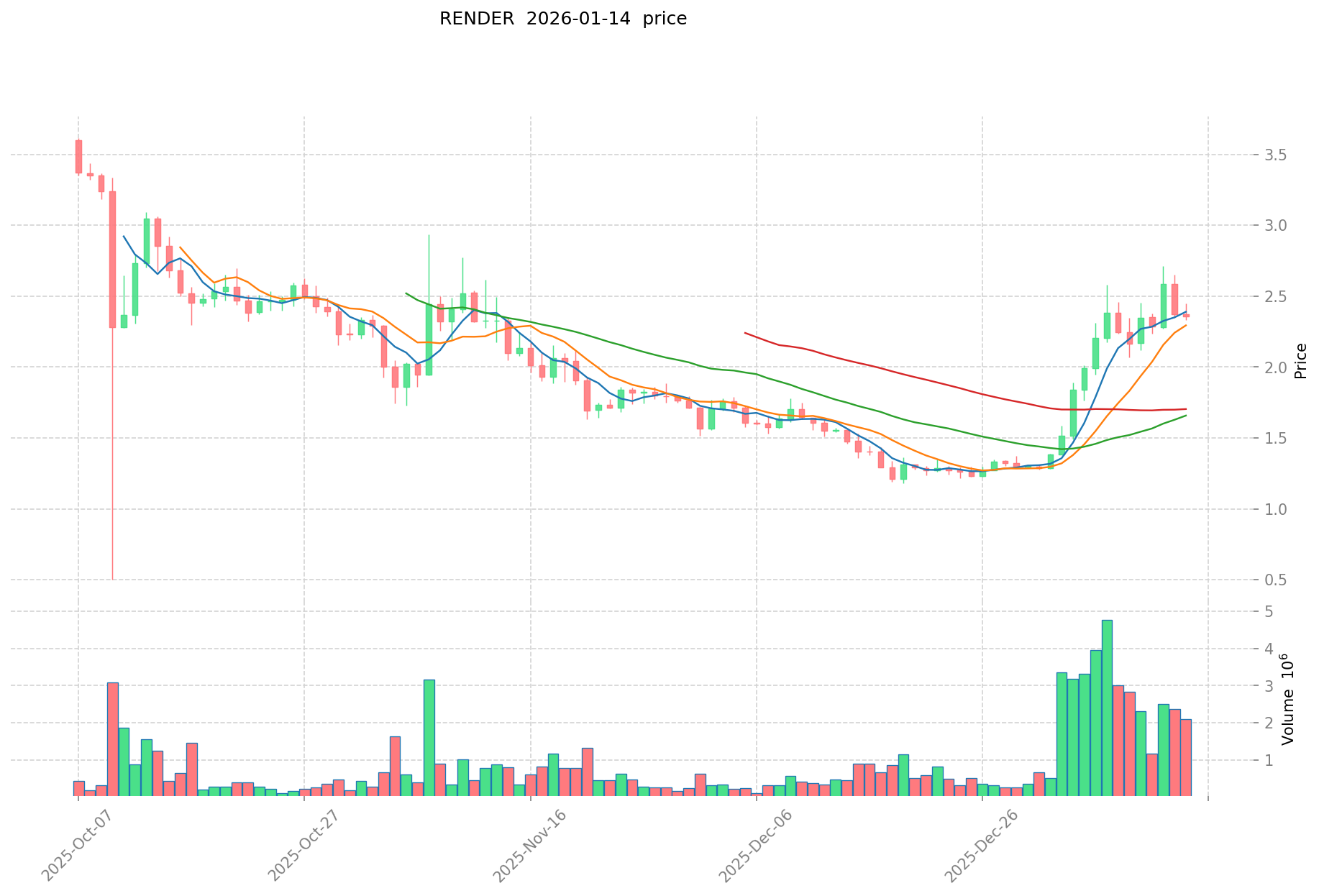
Render Network reached its all-time high price of $13.60 on March 18, 2024, driven by increasing demand for decentralized GPU computing solutions and broader market momentum during that period. The token's lowest recorded price was $0.0368, occurring on June 16, 2020, which reflected earlier market conditions and limited adoption. As of the current date, the token is trading at $2.37, representing a significant decline of approximately 65.94% over the past year. Recent price movements show a 24-hour change of -0.91%, with prices fluctuating between $2.33 and $2.45 in the past day. However, the token has experienced notable growth of 60.45% over the past 30 days, suggesting renewed market interest. These fluctuations reflect broader market sentiment, adoption trends in the GPU rendering space, and the evolving dynamics of decentralized infrastructure projects. The current price of $2.37 represents an increase of approximately 847.44% from its initial listing price of $0.25 in October 2023.
Click to view the current RENDER market price
On-Chain Metrics
- 24-Hour Trading Volume: The network recorded a trading volume of $5,065,319 in the past 24 hours, demonstrating active market participation and liquidity.
- Holder Count: Render Network has approximately 113,896 token holders, reflecting a growing user base and community engagement with the platform.
- Market Capitalization: The circulating market cap stands at $1,228,529,486, ranking the token at position 75 among all cryptocurrencies, with a market dominance of 0.037%.
- Fully Diluted Valuation: The fully diluted market cap is $1,260,615,472, with the market cap to FDV ratio at 97.45%, indicating minimal additional dilution expected from unreleased tokens.
Render Network Ecosystem Applications and Partners
Core Use Cases
Render Network's ecosystem supports multiple applications:
- 3D Rendering: Professional studios and independent creators leverage the decentralized GPU network for high-quality rendering tasks, including animation, visual effects, and architectural visualization.
- AI and Machine Learning: Emerging applications utilize idle GPU resources for computational tasks, enabling cost-effective processing for AI training and inference workloads.
Strategic Partnerships
Render Network has established collaborations with industry leaders to enhance its technological capabilities and market presence.
These partnerships provide a solid foundation for Render Network's ecosystem expansion.
Controversies and Challenges
Render Network faces the following challenges:
- Technical Hurdles: Balancing rendering quality with decentralized network efficiency remains an ongoing optimization process.
- Competitive Pressure: Competition from traditional cloud rendering services and emerging decentralized computing platforms requires continuous innovation.
These issues have sparked discussions within the community and market, driving Render Network's continued evolution.
Render Network's community demonstrates strong activity, with 113,896 token holders participating in the ecosystem.
On X platform, related posts and hashtags (such as #RENDER) frequently trend, generating substantial engagement.
Recent developments and platform updates have energized community participation.
Sentiment on X shows diverse perspectives:
- Supporters praise Render Network's decentralized GPU infrastructure and practical utility, recognizing it as "the future of distributed computing".
- Critics focus on price volatility and market competition.
Recent trends indicate varied sentiment patterns corresponding to market conditions.
Hot Topics
X users actively discuss Render Network's technological advancements, GPU provider economics, and ecosystem development,
showcasing both its transformative potential and the challenges in mainstream adoption.
- Official Website: Visit Render Network Official Site for features, use cases, and latest updates.
- Whitepaper: Render Network Whitepaper details its technical architecture, objectives, and vision.
- X Updates: On X platform, Render Network maintains an active presence through @rendernetwork,
with posts covering technical upgrades, community events, and ecosystem news, generating significant engagement.
Render Network Future Roadmap
- Ongoing Development: Continued enhancement of network efficiency and rendering capabilities, improving throughput and cost-effectiveness
- Ecosystem Goals: Expanding GPU provider network and supporting diverse computational workloads
- Long-term Vision: Establishing itself as the leading decentralized GPU computing infrastructure
How to Participate in Render Network?
- Purchase Options: Acquire RENDER on Gate.com and other supported exchanges
- Storage Solutions: Securely store tokens using Solana-compatible wallets
- Network Participation: Contribute GPU resources or utilize the network for rendering tasks
- Ecosystem Building: Visit developer documentation to explore integration opportunities
Summary
Render Network redefines GPU computing through blockchain technology, providing decentralized rendering infrastructure, cost efficiency, and scalable performance.
Its active community, comprehensive resources, and market presence establish its position in the cryptocurrency sector.
Despite facing competitive and technical challenges, Render Network's innovative approach and clear development direction position it as a significant player in decentralized computing.
Whether you are new to crypto or an experienced participant, Render Network offers compelling opportunities for engagement.
FAQ
What is Render (RENDER) and how does it work?
Render (RENDER) is a decentralized GPU computing network connecting users needing rendering and AI processing services with providers supplying computing power. It uses blockchain for fair resource allocation and transparent payments. Providers earn RENDER tokens for contributing computational resources.
What is the difference between Render and other GPU computing projects?
Render distinguishes itself through decentralized GPU infrastructure, offering creators accessible distributed rendering power. Unlike centralized competitors, Render enables peer-to-peer compute sharing with lower costs and faster processing for 3D rendering, AI, and graphics workloads.
How can I buy and store RENDER tokens?
Purchase RENDER tokens on major cryptocurrency exchanges using fiat or crypto like ETH or BTC. Transfer them to a secure wallet supporting RNDR tokens, such as hardware wallets or reputable software wallets for optimal security.
What are the main use cases for Render network?
Render Network enables distributed GPU rendering for visual effects, motion graphics, and 3D animation production. It allows artists to access affordable computing power for high-quality rendering tasks, supporting real-time rendering, game development, and metaverse applications.
Is Render a good investment? What are the risks?
Render offers strong growth potential in GPU computing, with increasing demand for AI and rendering. Key risks include market volatility, regulatory uncertainty, and competition. Conduct thorough research before investing.
How does Render's GPU rendering network compare to traditional cloud rendering services?
Render offers decentralized GPU rendering with lower costs and faster processing compared to traditional centralized cloud services. It leverages idle GPU resources globally, providing more efficient and cost-effective rendering solutions than established providers.
* The information is not intended to be and does not constitute financial advice or any other recommendation of any sort offered or endorsed by Gate.