Japan Open Chain (JOC) is an Ethereum-compatible Layer 1 blockchain launched in 2024, designed to balance decentralization with enterprise-grade scalability. Backed by major Japanese corporations including Sony Group, NTT Group, and Dentsu Group, JOC operates under a Proof of Authority consensus mechanism and Japanese legal framework, offering compliant blockchain infrastructure for financial and commercial sectors. As of February 2026, JOC features a circulating supply of 40 million tokens with a current price of 0.04194 USD. The platform addresses critical enterprise blockchain challenges through institutional validator networks, enhanced security protocols, and regulatory compliance. Despite early-stage ecosystem constraints and limited exchange availability on Gate, JOC's strategic partnerships and compliance-focused positioning establish it as a distinctive bridge between traditional business and blockchain technology, making it noteworthy for enterprises seeking regulated digital asset solutions.
Japan Open Chain's Positioning and Significance
In 2024, Japan Open Chain launched Japan Open Chain (JOC), aiming to address the challenges of balancing decentralization and scalability in enterprise-grade blockchain applications.
As an Ethereum-compatible Layer 1 blockchain optimized for business use, Japan Open Chain plays a key role in financial and commercial sectors.
As of 2026, Japan Open Chain has established itself as a trusted blockchain solution backed by prominent Japanese enterprises, with operations governed under Japanese legal framework.
This article will provide an in-depth analysis of its technical architecture, market performance, and future potential.
Origin and Development History
Genesis Background
Japan Open Chain was created in 2024, aiming to address the need for a blockchain that balances decentralization with practical scalability for enterprise applications.
It emerged in the context of growing demand for compliant, stable blockchain infrastructure in business sectors, with the goal of providing a secure, scalable, and legally compliant blockchain solution to transform the landscape.
The launch of Japan Open Chain brought new possibilities to enterprises in financial and commercial sectors seeking Ethereum-compatible solutions.
Key Milestones
- December 2024: Mainnet launch with initial trading price of $0.2, implementing Proof of Authority consensus mechanism.
- January 2025: Network expansion with validator network comprising trusted Japanese organizations including Sony Group, NTT Group, Dentsu Group, and academic institutions.
- 2025-2026: Continued development of ecosystem infrastructure and enterprise adoption initiatives.
With support from a consortium of highly trusted Japanese companies and organizations, Japan Open Chain continues to optimize its technology, security, and real-world applications.
How Japan Open Chain Works
Decentralized Operation
Japan Open Chain operates on a network of nodes distributed across trusted validators, eliminating single points of control.
These nodes collaborate to validate transactions, ensuring system transparency and resilience, providing users with greater autonomy while enhancing network stability.
Blockchain Foundation
Japan Open Chain's blockchain is a public, immutable digital ledger that records every transaction.
Transactions are grouped into blocks and linked through cryptographic hashes to form a secure chain.
Anyone can view the records, establishing trust without intermediaries.
As an Ethereum-compatible chain, it supports existing Ethereum tools and applications while offering enhanced performance characteristics.
Ensuring Security and Reliability
Japan Open Chain employs Proof of Authority (PoA) consensus mechanism to validate transactions and prevent fraudulent activities.
Validators comprising trusted Japanese organizations including Sony Group, NTT Group, Dentsu Group, and universities maintain network security through their established reputations and accountability.
This approach provides sufficient reliability and excellent scalability while operating under Japanese legal framework, significantly mitigating risks such as hacking and chain forks.
Secure Transactions
Japan Open Chain uses public-private key cryptography to protect transactions:
- Private keys (similar to secret passwords) are used to sign transactions
- Public keys (similar to account numbers) are used to verify ownership
This mechanism ensures fund security while maintaining transaction transparency on the public blockchain.
The validator structure composed of highly trusted Japanese entities provides additional security assurance through compliance with Japanese laws and regulations.
Circulation Overview
As of February 02, 2026, JOC has a circulating supply of 40,000,000 tokens, with a total supply of 1,000,000,000 tokens and a maximum supply capped at 1,000,000,000 tokens. The current circulating supply represents approximately 4% of the total supply, indicating significant room for future token distribution. The token operates under a fixed supply model with a predetermined maximum cap, which may influence its long-term supply dynamics and potential scarcity characteristics.
Price Fluctuations
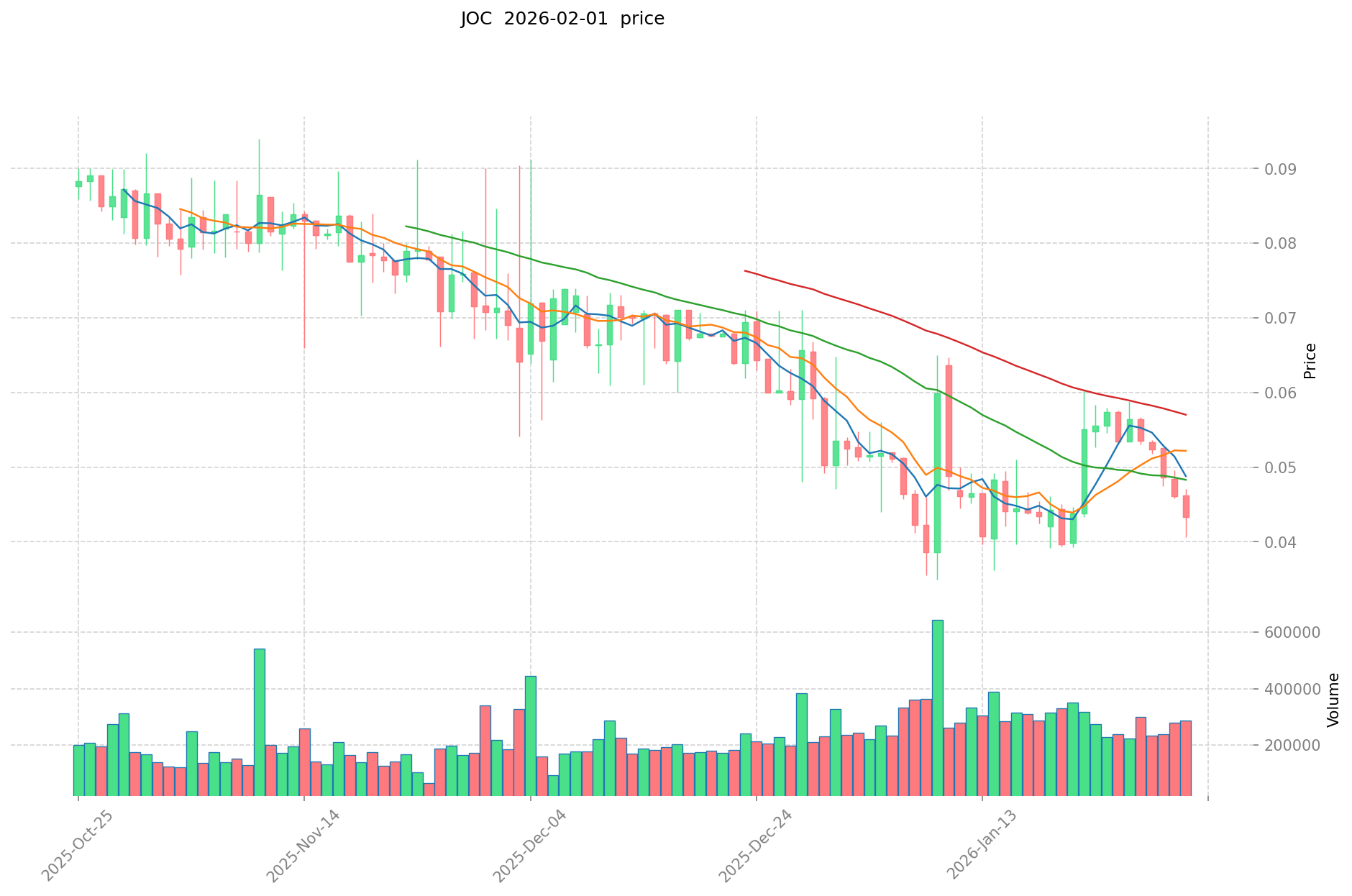
JOC reached a notable price level of 0.6479 USD on December 23, 2024, driven by factors related to its initial market launch phase and early trading activity. The token's lowest recorded price was 0.001 USD, occurring on January 10, 2025, reflecting early market volatility and price discovery mechanisms. As of the latest data, JOC is trading at 0.04194 USD, showing short-term fluctuations with a 2.04% increase over 1 hour and 1.77% gain over 24 hours, while experiencing broader corrections of -24.02% over 7 days and -20.52% over 30 days. These price movements reflect ongoing market sentiment adjustments, adoption patterns, and broader cryptocurrency market conditions.
Click to view current JOC market price
On-Chain Metrics
Based on available market data, JOC demonstrates the following market characteristics:
- 24-Hour Trading Volume: 12,022.76 USD (indicating current market liquidity levels)
- Market Capitalization: 1,677,600 USD (reflecting current market valuation)
- Fully Diluted Valuation: 41,940,000 USD (representing potential total market value at full circulation)
Japan Open Chain Ecosystem Applications and Partners
Core Use Cases
Japan Open Chain's ecosystem supports multiple enterprise-grade applications:
- Business Integration: The platform provides decentralized infrastructure solutions optimized for corporate deployments.
- Financial Services: JOC enables compliant blockchain operations under Japanese regulatory framework, facilitating institutional adoption.
Strategic Partnerships
Japan Open Chain has established collaborations with Sony Group, NTT Group, Dentsu Group, and multiple universities, enhancing its technical capabilities and market credibility.
These partnerships provide a solid foundation for JOC's ecosystem expansion and ensure operational compliance with Japanese legal standards.
Controversies and Challenges
Japan Open Chain faces the following challenges:
- Decentralization Trade-offs: The Proof of Authority consensus mechanism prioritizes scalability over full decentralization
- Market Competition: Competition from established Ethereum-compatible chains and other enterprise blockchain solutions
- Adoption Barriers: Limited exchange availability with trading currently on 1 platform
These issues have sparked discussions within the community and market, while also driving JOC's continuous innovation.
Japan Open Chain's community demonstrates growing interest, with the token maintaining a market presence since its launch in December 2024.
On X platform, related posts and hashtags (such as #JapanOpenChain) generate discussions around enterprise blockchain adoption.
Factors such as partnerships with major Japanese corporations and compliance-focused positioning have attracted attention from institutional observers.
Sentiment on X shows varied perspectives:
- Supporters praise JOC's institutional backing, regulatory compliance, and Ethereum compatibility, positioning it as a bridge between traditional enterprises and blockchain technology.
- Observers note limited trading availability, early-stage ecosystem development, and price volatility as areas requiring further maturation.
Recent trends indicate measured optimism regarding enterprise blockchain adoption in Japan.
Popular Topics
X users discuss JOC's regulatory compliance advantages, corporate validator structure, and potential for business integration,
showcasing both its innovative approach to enterprise blockchain and the challenges of bridging traditional business with decentralized technology.
- Official Website: Visit Japan Open Chain Official Site for features, use cases, and latest developments.
- White Paper: JOC White Paper details its technical architecture, objectives, and vision.
- X Updates: On X platform, Japan Open Chain actively engages through @JapanOpenChain,
sharing content covering technical updates, partnership announcements, and ecosystem developments.
Japan Open Chain Future Roadmap
- Ecosystem Development: Expanding validator network and enterprise partnerships to strengthen network reliability
- Technical Evolution: Enhancing Ethereum compatibility features and scalability improvements
- Long-term Vision: Establishing a compliant enterprise blockchain infrastructure for Japanese and international businesses
How to Participate in Japan Open Chain?
- Purchase Channels: Trade JOC on Gate.com
- Storage Solutions: Use Ethereum-compatible wallets for secure storage
- Blockchain Exploration: Access JOC Explorer to view network activity
- Learn More: Visit official documentation to understand technical specifications and business applications
Summary
Japan Open Chain redefines enterprise blockchain through a compliance-focused approach, providing regulatory clarity, institutional backing, and Ethereum compatibility.
Its strategic partnerships with major Japanese corporations and operation under Japanese legal framework position it uniquely in the enterprise blockchain space.
Despite facing early-stage ecosystem challenges and limited market presence, JOC's institutional support and clear compliance positioning give it a distinctive role in bridging traditional business with blockchain technology.
Whether you are exploring enterprise blockchain solutions or interested in regulated digital assets, Japan Open Chain represents an approach worth monitoring.
FAQ
What is Crypto JOC? What are its basic functions and characteristics?
Crypto JOC (Jump Over the Creek) represents a strong price breakout above key resistance levels. Its main characteristics include rapid price surge, complete supply absorption, and market dominance, typically accompanied by increased trading volume during the breakout.
JOC tokens can be purchased through major cryptocurrency exchanges with active JOC/USDT trading pairs. For storage, use secure cold wallets or hardware wallets to protect your tokens. Always enable two-factor authentication on exchange accounts for enhanced security.
What is the total supply of JOC tokens and how does its economic model work?
JOC token total supply is not publicly disclosed. Its economic model operates on supply and demand dynamics, with token price determined by total supply and market demand forces.
What are the risks of investing in JOC cryptocurrency? What security issues should I pay attention to?
JOC investments face hacking attacks, exchange vulnerabilities, and counterfeit coin risks. Protect private keys, use secure wallets, avoid public Wi-Fi, and never store credentials electronically. Choose reputable platforms with insurance protection.
What are the development prospects of the JOC project? What advantages does it have compared to similar projects?
JOC demonstrates strong development prospects through inclusive and diversified objectives, gaining competitive advantages. Its continuous improvement strategy excels in sustainable development, positioning it ahead of similar projects in the market.
* The information is not intended to be and does not constitute financial advice or any other recommendation of any sort offered or endorsed by Gate.