Cartesi (CTSI) is a Layer-2 blockchain infrastructure launched in 2020 that addresses scalability and developer accessibility by enabling off-chain computation in familiar Linux environments. The platform allows developers to build complex decentralized applications without the steep learning curve or computational constraints of traditional blockchain development. As of January 2026, CTSI demonstrates significant adoption with over 20,000 token holders and 901 million tokens in circulation (90.15% supply). The article provides comprehensive coverage of Cartesi's technical architecture using Proof-of-Stake consensus, market performance including current price of $0.03426 on Gate, and diverse ecosystem applications spanning DeFi and gaming. Whether you're a developer seeking advanced computational capabilities or an investor evaluating Layer-2 infrastructure solutions, this guide explores Cartesi's innovative approach to scaling blockchain applications while maintaining security guarantees and community engage
Cartesi's Positioning and Significance
In 2020, the Cartesi team launched Cartesi (CTSI), aiming to address the limitations of on-chain computation for complex decentralized applications and the steep learning curve for developers.
As a Layer-2 infrastructure enabling off-chain computation in Linux environments, Cartesi plays a critical role in blockchain scalability and developer accessibility.
As of 2026, Cartesi has established itself as an innovative solution bridging traditional software development and blockchain technology, with over 20,000 token holders and an active developer community.
This article provides an in-depth analysis of its technical architecture, market performance, and future potential.
Origin and Development History
Birth Background
Cartesi was created by the Cartesi Foundation in 2020, aiming to solve the computational constraints of smart contracts and the difficulty of building complex dApps on blockchain.
It emerged during the expansion of DeFi and the growing demand for scalable blockchain solutions, with the goal of providing developers with familiar Linux tools while maintaining decentralization and security.
Cartesi's launch brought new possibilities to blockchain developers and decentralized application ecosystems.
Important Milestones
- 2020: Mainnet launch, achieving off-chain computation capabilities within Linux environments.
- Ongoing development: Continuous optimization of the Cartesi Machine and integration with multiple blockchain platforms.
- Community growth: Token holder base expanding to over 20,000, demonstrating increasing adoption.
- Ecosystem expansion: Integration with various DeFi protocols and development tools, supporting diverse decentralized applications.
With support from the Cartesi Foundation and its community, Cartesi continues to enhance its technology, security, and real-world applications.
How Cartesi Works
Decentralized Control
Cartesi operates on a decentralized network of nodes distributed globally, independent of banks or government control.
These nodes collaborate to verify transactions, ensuring system transparency and attack resistance, granting users greater autonomy and enhancing network resilience.
Blockchain Foundation
Cartesi's blockchain serves as a public, immutable digital ledger recording every transaction.
Transactions are grouped into blocks, linked through cryptographic hashing to form a secure chain.
Anyone can view the records, establishing trust without intermediaries.
Cartesi's unique approach involves storing data temporarily on sidechains governed by Proof-of-Stake consensus, reducing the need for constant communication with the underlying blockchain while maintaining security.
Ensuring Fairness
Cartesi utilizes Proof-of-Stake (PoS) consensus to validate transactions and prevent fraudulent activities such as double-spending.
Validators maintain network security through staking CTSI tokens and validating transactions, earning CTSI rewards in return.
Its innovation includes enabling complex computations off-chain in Linux environments while maintaining on-chain security guarantees.
Secure Transactions
Cartesi employs public-private key cryptography to protect transactions:
- Private keys (like secret passwords) are used to sign transactions
- Public keys (like account numbers) are used to verify ownership
This mechanism ensures fund security while maintaining pseudonymous transaction privacy.
The platform's architecture allows developers to build complex dApps using familiar programming languages and tools, with computations verified through the Cartesi Machine emulator.
Circulation Overview
As of January 21, 2026, Cartesi (CTSI) has a circulating supply of 901,493,931.79 tokens, with a total supply of 1,000,000,000 tokens, representing a fixed supply model with a maximum cap of 1 billion tokens.
The circulating supply represents approximately 90.15% of the total supply, indicating a relatively high token circulation rate in the market. The token allocation and distribution mechanism influences the supply-demand dynamics of CTSI in the cryptocurrency market.
Price Fluctuations
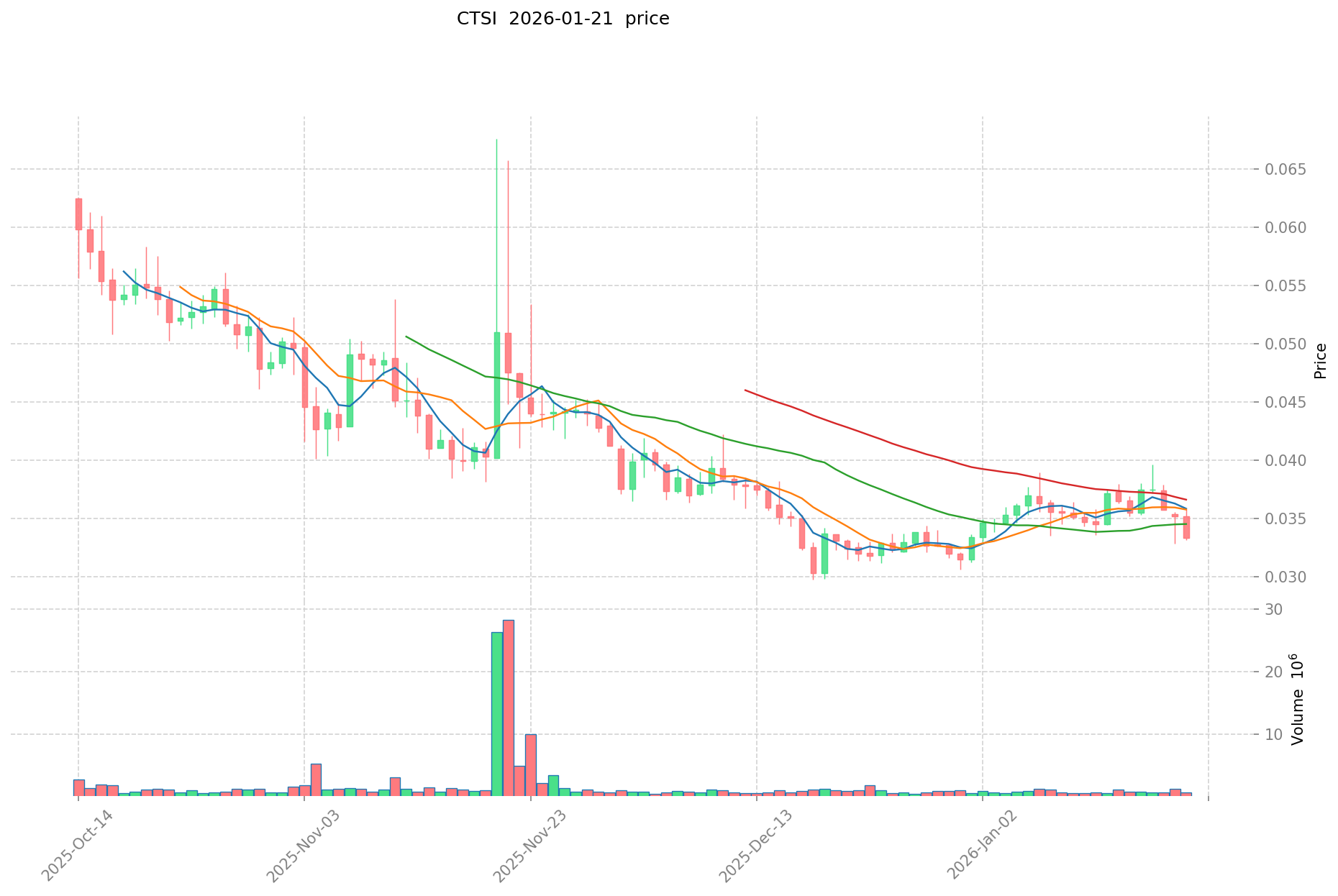
Cartesi (CTSI) reached a notable price level of $1.74 on May 9, 2021, during a period characterized by heightened market activity and increased interest in blockchain infrastructure solutions.
The token experienced its lower price point at $0.02606722 on October 11, 2025, reflecting market conditions and broader industry trends during that period.
As of January 21, 2026, CTSI is trading at $0.03426, showing the following recent price movements:
- 1-hour change: -1.19%
- 24-hour change: -1.1%
- 7-day change: -7.51%
- 30-day change: +4.97%
- 1-year change: -74.67%
These fluctuations reflect various factors including market sentiment, adoption trends, and the evolving landscape of Layer-2 infrastructure solutions in the blockchain ecosystem.
Click to view the current CTSI market price
On-chain Metrics
- 24-hour Trading Volume: $27,060.04 (indicating current market activity levels)
- Token Holders: 20,269 addresses (reflecting community distribution and user participation)
- Market Capitalization: $30,885,182.10 (representing approximately 0.0010% market dominance)
- Fully Diluted Valuation: $34,260,000.00 (market cap to FDV ratio of 90.15%)
Cartesi Ecosystem Applications and Partners
Core Use Cases
Cartesi's ecosystem supports diverse applications leveraging its unique Layer-2 infrastructure:
- DeFi (Decentralized Finance): Projects built on Cartesi can implement complex financial logic and intensive computations off-chain while maintaining security, enabling sophisticated DeFi protocols with enhanced computational capabilities.
- Gaming and Complex dApps: Developers utilize Cartesi's Linux environment to build feature-rich decentralized applications and blockchain games that require computational power beyond typical on-chain constraints.
Strategic Collaborations
Cartesi has established partnerships within the blockchain ecosystem to enhance its technological capabilities and expand its market presence. These collaborative relationships provide a solid foundation for Cartesi's ecosystem expansion and adoption among developers seeking familiar development environments.
Controversies and Challenges
Cartesi faces several challenges in its development:
- Technical Complexity: Balancing off-chain computation scalability with maintaining decentralization and security guarantees.
- Market Competition: Competing with other Layer-2 solutions and blockchain platforms offering similar developer-friendly environments.
- Adoption Barriers: Encouraging developers to transition to a hybrid on-chain/off-chain architecture requires education and ecosystem building.
These issues have sparked discussions within the community and the broader blockchain space, driving Cartesi's continuous innovation in its infrastructure.
Cartesi's community demonstrates active participation with over 20,269 token holders as of January 2026. The project maintains presence across multiple platforms including Twitter, Reddit, and Facebook, fostering developer collaboration and user engagement. Community discussions frequently center on technological developments, staking opportunities, and ecosystem growth.
Sentiment on social media platforms presents a mixed perspective:
- Supporters praise Cartesi's innovative approach to bringing Linux-based computation to blockchain, highlighting its potential to enable complex dApps that were previously impossible on-chain.
- Critics point to price volatility, with CTSI experiencing a 74.67% decline over the past year, and question the timeline for mainstream adoption.
Recent trends show cautious optimism as the project continues development despite market headwinds.
Hot Topics
Community members actively discuss Cartesi's progress in onboarding developers, the practical implementation of its Virtual Machine technology, and how its Proof-of-Stake consensus mechanism compares to other Layer-2 solutions. These conversations highlight both the transformative potential and the challenges in achieving widespread adoption.
- Official Website: Visit Cartesi's official website for features, use cases, and latest updates.
- Social Media: On X platform, Cartesi actively engages through @cartesiproject, sharing updates on technical developments, community initiatives, and partnership announcements.
- Development Resources: Access Cartesi's GitHub repositories including machine-emulator, arbitration-dlib, and machine-solidity-step for technical documentation.
How to Participate in Cartesi?
- Purchase Options: Acquire CTSI on Gate.com and other major cryptocurrency exchanges.
- Storage Solutions: Securely store CTSI using compatible Ethereum wallets such as MetaMask or hardware wallets, as CTSI is an ERC-20 token (contract address: 0x491604c0FDF08347Dd1fa4Ee062a822A5DD06B5D).
- Staking Participation: Engage with Cartesi's Proof-of-Stake consensus by participating in staking mechanisms to support network security.
- Ecosystem Building: Visit Cartesi's GitHub repositories and developer documentation to contribute code or build decentralized applications utilizing the Cartesi infrastructure.
Summary
Cartesi redefines blockchain application development by providing a Layer-2 infrastructure that enables complex computations in a familiar Linux environment without compromising decentralization or security. Its innovative approach offers developers access to mainstream programming tools and libraries, potentially unlocking new categories of decentralized applications.
Despite facing market volatility and adoption challenges, Cartesi's technical innovation and focus on developer experience position it as a noteworthy project in the blockchain space. With over 901 million CTSI tokens in circulation (90.15% of total supply) and listing on 32 exchanges, the project maintains significant market presence.
Whether you're a developer seeking advanced computational capabilities for dApps or an investor interested in Layer-2 infrastructure solutions, Cartesi represents an interesting approach to scaling blockchain applications while maintaining security guarantees.
FAQ
What is Cartesi (CTSI) and what problem does it solve?
Cartesi is a blockchain operating system enabling scalable smart contracts through off-chain computation. It solves Ethereum's scalability limitations by allowing complex computations off-chain while maintaining security through cryptographic verification, reducing gas costs and increasing transaction throughput significantly.
How does CTSI work and what is its technology architecture?
CTSI operates as a sidechain solution using Cartesi Machine, enabling off-chain computation while maintaining Ethereum security. It combines Linux runtime with optimistic rollup technology, allowing scalable dApp execution with reduced gas costs and improved transaction throughput through verifiable computation.
Where can I buy CTSI tokens and how do I store them safely?
Purchase CTSI on major cryptocurrency platforms. Store tokens securely using hardware wallets like Ledger or Trezor for maximum protection, or trusted custodial wallets for convenience.
What are the main use cases and applications of Cartesi?
Cartesi enables scalable smart contracts and decentralized applications through Linux-based computation. Main applications include complex DApp development, off-chain computation for dApps, enterprise blockchain solutions, and gaming platforms requiring intensive processing power.
How is CTSI different from other Layer 2 or blockchain solutions?
CTSI uses optimistic rollups with interactive verification, enabling cost-effective computation scaling. Its unique dispute resolution mechanism ensures security while reducing fees, making it ideal for complex dApps requiring high throughput and low latency compared to traditional Layer 2 solutions.
What is the tokenomics and supply of CTSI?
CTSI has a total supply of 1 billion tokens. The tokenomics include staking rewards, ecosystem development fund, and team allocation. Token distribution incentivizes network validators and long-term holders through competitive staking yields.
What are the risks and potential future prospects of CTSI?
CTSI faces market volatility and regulatory uncertainties as risks. However, its innovative layer-2 scaling solution positions it for growth as blockchain adoption accelerates. Increased enterprise adoption and ecosystem expansion suggest strong long-term potential for value appreciation.
* The information is not intended to be and does not constitute financial advice or any other recommendation of any sort offered or endorsed by Gate.