The article "USUAL vs ETH: The Battle for Decentralized Finance Dominance" provides an in-depth comparison of USUAL, a fiat-backed stablecoin, and Ethereum (ETH), a leading platform for decentralized applications. It discusses their investment value through historical price trends, supply mechanisms, and institutional adoption while examining potential risks. Aimed at investors, the article assesses which asset presents a more valuable buy. The structure outlines price history, factors affecting investment, predictions up to 2030, investment strategies, risks, and FAQs to assist readers in making informed decisions.
Introduction: USUAL vs ETH Investment Comparison
In the cryptocurrency market, USUAL vs ETH comparison remains an unavoidable topic for investors. The two not only differ significantly in market cap ranking, application scenarios, and price performance but also represent different cryptocurrency asset positions.
USUAL (USUAL): Since its launch, it has gained market recognition as a secure and decentralized fiat-backed stablecoin issuer that redistributes ownership and value.
Ethereum (ETH): Since 2015, it has been hailed as the foundation for decentralized applications and smart contracts, and is one of the cryptocurrencies with the highest global trading volume and market capitalization.
This article will provide a comprehensive analysis of the investment value comparison between USUAL and ETH, focusing on historical price trends, supply mechanisms, institutional adoption, technological ecosystems, and future predictions, attempting to answer the question investors care about most:
"Which is the better buy right now?"
I. Price History Comparison and Current Market Status
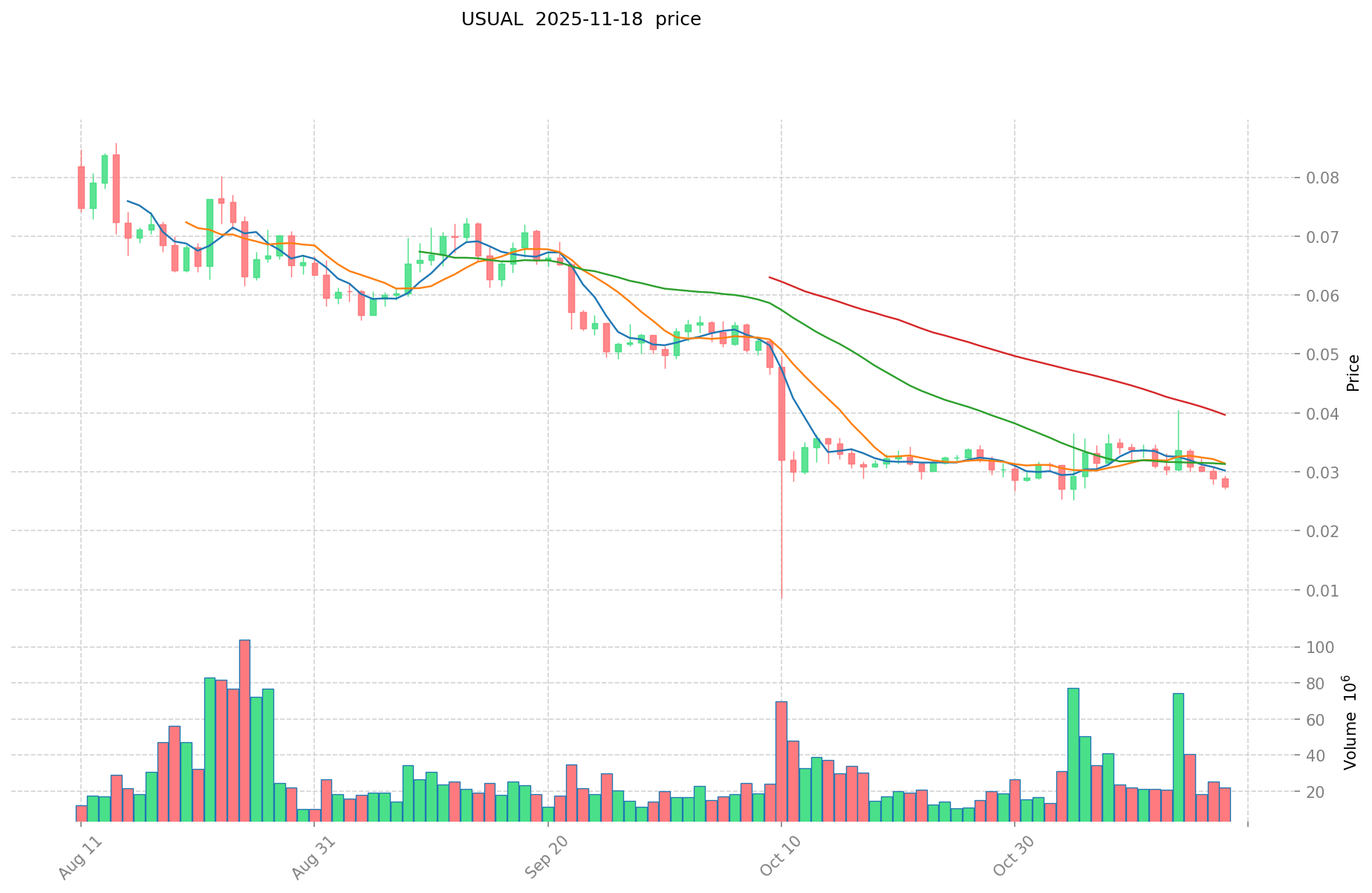
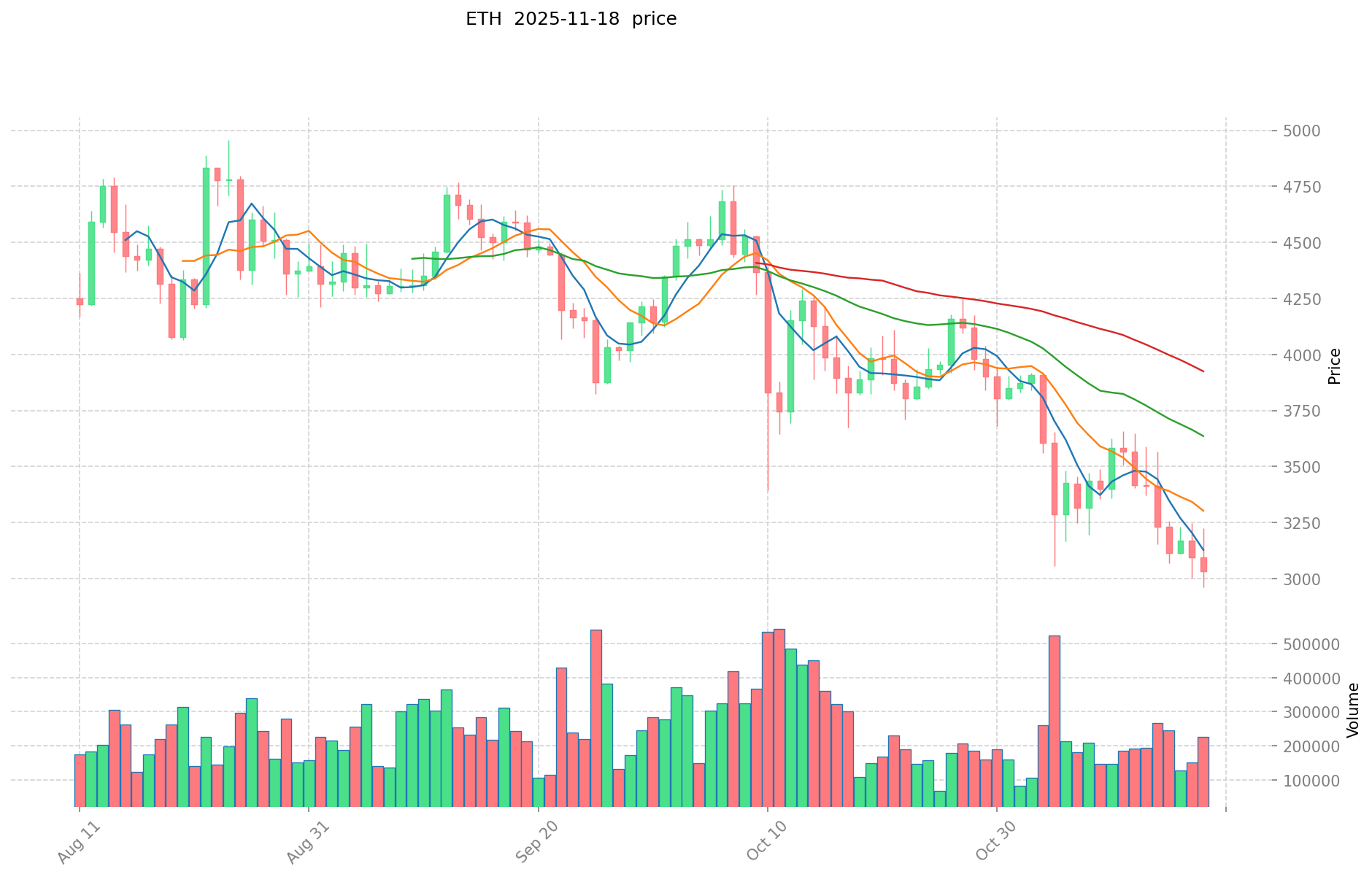
USUAL and ETH Historical Price Trends
- 2024: USUAL experienced significant price volatility due to its launch and initial market adoption.
- 2022: ETH underwent a major network upgrade with The Merge, transitioning to Proof of Stake.
- Comparative analysis: During the recent market cycle, USUAL dropped from its all-time high of $1.6555 to a low of $0.00851, while ETH demonstrated more stability, maintaining its position as the second-largest cryptocurrency by market cap.
Current Market Situation (2025-11-19)
- USUAL current price: $0.02829
- ETH current price: $3121.45
- 24-hour trading volume: USUAL $516,747 vs ETH $670,806,588
- Market Sentiment Index (Fear & Greed Index): 11 (Extreme Fear)
Click to view real-time prices:
- View USUAL current price Market Price
- View ETH current price Market Price
Factors Affecting Investment Value of USUAL vs ETH
Supply Mechanism Comparison (Tokenomics)
- USUAL: Dynamic minting mechanism with higher incentives in early stages and gradual reduction to balance supply and demand; 90% of tokens allocated to community
- ETH: Deflationary model after "The Merge" with EIP-1559 burning mechanism reducing circulating supply
- 📌 Historical pattern: ETH's deflationary mechanism tends to create upward price pressure during high network usage periods
Institutional Adoption and Market Applications
- Institutional holdings: ETH has broader institutional acceptance as a major cryptocurrency asset
- Enterprise adoption: ETH serves as foundation for DeFi ecosystem and NFTs; USUAL focuses on real-world asset (RWA) backed stablecoins
- Regulatory stance: ETH faces scrutiny but enjoys relatively established regulatory understanding; USUAL faces typical stablecoin regulatory uncertainties
Technical Development and Ecosystem Building
- USUAL technical upgrades: Protocol improvements that enhance user benefits could increase token market value
- ETH technical development: Network upgrades significantly impact price; successful scalability and security improvements typically drive price appreciation
- Ecosystem comparison: ETH powers thousands of dApps across DeFi, NFTs and smart contracts; USUAL ecosystem centers around USD0 stablecoin adoption and its implementation on DeFi platforms
Macroeconomic Factors and Market Cycles
- Inflation environment performance: ETH historically shows mixed correlation with inflation; USUAL's value tied to USD0 adoption which aims to provide stability
- Monetary policy impact: Interest rates and USD strength affect both assets, with ETH typically more volatile in response
- Geopolitical factors: Broader cryptocurrency market sentiment affects both, though USUAL's real-world asset backing could provide different risk profile during market stress
III. 2025-2030 Price Prediction: USUAL vs ETH
Short-term Prediction (2025)
- USUAL: Conservative $0.0232 - $0.0280 | Optimistic $0.0280 - $0.0389
- ETH: Conservative $2894.80 - $3112.69 | Optimistic $3112.69 - $3517.34
Mid-term Prediction (2027)
- USUAL may enter a growth phase, with expected prices ranging from $0.0336 to $0.0549
- ETH may enter a bullish market, with expected prices ranging from $3281.86 to $4667.54
- Key drivers: Institutional capital inflow, ETF, ecosystem development
Long-term Prediction (2030)
- USUAL: Base scenario $0.0579 - $0.0603 | Optimistic scenario $0.0603 - $0.0627
- ETH: Base scenario $4349.27 - $5116.78 | Optimistic scenario $5116.78 - $5781.96
View detailed price predictions for USUAL and ETH
Disclaimer: The above predictions are based on historical data and market trends. Cryptocurrency markets are highly volatile and subject to rapid changes. These forecasts should not be considered as financial advice. Always conduct your own research before making investment decisions.
USUAL:
| 年份 |
预测最高价 |
预测平均价格 |
预测最低价 |
涨跌幅 |
| 2025 |
0.0389339 |
0.02801 |
0.0232483 |
0 |
| 2026 |
0.0438482545 |
0.03347195 |
0.0170706945 |
18 |
| 2027 |
0.054897345195 |
0.03866010225 |
0.0336342889575 |
36 |
| 2028 |
0.0692325111093 |
0.0467787237225 |
0.0430364258247 |
65 |
| 2029 |
0.062646066809172 |
0.0580056174159 |
0.030162921056268 |
105 |
| 2030 |
0.062738875797037 |
0.060325842112536 |
0.057912808428034 |
113 |
ETH:
| 年份 |
预测最高价 |
预测平均价格 |
预测最低价 |
涨跌幅 |
| 2025 |
3517.3397 |
3112.69 |
2894.8017 |
0 |
| 2026 |
3978.01782 |
3315.01485 |
2784.612474 |
6 |
| 2027 |
4667.5409088 |
3646.516335 |
3281.8647015 |
16 |
| 2028 |
5362.566922251 |
4157.0286219 |
2577.357745578 |
33 |
| 2029 |
5473.767437886825 |
4759.7977720755 |
3617.44630677738 |
52 |
| 2030 |
5781.964343628713625 |
5116.7826049811625 |
4349.265214233988125 |
63 |
IV. Investment Strategy Comparison: USUAL vs ETH
Long-term vs Short-term Investment Strategies
- USUAL: Suitable for investors focused on stablecoin ecosystems and real-world asset backing
- ETH: Suitable for investors seeking exposure to the broader cryptocurrency market and DeFi ecosystem
Risk Management and Asset Allocation
- Conservative investors: USUAL: 20% vs ETH: 80%
- Aggressive investors: USUAL: 40% vs ETH: 60%
- Hedging tools: Stablecoin allocation, options, cross-currency portfolios
V. Potential Risk Comparison
Market Risk
- USUAL: Price volatility due to early-stage adoption and market sentiment
- ETH: Susceptible to broader cryptocurrency market trends and macroeconomic factors
Technical Risk
- USUAL: Scalability, network stability
- ETH: Network congestion, high gas fees during peak usage
Regulatory Risk
- Global regulatory policies may affect both assets differently, with stablecoins like USUAL potentially facing more scrutiny
VI. Conclusion: Which Is the Better Buy?
📌 Investment Value Summary:
- USUAL advantages: Real-world asset backing, potential for stable growth in USD0 adoption
- ETH advantages: Established ecosystem, deflationary mechanism, institutional acceptance
✅ Investment Advice:
- Novice investors: Consider a small allocation to ETH as part of a diversified portfolio
- Experienced investors: Balanced approach with both USUAL and ETH based on risk tolerance
- Institutional investors: ETH for broader market exposure, USUAL for potential stablecoin innovation
⚠️ Risk Warning: The cryptocurrency market is highly volatile. This article does not constitute investment advice.
None
VII. FAQ
Q1: What are the main differences between USUAL and ETH?
A: USUAL is a stablecoin issuer focusing on real-world asset backing, while ETH is the native cryptocurrency of the Ethereum network, powering decentralized applications and smart contracts. USUAL has a dynamic minting mechanism, while ETH has become deflationary after "The Merge".
Q2: Which has shown better price stability historically, USUAL or ETH?
A: ETH has demonstrated more price stability compared to USUAL. While USUAL experienced significant volatility since its launch, ETH has maintained its position as the second-largest cryptocurrency by market cap.
Q3: How do the supply mechanisms of USUAL and ETH differ?
A: USUAL employs a dynamic minting mechanism with higher initial incentives that gradually reduce to balance supply and demand. ETH, on the other hand, has become deflationary after "The Merge", with the EIP-1559 burning mechanism reducing the circulating supply.
Q4: What are the key factors affecting the investment value of USUAL and ETH?
A: Key factors include supply mechanisms, institutional adoption, market applications, technical development, ecosystem building, macroeconomic factors, and market cycles.
Q5: How do USUAL and ETH compare in terms of institutional adoption?
A: ETH has broader institutional acceptance as a major cryptocurrency asset, while USUAL is focused on real-world asset (RWA) backed stablecoins and faces typical stablecoin regulatory uncertainties.
Q6: What are the predicted price ranges for USUAL and ETH in 2030?
A: For USUAL, the base scenario predicts $0.0579 - $0.0603, with an optimistic scenario of $0.0603 - $0.0627. For ETH, the base scenario predicts $4349.27 - $5116.78, with an optimistic scenario of $5116.78 - $5781.96.
Q7: How should investors allocate their portfolio between USUAL and ETH?
A: Conservative investors might consider allocating 20% to USUAL and 80% to ETH, while aggressive investors might opt for 40% USUAL and 60% ETH. However, individual allocation should be based on personal risk tolerance and investment goals.
* The information is not intended to be and does not constitute financial advice or any other recommendation of any sort offered or endorsed by Gate.












