This comprehensive analysis compares PYR (Vulcan Forged) and SAND (The Sandbox), two leading metaverse tokens with distinct investment profiles. PYR, launched in 2021, serves as the native utility token for an NFT gaming ecosystem, supporting marketplace transactions and staking mechanisms. SAND, introduced in 2020, powers a decentralized virtual world enabling user-generated content monetization. Currently trading at $0.4294 and $0.1316 respectively, both tokens face extreme market fear conditions. SAND demonstrates superior liquidity with $444,543.08 daily trading volume versus PYR's $19,826.61, though both exhibit significant volatility. Conservative investors favor SAND's stronger price retention and market presence, while aggressive investors explore PYR's lower entry point. Forecasts suggest both tokens could appreciate substantially through 2031, yet risks include regulatory uncertainty and ecosystem adoption challenges. The article provides tailored investment strategies for different investor profile
Introduction: PYR vs SAND Investment Comparison
In the cryptocurrency market, the comparison between PYR vs SAND has consistently been a topic of interest for investors. These two assets exhibit notable differences in market cap ranking, application scenarios, and price performance, representing distinct positioning within the crypto asset landscape.
PYR (Vulcan Forged): Launched in 2021, this token has gained market recognition through its positioning as a native utility token for an NFT gaming ecosystem. PYR serves multiple functions including NFT marketplace transactions, staking mechanisms, and liquidity provision within the Vulcan Forged platform.
SAND (The Sandbox): Since its introduction in 2020, SAND has been recognized as a fundamental token for a decentralized virtual gaming world, enabling players to create, own, and monetize gaming experiences through blockchain technology.
This article will comprehensively analyze the investment value comparison between PYR vs SAND, focusing on historical price trends, supply mechanisms, institutional adoption patterns, technical ecosystem development, and future projections. We aim to address the question most relevant to investors:
"Which is the better buy right now?"
I. Historical Price Comparison and Current Market Status
Historical Price Trends of PYR (Coin A) and SAND (Coin B)
- 2021: PYR reached an all-time high of $49.24 on December 1, 2021, reflecting strong market momentum during the broader crypto bull market period.
- 2021: SAND achieved its historical peak of $8.4 on November 25, 2021, driven by increased interest in metaverse and gaming projects.
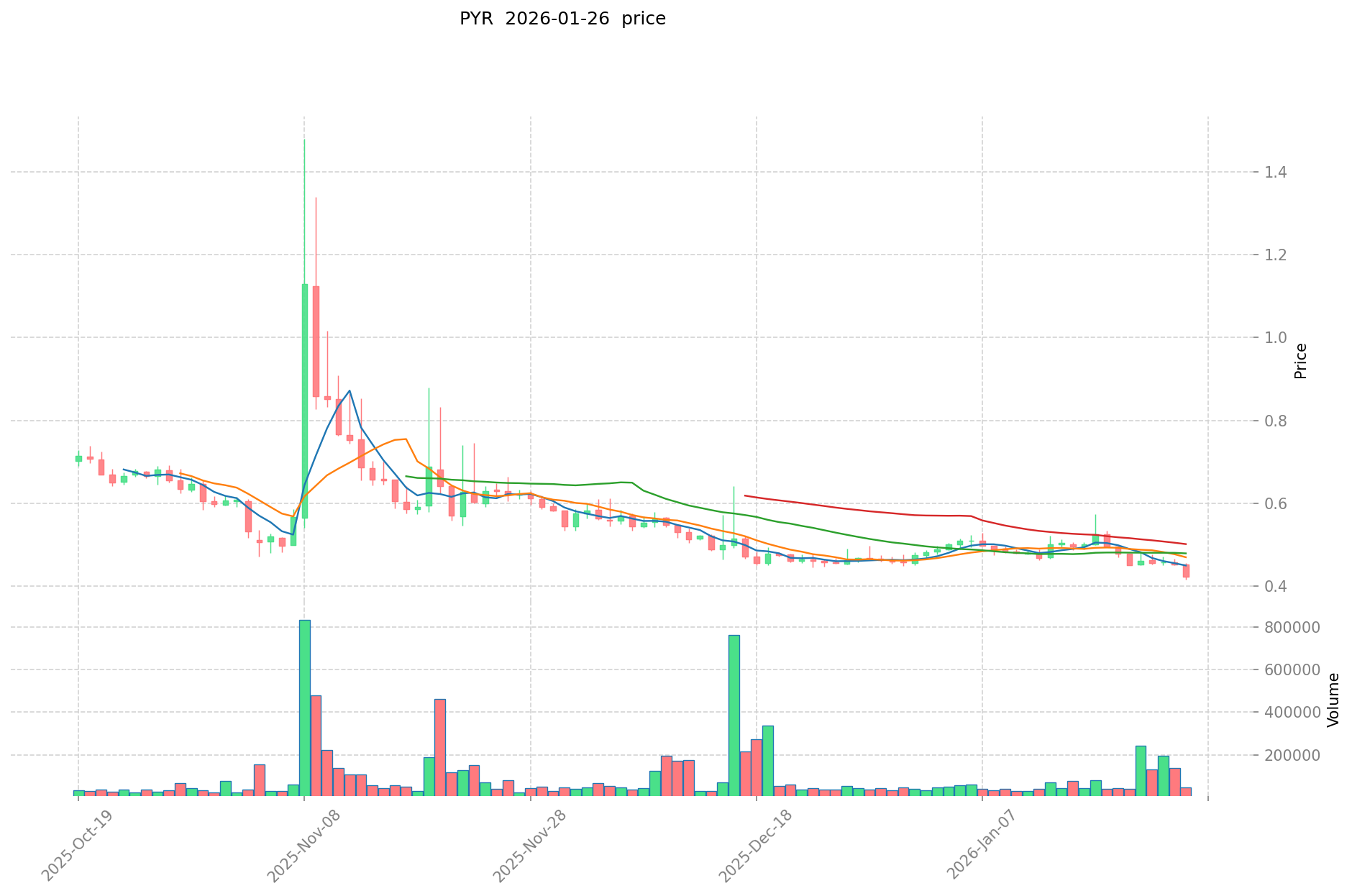
- 2026: PYR recorded an all-time low of $0.418274 on January 26, 2026, representing a significant decline from its previous peak.
- 2020: SAND established its all-time low of $0.02897764 on November 4, 2020, during the early stages of the project's market presence.
- Comparative Analysis: During the recent market cycle, PYR experienced a substantial decline of approximately 99.1% from its all-time high to its current level, while SAND has demonstrated relatively stronger price retention, maintaining a higher distance from its historical low despite market downturns.
Current Market Status (January 26, 2026)
- PYR current price: $0.4294
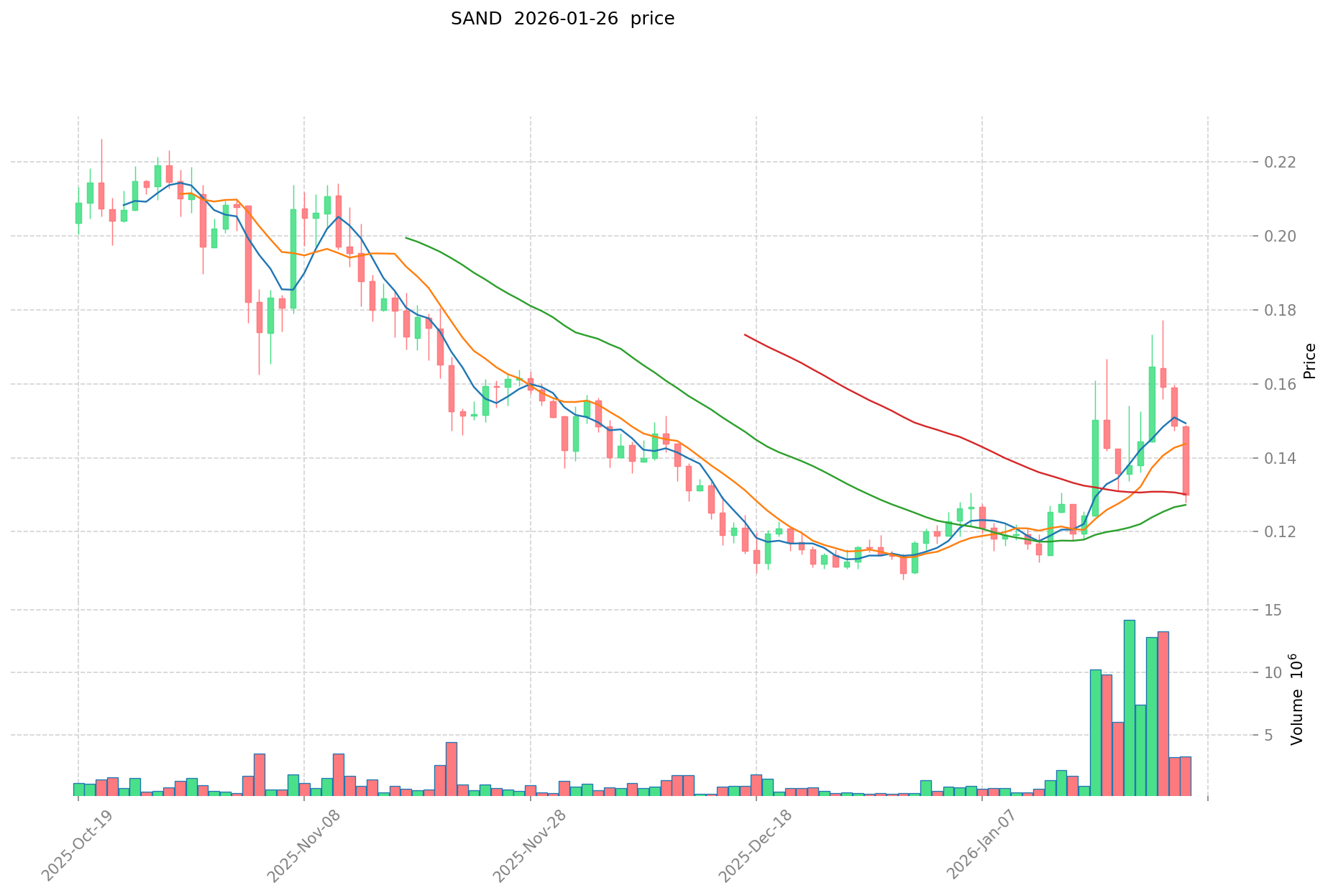
- SAND current price: $0.1316
- 24-hour trading volume: PYR $19,826.61 vs SAND $444,543.08
- Market Sentiment Index (Fear & Greed Index): 20 (Extreme Fear)
- PYR 24-hour price change: -5.06%
- SAND 24-hour price change: -9.04%
View real-time prices:
II. Core Factors Influencing PYR vs SAND Investment Value
Supply Mechanism Comparison (Tokenomics)
Due to the absence of specific tokenomics data in the provided materials, a detailed comparative analysis of the supply mechanisms for PYR and SAND cannot be conducted at this time. Generally speaking, token supply models—whether fixed supply, deflationary mechanisms, or periodic release schedules—can influence long-term price dynamics by affecting market circulation and scarcity perception.
Institutional Adoption and Market Application
Without available data on institutional holdings, enterprise adoption cases, or specific regulatory stances toward PYR and SAND across different jurisdictions, a comparative assessment of their institutional appeal and real-world application scenarios cannot be provided. Institutional participation and corporate integration typically serve as indicators of market maturity and broader acceptance within the digital asset ecosystem.
Technological Development and Ecosystem Construction
In the absence of concrete information regarding recent technical upgrades, development roadmaps, or ecosystem expansion activities for either PYR or SAND, it is not feasible to compare their technological trajectories or evaluate their respective positions within DeFi, NFT, payment solutions, or smart contract implementations. Technological innovation and ecosystem vitality are commonly viewed as key drivers of long-term value proposition in the crypto asset space.
Macroeconomic Environment and Market Cycles
Given the lack of specific performance data or analytical insights related to inflation environments, monetary policy shifts, interest rate fluctuations, or geopolitical factors affecting PYR and SAND, a comparative evaluation of their behavior under varying macroeconomic conditions cannot be established. Macroeconomic variables and market cycles generally play significant roles in shaping risk appetite and asset allocation strategies within the digital asset market.
III. 2026-2031 Price Forecast: PYR vs SAND
Short-term Forecast (2026)
- PYR: Conservative $0.221416 - $0.4258 | Optimistic $0.4258 - $0.451348
- SAND: Conservative $0.092797 - $0.1307 | Optimistic $0.1307 - $0.148998
Mid-term Forecast (2028-2029)
- PYR may enter a consolidation phase, with projected prices ranging from $0.41739964728 to $0.6956660788
- SAND may enter a growth phase, with projected prices ranging from $0.0898669674 to $0.273495137454
- Key drivers: institutional capital inflows, ETF developments, ecosystem expansion
Long-term Forecast (2030-2031)
- PYR: Base scenario $0.339882569928 - $0.5962852104 | Optimistic scenario $0.5962852104 - $0.846724998768
- SAND: Base scenario $0.22592355899988 - $0.240344211702 | Optimistic scenario $0.240344211702 - $0.315451777858875
View detailed price predictions for PYR and SAND
Disclaimer
PYR:
| Year |
Predicted High Price |
Predicted Average Price |
Predicted Low Price |
Price Change |
| 2026 |
0.451348 |
0.4258 |
0.221416 |
0 |
| 2027 |
0.5262888 |
0.438574 |
0.3508592 |
2 |
| 2028 |
0.511377284 |
0.4824314 |
0.463134144 |
12 |
| 2029 |
0.6956660788 |
0.496904342 |
0.41739964728 |
15 |
| 2030 |
0.846724998768 |
0.5962852104 |
0.339882569928 |
38 |
| 2031 |
0.77201046190488 |
0.721505104584 |
0.44733316484208 |
68 |
SAND:
| Year |
Predicted High Price |
Predicted Average Price |
Predicted Low Price |
Price Change |
| 2026 |
0.148998 |
0.1307 |
0.092797 |
0 |
| 2027 |
0.19299162 |
0.139849 |
0.08251091 |
5 |
| 2028 |
0.2479662619 |
0.16642031 |
0.0898669674 |
26 |
| 2029 |
0.273495137454 |
0.20719328595 |
0.1636826959005 |
56 |
| 2030 |
0.2643786328722 |
0.240344211702 |
0.22592355899988 |
82 |
| 2031 |
0.315451777858875 |
0.2523614222871 |
0.239743351172745 |
91 |
IV. Investment Strategy Comparison: PYR vs SAND
Long-term vs Short-term Investment Strategies
- PYR: May appeal to investors focused on NFT gaming ecosystem development and utility-driven platforms, particularly those seeking exposure to niche gaming metaverse projects with established marketplace infrastructure.
- SAND: May suit investors interested in broader metaverse adoption and decentralized virtual world concepts, with emphasis on user-generated content and established brand recognition in the gaming blockchain sector.
Risk Management and Asset Allocation
- Conservative investors: PYR 30% vs SAND 70% - reflecting SAND's relatively stronger historical price retention and higher trading volume indicators.
- Aggressive investors: PYR 55% vs SAND 45% - considering PYR's lower current price point relative to historical levels, which may present higher risk-reward scenarios.
- Hedging instruments: stablecoin allocation for liquidity management, options strategies for downside protection, cross-asset portfolio diversification across multiple gaming and metaverse tokens.
V. Potential Risk Comparison
Market Risks
- PYR: Exhibits significant price volatility with approximately 99.1% decline from all-time high levels, lower 24-hour trading volume of $19,826.61 suggests limited liquidity conditions, and recent 24-hour decline of 5.06% reflects ongoing market pressure.
- SAND: Demonstrates considerable price fluctuation with 24-hour decline of 9.04%, though maintains higher trading volume of $444,543.08 indicating relatively better market liquidity, and benefits from stronger historical price retention compared to peak levels.
Technical Risks
- PYR: Scalability considerations for NFT marketplace operations, network stability requirements for gaming platform functionality.
- SAND: Infrastructure capacity for virtual world hosting, potential security vulnerabilities in smart contract implementations.
Regulatory Risks
- Global regulatory developments regarding NFT classifications, gaming token regulations, and virtual asset frameworks may impact both projects differently based on their specific use cases and jurisdictional exposure, though specific regulatory stances toward PYR and SAND across different regions require ongoing monitoring.
VI. Conclusion: Which Is the Better Buy?
📌 Investment Value Summary:
- PYR Advantages: Lower current entry price point at $0.4294, established NFT gaming ecosystem with marketplace functionality, staking mechanisms providing potential utility value.
- SAND Advantages: Higher trading volume indicating better market liquidity, stronger brand recognition in metaverse sector, relatively better historical price retention from peak levels.
✅ Investment Recommendations:
- Novice investors: Consider SAND for higher liquidity and established market presence, allocate smaller position sizes given extreme fear sentiment (Fear & Greed Index: 20), implement dollar-cost averaging approach to mitigate entry timing risks.
- Experienced investors: May explore diversified exposure across both assets based on individual risk tolerance, monitor ecosystem developments and adoption metrics, consider technical analysis patterns alongside fundamental factors.
- Institutional investors: Evaluate liquidity requirements against trading volume data, assess alignment with portfolio mandates regarding gaming and metaverse exposure, conduct thorough due diligence on regulatory compliance frameworks.
⚠️ Risk Disclaimer: The cryptocurrency market exhibits extreme volatility. This content does not constitute investment advice. Investors should conduct independent research and consult qualified financial professionals before making investment decisions.
VII. FAQ
Q1: Which cryptocurrency has better liquidity for trading - PYR or SAND?
SAND demonstrates significantly better liquidity with a 24-hour trading volume of $444,543.08 compared to PYR's $19,826.61. This approximately 22x difference in trading volume indicates that SAND offers easier entry and exit opportunities for investors, reducing the risk of slippage during transactions. Higher liquidity is particularly important for both institutional investors and individual traders who require the ability to execute larger orders without substantially impacting the market price. The liquidity advantage also suggests stronger market maker presence and broader exchange participation for SAND.
Q2: What are the main risk differences between investing in PYR versus SAND?
PYR presents higher volatility risk, having declined approximately 99.1% from its all-time high of $49.24 to its current price of $0.4294, while SAND has shown relatively stronger price retention from its peak. PYR's lower trading volume of $19,826.61 creates additional liquidity risk, potentially making it more difficult to exit positions during market stress. However, SAND experienced a sharper 24-hour decline of 9.04% compared to PYR's 5.06%, suggesting both assets remain highly volatile. Both projects face technological risks related to their respective gaming ecosystems, though SAND's broader metaverse positioning may offer more diversified use case scenarios.
Q3: How do the price forecasts differ between PYR and SAND for 2026-2031?
For short-term 2026 projections, PYR shows a conservative range of $0.221416-$0.4258 and optimistic range of $0.4258-$0.451348, while SAND projects conservatively at $0.092797-$0.1307 and optimistically at $0.1307-$0.148998. By 2031, PYR's base scenario forecasts $0.339882569928-$0.5962852104 with an optimistic high of $0.846724998768, representing a potential 68% price change. SAND's 2031 projections range from $0.22592355899988-$0.240344211702 in the base scenario, with an optimistic high of $0.315451777858875, indicating a potential 91% price change. These forecasts suggest both assets could experience significant appreciation, though actual performance will depend on ecosystem development, adoption rates, and broader market conditions.
Q4: What portfolio allocation strategy is recommended for balancing PYR and SAND investments?
For conservative investors seeking lower risk exposure, a 30% PYR and 70% SAND allocation is recommended, reflecting SAND's superior liquidity metrics and stronger historical price retention. This approach prioritizes established market presence and trading accessibility. Aggressive investors with higher risk tolerance may consider a 55% PYR and 45% SAND allocation, capitalizing on PYR's significantly lower price point relative to historical levels, which presents potential higher risk-reward scenarios. Both strategies should incorporate stablecoin reserves for liquidity management, with regular rebalancing based on changing market conditions. Investors should also consider implementing options strategies for downside protection and maintaining diversification across multiple gaming and metaverse tokens beyond just PYR and SAND.
Q5: What are the primary use cases that differentiate PYR from SAND?
PYR functions as the native utility token for the Vulcan Forged NFT gaming ecosystem, serving multiple purposes including NFT marketplace transactions, staking mechanisms, and liquidity provision within a specialized gaming platform. This positioning targets a niche audience focused on NFT-integrated gaming experiences with established marketplace infrastructure. SAND, conversely, serves as the fundamental token for The Sandbox decentralized virtual gaming world, emphasizing user-generated content creation, ownership, and monetization of gaming experiences. SAND's broader metaverse positioning and focus on player creativity distinguishes it from PYR's more marketplace-centric approach. These fundamental differences in use cases and target audiences should inform investor decisions based on which ecosystem model aligns better with their investment thesis regarding the future development of blockchain gaming.
Q6: How does the current market sentiment affect PYR and SAND investment decisions?
The current Fear & Greed Index reading of 20 indicates "Extreme Fear" in the cryptocurrency market, historically associated with potential buying opportunities for long-term investors following Warren Buffett's principle of being "greedy when others are fearful." However, this extreme sentiment also suggests continued downward pressure may persist in the short term. Both PYR and SAND experienced negative 24-hour price changes (5.06% and 9.04% respectively), confirming the bearish sentiment. This environment favors implementing dollar-cost averaging strategies rather than lump-sum investments, allowing investors to build positions gradually while managing timing risk. The extreme fear conditions may present attractive entry points for investors with strong conviction in the gaming and metaverse sectors, though caution remains warranted given both assets' substantial declines from historical peaks.
* The information is not intended to be and does not constitute financial advice or any other recommendation of any sort offered or endorsed by Gate.