This comprehensive analysis compares OORT and SOL as cryptocurrency investment options within the current market environment. OORT, launched in 2024, focuses on decentralized AI infrastructure emphasizing data privacy and cost optimization. SOL (Solana), established since 2020, operates as a high-performance blockchain protocol. The article examines historical price trends, tokenomics structures, institutional adoption patterns, and technical ecosystem development. Current market conditions show OORT trading at $0.01635 with minimal liquidity ($37,088.98 daily volume), while SOL trades at $125.56 with substantial trading volume ($70,192,935.06 daily). Investment recommendations vary by investor profile: conservative investors should favor SOL's established ecosystem and superior liquidity, while experienced investors may diversify holdings. Risk analysis highlights OORT's extreme volatility and limited track record against SOL's network stability concerns. Both assets carry regulatory uncertainty and cryptocu
Introduction: Investment Comparison Between OORT and SOL
In the cryptocurrency market, the comparison between OORT vs SOL has become a topic of growing interest among investors. These two assets differ significantly in market capitalization ranking, application scenarios, and price performance, representing distinct positioning within the crypto asset landscape.
OORT (OORT): Launched in 2024, this decentralized AI infrastructure project has gained market attention through its focus on data privacy protection and cost optimization by integrating global computing and storage resources to support trustworthy AI applications.
SOL (SOL): Since its establishment in 2020, Solana has been recognized as a high-performance blockchain protocol, designed to provide scalability without compromising decentralization or security, making it one of the leading cryptocurrencies by trading volume and market capitalization.
This article will comprehensively analyze the investment value comparison between OORT vs SOL through historical price trends, supply mechanisms, institutional adoption, technical ecosystems, and future predictions, attempting to address investors' most pressing question:
"Which is the better buy right now?"
I. Historical Price Comparison and Market Status
OORT (Coin A) and SOL (Coin B) Historical Price Trends
- 2024: OORT reached its historical high of $1.22 on January 15, 2024, shortly after its launch in January 2024, reflecting initial market enthusiasm for its decentralized AI infrastructure positioning.
- 2020-2025: SOL experienced significant volatility, recording an all-time low of $0.500801 on May 12, 2020, and later achieving an all-time high of $293.31 on January 19, 2025, driven by ecosystem expansion and adoption in the DeFi and NFT sectors.
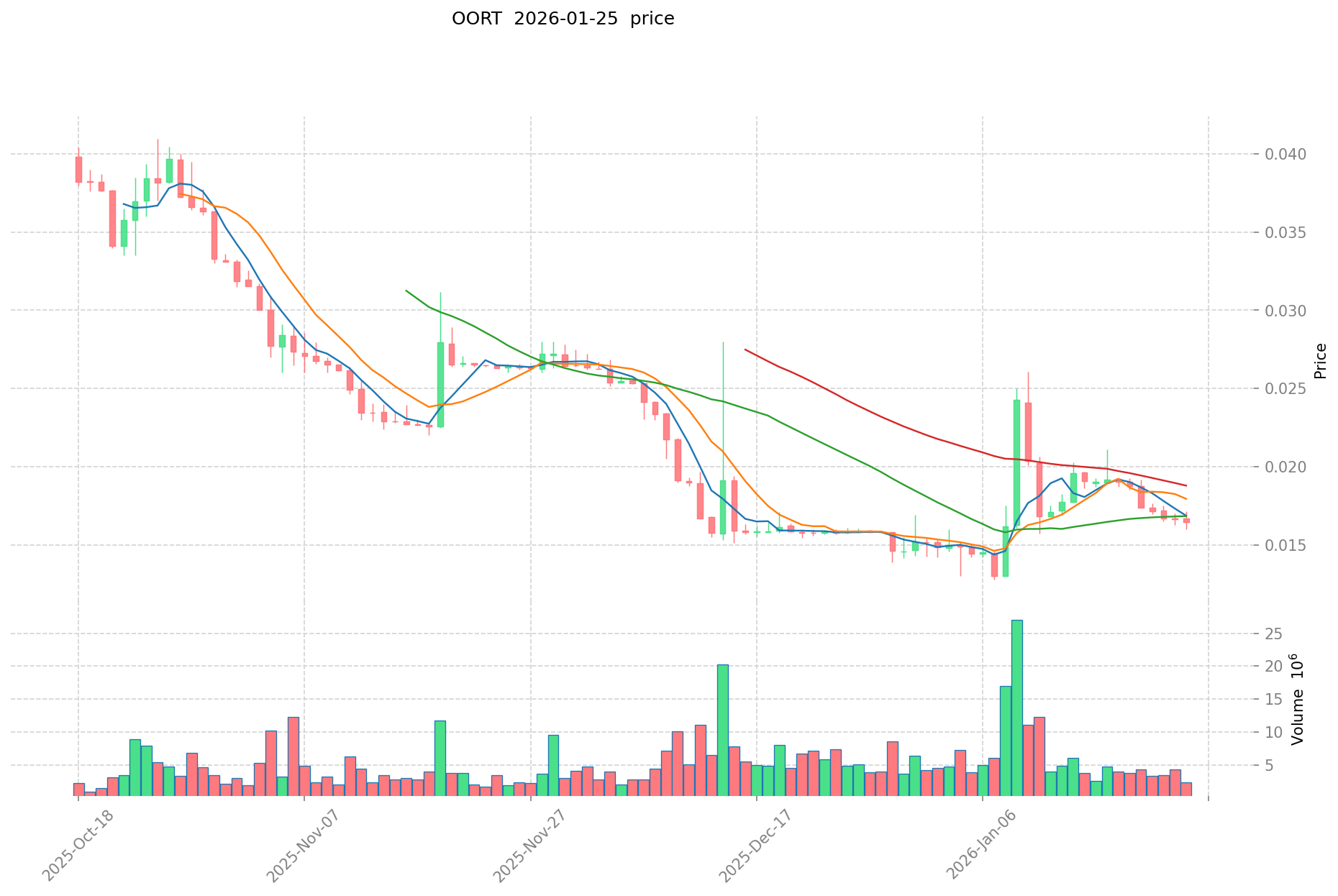
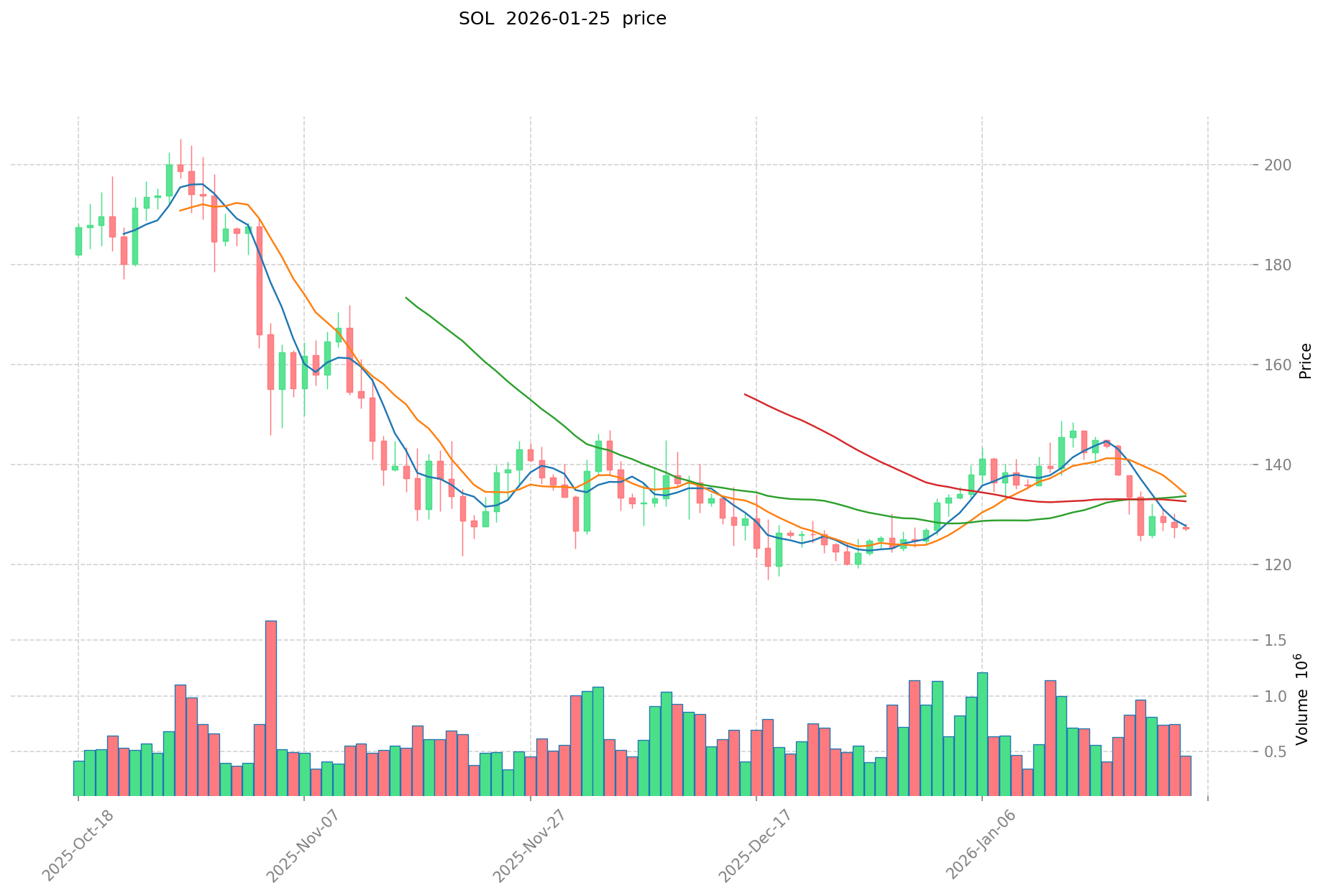
- Comparative Analysis: During recent market cycles, OORT declined from its peak of $1.22 to a low of $0.01276 recorded on January 7, 2026, representing a substantial correction. Meanwhile, SOL demonstrated relatively stronger resilience, though it also experienced a decline from its January 2025 peak to current levels around $125.56.
Current Market Status (January 26, 2026)
- OORT current price: $0.01635
- SOL current price: $125.56
- 24-hour trading volume: OORT $37,088.98 vs SOL $70,192,935.06
- Market sentiment index (Fear & Greed Index): 25 (Extreme Fear)
View real-time prices:
- Check OORT current price Market Price
- Check SOL current price Market Price
II. Core Factors Affecting OORT vs SOL Investment Value
Supply Mechanism Comparison (Tokenomics)
Due to limited available data on the specific tokenomics structures of OORT and SOL, a detailed comparison of their supply mechanisms cannot be provided at this time. Generally, understanding whether a token employs a fixed supply model, deflationary mechanism, or inflationary distribution schedule is crucial for evaluating long-term value trajectories.
Institutional Adoption and Market Application
Institutional Holdings: Information regarding institutional preference between OORT and SOL is not currently available in the reference materials.
Enterprise Adoption: Comparative data on OORT and SOL applications in cross-border payments, settlement systems, or institutional investment portfolios is not provided in the available resources.
National Policy: Specific regulatory attitudes from different jurisdictions toward OORT and SOL cannot be determined from the current materials.
Technical Development and Ecosystem Building
OORT Technical Upgrades: Details on recent or planned technical upgrades for OORT and their potential market impact are not available in the reference materials.
SOL Technical Development: Information on Solana's ongoing technical development initiatives and their implications is not provided in the available resources.
Ecosystem Comparison: A comprehensive comparison of DeFi, NFT, payment solutions, and smart contract deployment between OORT and SOL ecosystems cannot be conducted based on the current materials.
Macroeconomic Environment and Market Cycles
Performance in Inflationary Environment: Data comparing the inflation-hedge characteristics of OORT versus SOL is not available in the reference materials.
Macroeconomic Monetary Policy: The specific impacts of interest rate changes and US dollar index fluctuations on OORT and SOL cannot be assessed from the current resources.
Geopolitical Factors: Information on how cross-border transaction demand and international circumstances affect the relative positioning of OORT and SOL is not provided in the available materials.
III. 2026-2031 Price Prediction: OORT vs SOL
Short-term Forecast (2026)
- OORT: Conservative $0.0154 - $0.0162 | Optimistic $0.0162 - $0.0199
- SOL: Conservative $85.05 - $123.26 | Optimistic $123.26 - $133.12
Medium-term Forecast (2028-2029)
- OORT may enter a gradual growth phase, with projected price range of $0.0153 - $0.0283 in 2028 and $0.0204 - $0.0311 in 2029
- SOL may enter a consolidation and expansion phase, with projected price range of $128.06 - $172.17 in 2028 and $81.76 - $177.67 in 2029
- Key drivers: institutional capital inflows, ETF developments, ecosystem expansion
Long-term Forecast (2030-2031)
- OORT: Baseline scenario $0.0210 - $0.0280 (2030) | Optimistic scenario $0.0250 - $0.0414 (2031)
- SOL: Baseline scenario $88.75 - $167.45 (2030) | Optimistic scenario $113.88 - $203.96 (2031)
View detailed price predictions for OORT and SOL
Disclaimer
OORT:
| Year |
Predicted High Price |
Predicted Average Price |
Predicted Low Price |
Price Change |
| 2026 |
0.0199137 |
0.01619 |
0.0153805 |
0 |
| 2027 |
0.0250920715 |
0.01805185 |
0.0110116285 |
10 |
| 2028 |
0.0282592685825 |
0.02157196075 |
0.0153160921325 |
32 |
| 2029 |
0.031144518332812 |
0.02491561466625 |
0.020430804026325 |
52 |
| 2030 |
0.041484498419306 |
0.028030066499531 |
0.021022549874648 |
71 |
| 2031 |
0.041361166126708 |
0.034757282459418 |
0.025025243370781 |
112 |
SOL:
| Year |
Predicted High Price |
Predicted Average Price |
Predicted Low Price |
Price Change |
| 2026 |
133.1208 |
123.26 |
85.0494 |
-1 |
| 2027 |
156.392288 |
128.1904 |
71.786624 |
2 |
| 2028 |
172.17252624 |
142.291344 |
128.0622096 |
13 |
| 2029 |
177.6720866856 |
157.23193512 |
81.7606062624 |
25 |
| 2030 |
172.475571229884 |
167.4520109028 |
88.749565778484 |
33 |
| 2031 |
203.9565492796104 |
169.963791066342 |
113.87574001444914 |
35 |
IV. Investment Strategy Comparison: OORT vs SOL
Long-term vs Short-term Investment Strategies
- OORT: May appeal to investors focused on emerging AI infrastructure narratives and speculative opportunities in early-stage projects with significant volatility potential
- SOL: May suit investors seeking exposure to established blockchain ecosystems with demonstrated network effects, DeFi integration, and broader market liquidity
Risk Management and Asset Allocation
- Conservative Investors: OORT 5-10% vs SOL 15-25% (prioritizing established assets with deeper liquidity)
- Aggressive Investors: OORT 15-25% vs SOL 25-35% (accepting higher volatility for potential asymmetric returns)
- Hedging Tools: Stablecoin reserves, options strategies, cross-asset diversification across multiple blockchain protocols
V. Potential Risk Comparison
Market Risk
- OORT: Extreme volatility evidenced by decline from $1.22 to $0.01635, limited trading volume of $37,088.98 (24h), susceptibility to low-liquidity market dynamics
- SOL: Substantial price fluctuations between $0.500801 and $293.31 historically, though with significantly higher liquidity demonstrated by $70,192,935.06 in 24-hour trading volume
Technical Risk
- OORT: Scalability challenges inherent in decentralized AI infrastructure, dependency on global computing resource integration, limited track record since 2024 launch
- SOL: Network stability concerns related to historical outages, ongoing development requirements for sustained scalability, ecosystem dependency on continuous technical innovation
Regulatory Risk
- Global regulatory frameworks may impact both assets differently, with established protocols like SOL potentially facing greater scrutiny due to market prominence, while newer projects like OORT may encounter uncertainty regarding classification and compliance requirements across jurisdictions
VI. Conclusion: Which Is the Better Buy?
📌 Investment Value Summary:
- OORT Advantages: Early-stage positioning in decentralized AI infrastructure sector, potential for significant appreciation if adoption accelerates, lower entry price point
- SOL Advantages: Established ecosystem with proven use cases, substantially higher liquidity and trading volume, broader institutional recognition and market integration
✅ Investment Recommendations:
- Novice Investors: Consider SOL for exposure to established blockchain infrastructure with greater liquidity, limiting allocation to 5-10% of crypto portfolio while maintaining substantial stablecoin reserves
- Experienced Investors: Evaluate portfolio diversification strategies incorporating both assets, with OORT representing higher-risk/higher-potential allocation (5-15%) and SOL forming core blockchain exposure (15-30%)
- Institutional Investors: Focus on SOL for deeper liquidity requirements and established market infrastructure, potentially incorporating OORT as minimal exploratory allocation pending further ecosystem maturation
⚠️ Risk Warning: Cryptocurrency markets exhibit extreme volatility. This analysis does not constitute investment advice. Conduct thorough due diligence and consider consulting qualified financial advisors before making investment decisions.
VII. FAQ
Q1: What is the main difference between OORT and SOL in terms of use cases?
OORT focuses on decentralized AI infrastructure with emphasis on data privacy and cost optimization, while SOL (Solana) serves as a high-performance blockchain protocol for scalability across various applications. OORT, launched in 2024, integrates global computing and storage resources to support trustworthy AI applications, representing an emerging sector within crypto. In contrast, SOL, established in 2020, has developed a mature ecosystem encompassing DeFi, NFTs, and smart contracts, positioning itself as general-purpose blockchain infrastructure rather than AI-specific solutions.
Q2: Which asset has better liquidity for trading?
SOL demonstrates significantly superior liquidity with 24-hour trading volume of $70,192,935.06 compared to OORT's $37,088.98. This substantial difference—approximately 1,900 times greater volume—means SOL offers easier entry and exit positions, tighter bid-ask spreads, and reduced slippage risk. For investors prioritizing portfolio liquidity and the ability to execute larger transactions without material price impact, SOL presents clear advantages over OORT's limited market depth.
Q3: How have OORT and SOL performed since their respective launches?
OORT reached its all-time high of $1.22 shortly after launching in January 2024 but subsequently declined 98.7% to $0.01276 by January 2026, reflecting extreme volatility typical of new token launches. SOL has demonstrated more established price action, rising from its May 2020 low of $0.500801 to an all-time high of $293.31 in January 2025—representing approximately 58,500% growth—though it has since corrected to around $125.56. SOL's longer track record and higher absolute price levels indicate greater market validation compared to OORT's early-stage performance.
Q4: What are the primary risks associated with investing in OORT versus SOL?
OORT carries higher risks due to limited liquidity ($37,088.98 daily volume), extreme price volatility (98.7% decline from peak), and unproven technology since its 2024 launch in the nascent decentralized AI infrastructure sector. SOL presents more moderate risks including historical network stability concerns, regulatory scrutiny associated with established protocols, and substantial though less extreme price fluctuations. Both assets face regulatory uncertainty, but OORT's lower liquidity amplifies downside risk potential, while SOL's market prominence may attract greater regulatory attention.
Q5: Which asset is more suitable for conservative investors?
SOL is more appropriate for conservative crypto investors seeking blockchain exposure. Its established ecosystem, substantially higher liquidity, broader institutional recognition, and four-year operational history provide relatively greater stability within the volatile cryptocurrency market. Conservative portfolios might allocate 15-25% to SOL while limiting OORT exposure to 5-10% or avoiding it entirely. The dramatic price decline and limited trading volume of OORT make it unsuitable for risk-averse investment strategies, whereas SOL offers demonstrated network effects and market integration despite inherent crypto volatility.
Q6: What factors could drive future price appreciation for OORT and SOL?
OORT's potential appreciation depends on successful adoption of its decentralized AI infrastructure, expansion of computing resource integration, and growing demand for privacy-focused AI solutions—all contingent on technology validation and ecosystem development. SOL's price drivers include continued ecosystem expansion across DeFi and NFTs, resolution of historical network stability issues, potential institutional adoption through investment products, and broader blockchain scalability achievements. Both assets may benefit from favorable cryptocurrency market cycles and regulatory clarity, though SOL's established position provides more diversified catalysts compared to OORT's concentrated AI infrastructure thesis.
Q7: How do the 2026-2031 price predictions compare between OORT and SOL?
Price predictions suggest modest growth trajectories for both assets with substantial uncertainty. OORT projections range from conservative estimates of $0.0154-$0.0162 in 2026 to optimistic scenarios reaching $0.0414 by 2031, representing potential returns of 71-112% from 2026 baselines. SOL predictions span from conservative $85.05-$123.26 in 2026 to optimistic $203.96 by 2031, indicating potential 35% growth from 2026 averages. These forecasts reflect OORT's higher percentage appreciation potential from lower base prices versus SOL's more moderate growth from established valuation levels, though both projections carry significant uncertainty inherent in cryptocurrency price modeling.
Q8: Should investors choose OORT or SOL for portfolio diversification?
Experienced investors might incorporate both assets serving different portfolio functions: SOL as core blockchain infrastructure exposure (15-30% of crypto allocation) providing established ecosystem access and liquidity, and OORT as speculative positioning (5-15%) in emerging AI infrastructure with asymmetric return potential. This approach balances SOL's relative stability and proven use cases against OORT's higher-risk/higher-potential early-stage characteristics. However, novice investors should prioritize SOL's greater liquidity and market validation while maintaining substantial stablecoin reserves, potentially avoiding OORT entirely until demonstrating sustained adoption and reduced volatility.
* The information is not intended to be and does not constitute financial advice or any other recommendation of any sort offered or endorsed by Gate.