This comprehensive analysis compares OM and FIL as leading decentralized solutions within distinct market sectors. OM, launched in August 2020, functions as a governance token within the MANTRA DAO ecosystem, focusing on DeFi protocol participation, while FIL, operational since October 2020, serves as the core infrastructure token for distributed storage networks. The article examines critical investment factors including historical price trends showing both tokens declined significantly from their peaks, current market capitalizations with FIL maintaining $1.16B versus OM's $89.03M, and tokenomics differences between governance and infrastructure models. It provides detailed price predictions spanning 2026-2031, compares institutional adoption patterns, analyzes technical ecosystems, and evaluates regulatory landscapes. The analysis addresses key investment questions through risk assessments, allocation strategies for different investor types, and market cycle considerations, helping readers understand which
Introduction: Investment Comparison Between OM and FIL
In the cryptocurrency market, the comparison between OM vs FIL has consistently been a topic that investors cannot overlook. Both assets exhibit notable differences in market capitalization ranking, use cases, and price performance, representing distinct positioning within the crypto asset landscape.
OM (MANTRA): Launched in August 2020, this security-first RWA Layer 1 blockchain has gained market recognition for its capability to adhere to and enforce real-world regulatory requirements, designed specifically for institutions and developers.
FIL (Filecoin): Since its launch in October 2020, it has been recognized as a decentralized storage solution built on IPFS, operating through a unique proof-of-work mechanism that rewards miners based on contributed storage capacity.
This article will provide a comprehensive analysis of the investment value comparison between OM vs FIL, examining historical price trends, supply mechanisms, institutional adoption, technical ecosystems, and future projections, attempting to address investors' most pressing question:
"Which is the better buy right now?"
I. Historical Price Comparison and Current Market Status
Historical Price Trends of OM (Coin A) and FIL (Coin B)
- 2021: FIL experienced notable price movements following its mainnet launch, with the price reaching an all-time high of $236.84 on April 1, 2021.
- 2023: OM recorded its historical low of $0.01726188 on October 13, 2023, reflecting a period of market contraction.
- 2025: OM reached an all-time high of $8.99 on February 23, 2025, demonstrating significant appreciation from its previous lows.
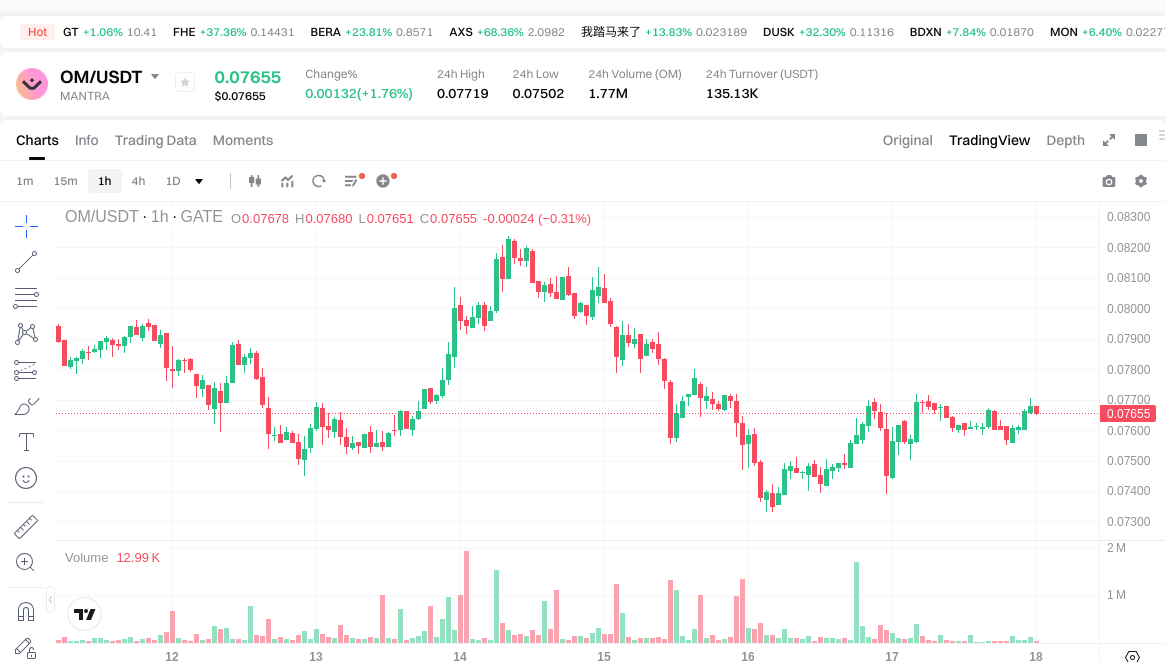
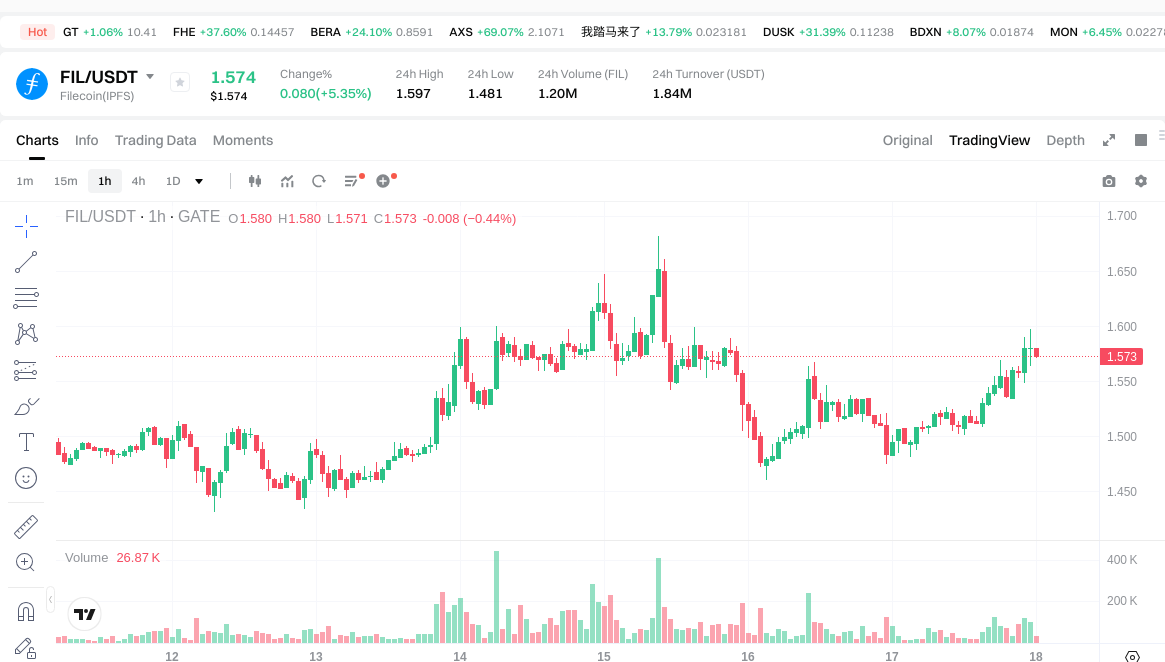
- Comparative analysis: During the recent market cycle, OM declined from its peak of $8.99 to the current level of $0.07665, representing a decline of approximately 99.15%, while FIL decreased from its historical high of $236.84 to $1.577, reflecting a decline of approximately 99.33%.
Current Market Situation (January 18, 2026)
- OM current price: $0.07665
- FIL current price: $1.577
- 24-hour trading volume: OM recorded $139,847.44 compared to FIL's $1,827,028.84
- Market capitalization: OM stands at $89.03M while FIL maintains $1.16B
- Market sentiment index (Fear & Greed Index): 50 (Neutral)
View real-time prices:
- Check OM current price Market Price
- Check FIL current price Market Price
II. Core Factors Influencing OM vs FIL Investment Value
Supply Mechanism Comparison (Tokenomics)
- OM: Functions as the core governance and utility token within the MANTRA DAO ecosystem, initially launched in 2020 as an ERC-20 standard token. The supply mechanism is designed to support DeFi operations and governance participation.
- FIL: Serves as the core token for distributed storage and retrieval networks. As cloud computing and big data applications expand, market demand for FIL tokens may continue to grow, reflecting the increasing need for decentralized storage solutions.
- 📌 Historical Pattern: Supply mechanisms play a role in shaping token price cycles, with governance-focused tokens and utility-driven tokens responding differently to market adoption phases and technological milestone achievements.
Institutional Adoption and Market Application
- Institutional Holdings: Both tokens serve distinct market segments - OM targets the DeFi governance space while FIL addresses distributed storage infrastructure needs. Institutional preference depends on strategic focus areas and sector exposure objectives.
- Enterprise Adoption: OM operates within decentralized finance applications, primarily focusing on governance and DeFi protocol participation. FIL finds applications in distributed storage networks, serving enterprises requiring decentralized data storage and retrieval solutions.
- National Policies: Regulatory attitudes toward both tokens vary across jurisdictions, influenced by their respective roles in DeFi ecosystems and data storage infrastructure. Policy frameworks continue to evolve as these sectors mature.
Technology Development and Ecosystem Building
- OM Technology: As a component of MANTRA DAO, OM supports DeFi operations and governance mechanisms within its ecosystem. Development focuses on enhancing governance capabilities and protocol integration.
- FIL Technology: Development centers on improving distributed storage network efficiency and expanding retrieval capabilities. Technology advancement aims to meet growing demand from cloud computing and data storage sectors.
- Ecosystem Comparison: OM concentrates on DeFi governance and protocol participation, while FIL emphasizes distributed storage infrastructure. Both ecosystems serve different market needs, with varying levels of integration in smart contracts and decentralized applications.
Macroeconomic Environment and Market Cycles
- Inflationary Environment Performance: Both tokens respond to macroeconomic conditions through their respective sector dynamics. OM's performance relates to DeFi sector health, while FIL's value connects to data storage demand trends.
- Macroeconomic Monetary Policy: Interest rate changes and dollar index movements affect both tokens through broader cryptocurrency market sentiment and sector-specific capital flows.
- Geopolitical Factors: Cross-border transaction requirements and international developments influence adoption patterns for both tokens, with varying impact depending on their primary use cases and target markets.
III. 2026-2031 Price Prediction: OM vs FIL
Short-term Prediction (2026)
- OM: Conservative $0.064-$0.077 | Optimistic $0.077-$0.102
- FIL: Conservative $1.16-$1.57 | Optimistic $1.57-$2.19
Mid-term Prediction (2028-2029)
- OM may enter a consolidation phase with estimated price range of $0.064-$0.158
- FIL may enter a growth phase with estimated price range of $1.91-$3.12
- Key drivers: institutional capital inflows, ETF developments, ecosystem expansion
Long-term Prediction (2030-2031)
- OM: Baseline scenario $0.083-$0.154 | Optimistic scenario $0.170-$0.200
- FIL: Baseline scenario $2.49-$2.96 | Optimistic scenario $3.08-$3.43
View detailed price predictions for OM and FIL
Disclaimer
OM:
| Year |
Predicted High Price |
Predicted Average Price |
Predicted Low Price |
Price Change |
| 2026 |
0.1018115 |
0.07655 |
0.064302 |
0 |
| 2027 |
0.101666055 |
0.08918075 |
0.0597511025 |
16 |
| 2028 |
0.140272401675 |
0.0954234025 |
0.063933679675 |
24 |
| 2029 |
0.15791618879725 |
0.1178479020875 |
0.0895644055865 |
53 |
| 2030 |
0.169594915894121 |
0.137882045442375 |
0.097896252264086 |
79 |
| 2031 |
0.199860024868722 |
0.153738480668248 |
0.083018779560853 |
100 |
FIL:
| Year |
Predicted High Price |
Predicted Average Price |
Predicted Low Price |
Price Change |
| 2026 |
2.18786 |
1.574 |
1.16476 |
0 |
| 2027 |
2.6709206 |
1.88093 |
1.8056928 |
19 |
| 2028 |
2.799388119 |
2.2759253 |
1.911777252 |
44 |
| 2029 |
3.121317752685 |
2.5376567095 |
2.18238477017 |
60 |
| 2030 |
3.084141081890825 |
2.8294872310925 |
2.4899487633614 |
79 |
| 2031 |
3.429904421530328 |
2.956814156491662 |
2.631564599277579 |
87 |
IV. Investment Strategy Comparison: OM vs FIL
Long-term vs Short-term Investment Strategies
- OM: May appeal to investors focused on DeFi governance participation and decentralized protocol ecosystems, with positioning suitable for those monitoring governance token dynamics and DeFi sector developments.
- FIL: May attract investors interested in distributed storage infrastructure and data economy trends, with characteristics aligning with those seeking exposure to decentralized cloud storage sector growth.
Risk Management and Asset Allocation
- Conservative investors: OM 30% vs FIL 70% (reflecting market capitalization differential and established infrastructure)
- Aggressive investors: OM 50% vs FIL 50% (balanced exposure to both governance and storage sectors)
- Hedging instruments: stablecoin allocation, options strategies, cross-asset portfolio diversification
V. Potential Risk Comparison
Market Risks
- OM: Exposure to DeFi sector volatility, governance token market dynamics, and adoption rate fluctuations within decentralized finance protocols.
- FIL: Subject to distributed storage sector competition, network utilization rates, and demand cycles in cloud storage and data management industries.
Technical Risks
- OM: Scalability considerations, protocol integration complexity, and governance mechanism effectiveness.
- FIL: Network capacity expansion challenges, storage provider concentration patterns, and distributed system security considerations.
Regulatory Risks
- Regulatory frameworks affecting both tokens differ based on their functional classifications - governance tokens face scrutiny around securities regulations, while storage network tokens encounter data sovereignty and infrastructure compliance requirements across various jurisdictions.
VI. Conclusion: Which Is the Better Buy?
📌 Investment Value Summary:
- OM advantages: Positioned within the DeFi governance sector with focus on protocol participation; demonstrated price recovery from 2023 lows to 2025 peaks; serves ecosystem governance functions.
- FIL advantages: Established presence in distributed storage infrastructure; larger market capitalization of $1.16B; addresses growing data storage and retrieval market demands; longer operational history since October 2020.
✅ Investment Recommendations:
- Novice investors: Consider initiating positions with smaller allocations while studying both sectors; prioritize understanding fundamental differences between governance tokens and infrastructure tokens; utilize dollar-cost averaging strategies.
- Experienced investors: Evaluate portfolio exposure to DeFi governance versus storage infrastructure sectors; assess risk tolerance relative to market capitalization differentials; monitor ecosystem development milestones and adoption metrics.
- Institutional investors: Conduct comprehensive due diligence on regulatory compliance frameworks; evaluate sector allocation strategies based on investment mandates; consider both tokens' roles within broader digital asset portfolios.
⚠️ Risk Warning: Cryptocurrency markets exhibit substantial volatility. This content does not constitute investment advice.
VII. FAQ
Q1: What are the main differences between OM and FIL in terms of their core functions?
OM serves as a governance and utility token within the MANTRA DAO ecosystem, focusing on DeFi protocol participation and decentralized governance mechanisms. FIL operates as the core token for Filecoin's distributed storage network, incentivizing storage providers and facilitating decentralized data storage and retrieval services. The fundamental distinction lies in their target sectors: OM addresses DeFi governance needs while FIL provides infrastructure for decentralized cloud storage solutions.
Q2: Which token experienced a smaller decline from its all-time high?
OM declined approximately 99.15% from its peak of $8.99 to the current level of $0.07665, while FIL decreased approximately 99.33% from its historical high of $236.84 to $1.577. While both tokens experienced substantial corrections from their respective peaks, OM's decline was marginally smaller. However, it's important to note that FIL's peak occurred during the 2021 bull market, whereas OM's peak was reached in early 2025, representing different market cycle contexts.
Q3: What is the market capitalization difference between OM and FIL as of January 18, 2026?
FIL maintains a significantly larger market capitalization of $1.16B compared to OM's $89.03M, representing approximately a 13-fold difference. This substantial disparity reflects FIL's more established market position, longer operational history since October 2020, and broader adoption in the distributed storage infrastructure sector. The market cap differential suggests different risk-reward profiles for potential investors.
Q4: How do the price predictions for 2031 compare between OM and FIL?
For 2031, OM's predicted price range spans from $0.083 (low) to $0.200 (optimistic high), while FIL's forecasts range from $2.49 (low) to $3.43 (optimistic high). In percentage terms, OM shows a potential increase of approximately 100% from current levels by 2031, whereas FIL indicates a potential growth of around 87%. These projections suggest both tokens may experience modest appreciation over the long term, though predictions carry inherent uncertainty.
Q5: What are the recommended allocation strategies for different investor types?
Conservative investors might consider a 30% OM / 70% FIL allocation, reflecting FIL's larger market capitalization and established infrastructure. Aggressive investors could opt for a balanced 50% OM / 50% FIL split to gain exposure to both DeFi governance and storage sectors. Novice investors should begin with smaller positions while studying both ecosystems, utilizing dollar-cost averaging strategies to mitigate volatility risks.
Q6: What are the primary regulatory risks associated with each token?
OM faces regulatory scrutiny related to governance tokens and potential securities classifications within DeFi protocols, with compliance requirements varying across jurisdictions. FIL encounters regulatory considerations around data sovereignty, infrastructure compliance, and cross-border data storage regulations. Both tokens operate in evolving regulatory environments, with different compliance frameworks applicable to governance mechanisms versus storage infrastructure services.
Q7: How do institutional adoption patterns differ between OM and FIL?
Institutional interest in OM primarily stems from organizations focused on DeFi governance participation and decentralized protocol ecosystems. FIL attracts institutions requiring distributed storage solutions, including enterprises with significant data management needs and cloud storage requirements. The adoption patterns reflect distinct use cases: governance-oriented institutions versus infrastructure-focused entities seeking decentralized alternatives to traditional cloud storage providers.
Q8: What technological developments could impact the future value of these tokens?
OM's value trajectory depends on developments in DeFi governance mechanisms, protocol integration capabilities, and ecosystem expansion within decentralized finance. FIL's future performance relates to improvements in distributed storage network efficiency, storage provider network growth, and adoption by enterprises requiring decentralized data solutions. Both tokens' valuations are influenced by technological advancements in their respective sectors and broader trends in blockchain infrastructure adoption.
* The information is not intended to be and does not constitute financial advice or any other recommendation of any sort offered or endorsed by Gate.