This comprehensive article compares JUV and GRT tokens across multiple dimensions to guide investment decisions. JUV, a Juventus fan engagement token, differs fundamentally from GRT, a blockchain data indexing protocol, offering distinct market positioning and utility. The analysis examines historical price trends, current market status (JUV $0.6871 vs GRT $0.03621), tokenomics, institutional adoption, and technical ecosystems through 2031. Price forecasts project GRT with 110% growth potential versus JUV's 70% by 2031, though current market sentiment indicates extreme fear conditions. Investment strategies accommodate conservative to aggressive portfolios with differentiated risk profiles. The article emphasizes that neither token serves as standalone investments, highlighting sector-specific market risks and regulatory uncertainties while providing strategic allocation recommendations for diverse investor types on Gate trading platform.
Introduction: JUV vs GRT Investment Comparison
In the cryptocurrency market, the comparison between JUV vs GRT has consistently been a topic investors cannot overlook. These two tokens differ significantly in market capitalization ranking, application scenarios, and price performance, representing distinct positioning within the crypto asset landscape.
JUV (Juventus Fan Token): Launched in 2020, JUV has gained market recognition through its positioning as a fan engagement utility token, enabling Juventus football club supporters to participate in club governance decisions via the Socios platform built on Chiliz Chain.
GRT (The Graph): Since its debut in 2020, GRT has been recognized as a decentralized indexing and querying protocol for blockchain data, primarily serving the Ethereum ecosystem and facilitating data accessibility across decentralized applications.
This article will provide a comprehensive analysis of JUV vs GRT investment value comparison, examining historical price trends, supply mechanisms, institutional adoption, technical ecosystems, and future projections, while attempting to address the question investors care about most:
"Which is the better buy right now?"
I. Historical Price Comparison and Current Market Status
JUV (Coin A) and GRT (Coin B) Historical Price Trends
- 2020: JUV experienced significant volatility following its launch in December 2020, with price movements influenced by fan engagement activities on the Socios platform.
- 2021: GRT showed notable price appreciation in early 2021, with market activity related to the expansion of its decentralized indexing protocol for blockchain data.
- Comparative Analysis: During the 2020-2021 market cycle, JUV moved from its all-time high of $37.83 (December 21, 2020) to lower levels, while GRT reached its peak of $2.84 (February 12, 2021) before entering a correction phase.
Current Market Status (2026-01-26)
- JUV Current Price: $0.6871
- GRT Current Price: $0.03621
- 24-Hour Trading Volume: JUV $19,262.94 vs GRT $86,479.66
- Market Sentiment Index (Fear & Greed Index): 20 (Extreme Fear)
View real-time prices:
- Check JUV current price Market Price
- Check GRT current price Market Price
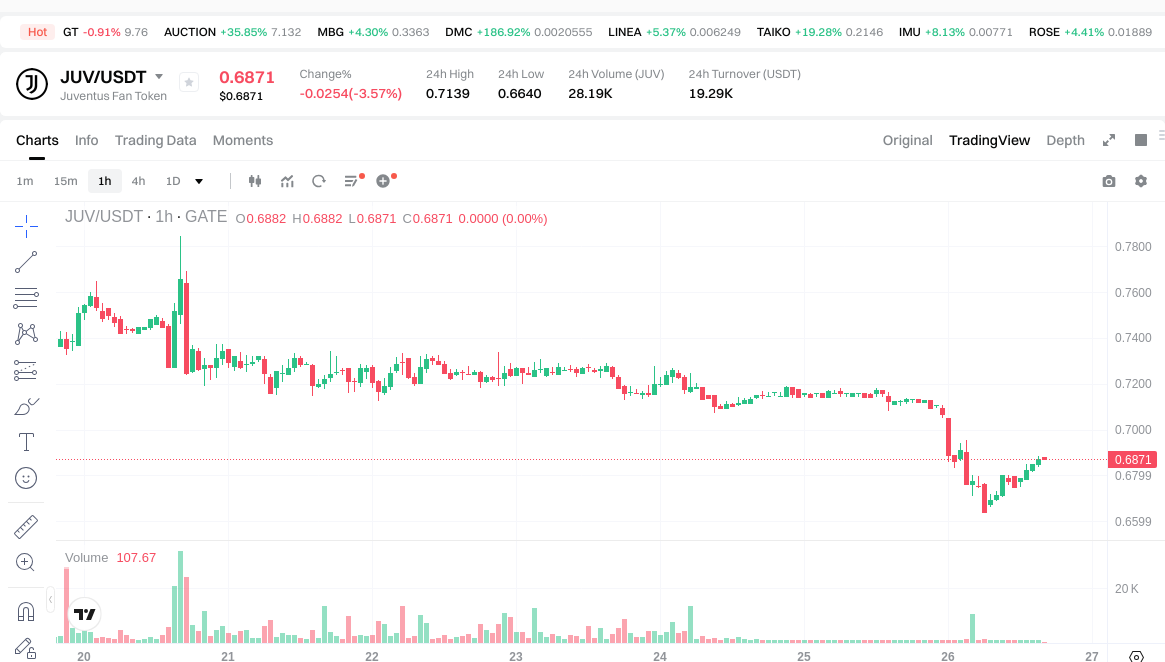
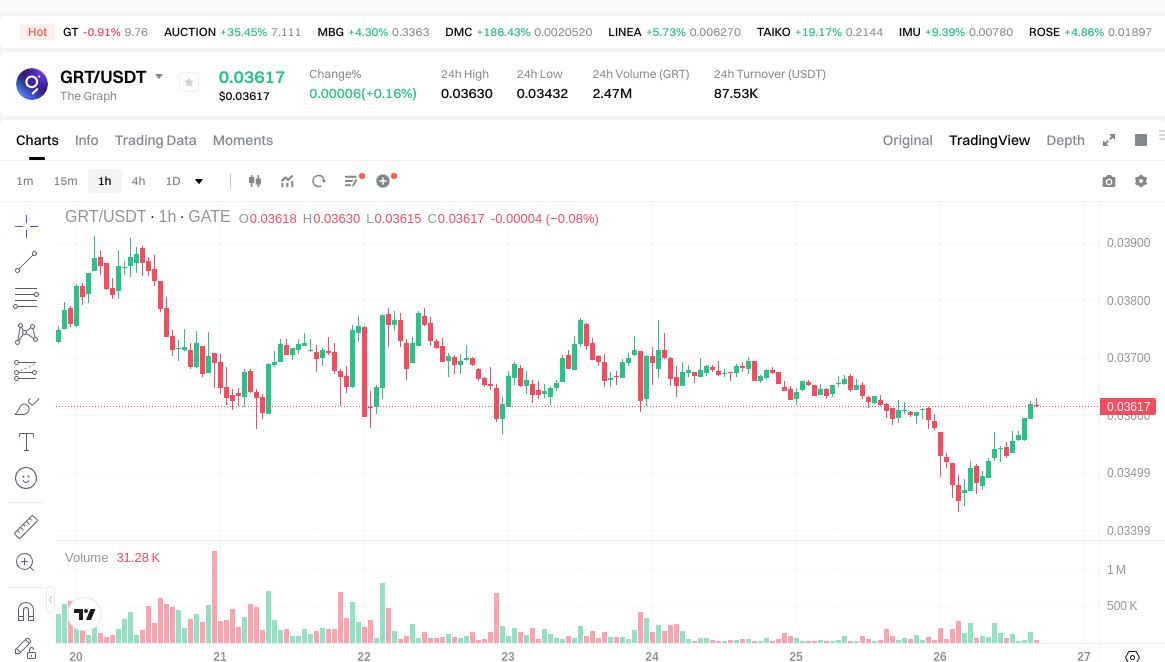
II. Core Factors Influencing JUV vs GRT Investment Value
Supply Mechanism Comparison (Tokenomics)
Due to insufficient reference materials regarding the supply mechanisms of JUV and GRT, this section cannot provide detailed comparative analysis at this time.
Institutional Adoption and Market Application
Without available data on institutional holdings, enterprise adoption patterns, or regulatory positions across different jurisdictions for JUV and GRT, a comprehensive comparison of their market application status cannot be established.
Technical Development and Ecosystem Construction
The reference materials do not contain sufficient information about technical upgrades, development roadmaps, or ecosystem implementations (including DeFi, NFT, payment systems, and smart contract deployments) for either JUV or GRT.
Macroeconomic Environment and Market Cycles
Given the absence of historical performance data and macroeconomic correlation analysis in the provided materials, assessments regarding inflation-hedging properties, monetary policy impacts (interest rates, dollar index fluctuations), and geopolitical factors affecting JUV and GRT cannot be made.
III. 2026-2031 Price Forecast: JUV vs GRT
Short-term Forecast (2026)
- JUV: Conservative $0.632132 - $0.6871 | Optimistic $0.6871 - $0.955069
- GRT: Conservative $0.0318296 - $0.03617 | Optimistic $0.03617 - $0.047021
Mid-term Forecast (2028-2029)
- JUV may enter a consolidation phase, with estimated prices ranging from $0.47220569595 to $1.369003013508375
- GRT may enter a growth phase, with estimated prices ranging from $0.0414956708 to $0.075025137822
- Key drivers: institutional capital inflows, ETF developments, ecosystem expansion
Long-term Forecast (2030-2031)
- JUV: Baseline scenario $0.667086298351053 - $1.150148790260437 | Optimistic scenario $1.196154741870855 - $1.513365778224683
- GRT: Baseline scenario $0.04550839866792 - $0.076163361659505 | Optimistic scenario $0.08912061405801 - $0.085302965058645
View detailed price predictions for JUV and GRT
Disclaimer
JUV:
| Year |
Predicted High Price |
Predicted Average Price |
Predicted Low Price |
Price Change |
| 2026 |
0.955069 |
0.6871 |
0.632132 |
0 |
| 2027 |
0.927825485 |
0.8210845 |
0.77181943 |
19 |
| 2028 |
0.988134141525 |
0.8744549925 |
0.47220569595 |
27 |
| 2029 |
1.369003013508375 |
0.9312945670125 |
0.521524957527 |
35 |
| 2030 |
1.196154741870855 |
1.150148790260437 |
0.667086298351053 |
67 |
| 2031 |
1.513365778224683 |
1.173151766065646 |
0.821206236245952 |
70 |
GRT:
| Year |
Predicted High Price |
Predicted Average Price |
Predicted Low Price |
Price Change |
| 2026 |
0.047021 |
0.03617 |
0.0318296 |
0 |
| 2027 |
0.05490606 |
0.0415955 |
0.03244449 |
14 |
| 2028 |
0.0545233814 |
0.04825078 |
0.0414956708 |
33 |
| 2029 |
0.075025137822 |
0.0513870807 |
0.047789985051 |
41 |
| 2030 |
0.08912061405801 |
0.063206109261 |
0.04550839866792 |
74 |
| 2031 |
0.085302965058645 |
0.076163361659505 |
0.061692322944199 |
110 |
IV. Investment Strategy Comparison: JUV vs GRT
Long-term vs Short-term Investment Strategies
- JUV: May appeal to investors interested in sports fan engagement platforms and utility token ecosystems, particularly those who value community-driven governance mechanisms in the sports entertainment sector.
- GRT: May attract investors focused on blockchain infrastructure and data indexing services, especially those seeking exposure to protocols that support decentralized application development.
Risk Management and Asset Allocation
- Conservative Investors: JUV 30% vs GRT 70% allocation could balance exposure between niche fan token markets and broader blockchain infrastructure services.
- Aggressive Investors: JUV 60% vs GRT 40% allocation might provide greater potential upside through concentrated positioning in emerging fan engagement platforms.
- Hedging Tools: Stablecoin allocations, options strategies, and cross-asset portfolio diversification can help manage volatility exposure.
V. Potential Risk Comparison
Market Risk
- JUV: Price movements may be influenced by football club performance, fan engagement levels, and the adoption rate of sports-related blockchain platforms, creating sector-specific volatility patterns.
- GRT: Market performance could be affected by competition from alternative data indexing solutions, changes in blockchain adoption rates, and shifts in decentralized application development trends.
Technical Risk
- JUV: Scalability considerations related to fan token platform infrastructure and network stability during high-traffic engagement events.
- GRT: Protocol reliability concerns, potential network congestion during peak query periods, and security considerations in decentralized indexing operations.
Regulatory Risk
- Global regulatory frameworks may treat fan tokens and blockchain infrastructure protocols differently, with potential variations in classification, compliance requirements, and jurisdictional oversight across different regions.
VI. Conclusion: Which Is the Better Buy?
📌 Investment Value Summary:
- JUV Advantages: Represents exposure to the intersection of sports entertainment and blockchain technology, with potential value derived from fan community engagement and platform utility features.
- GRT Advantages: Provides positioning in blockchain infrastructure services, with potential growth linked to the expansion of decentralized applications and data accessibility requirements.
✅ Investment Recommendations:
- New Investors: Consider starting with smaller allocations to understand market dynamics, focusing on fundamental research and gradual position building rather than large initial commitments.
- Experienced Investors: May evaluate diversified exposure across both assets based on risk tolerance, incorporating technical analysis and market cycle considerations into allocation decisions.
- Institutional Investors: Could assess both tokens within broader portfolio strategies, considering liquidity requirements, regulatory compliance frameworks, and correlation with existing holdings.
⚠️ Risk Disclosure: Cryptocurrency markets exhibit elevated volatility levels. This content does not constitute investment advice, financial guidance, or trading recommendations. Individuals should conduct independent research and consult qualified financial professionals before making investment decisions.
VII. FAQ
Q1: What are the main differences between JUV and GRT tokens?
JUV is a fan engagement utility token enabling Juventus supporters to participate in club governance decisions through the Socios platform, while GRT serves as a decentralized indexing and querying protocol for blockchain data primarily supporting the Ethereum ecosystem. JUV operates in the sports entertainment sector with community-driven governance mechanisms, whereas GRT functions as blockchain infrastructure providing data accessibility services for decentralized applications. Their fundamental purposes differ significantly—JUV focuses on fan participation and sports-related utility, while GRT addresses technical infrastructure needs in the blockchain data layer.
Q2: Which token shows better price performance potential through 2031?
Based on forecasted data, GRT demonstrates superior percentage growth potential with an estimated 110% price change by 2031 (predicted range: $0.061692 - $0.085303), compared to JUV's 70% estimated change (predicted range: $0.821206 - $1.513366). However, GRT currently trades at a significantly lower absolute price ($0.03621) versus JUV ($0.6871), meaning percentage gains may not translate to equivalent absolute dollar returns. Long-term performance will depend on factors including institutional adoption rates, ecosystem development, and sector-specific market dynamics affecting sports tokens versus blockchain infrastructure protocols.
Q3: How should conservative investors allocate between JUV and GRT?
Conservative investors may consider a 30% JUV and 70% GRT allocation strategy to balance exposure between niche fan token markets and broader blockchain infrastructure services. This allocation weights more heavily toward GRT's blockchain infrastructure positioning, which may offer greater diversification across decentralized application development trends. The lower JUV allocation limits exposure to sports entertainment sector volatility while maintaining potential upside from fan engagement platform growth. Conservative investors should complement this allocation with stablecoin holdings and implement appropriate risk management tools including stop-loss orders and periodic rebalancing.
Q4: What are the primary risks associated with investing in JUV?
JUV faces sector-specific market risks tied to football club performance, fan engagement fluctuations, and adoption rates of sports-related blockchain platforms. Technical risks include scalability considerations related to fan token platform infrastructure and network stability during high-traffic engagement events. Regulatory uncertainty represents another concern, as global frameworks may classify and regulate fan tokens differently across jurisdictions. Additionally, JUV's market capitalization and trading volume ($19,262.94 daily) suggest lower liquidity compared to broader market infrastructure tokens, potentially increasing price volatility and execution challenges during market stress periods.
Q5: What advantages does GRT offer for blockchain infrastructure exposure?
GRT provides direct exposure to critical blockchain infrastructure through its decentralized indexing protocol, which supports data accessibility requirements for decentralized applications. As blockchain adoption expands, demand for efficient data querying services may increase, potentially benefiting GRT's utility value. The protocol's focus on Ethereum ecosystem integration positions it within the largest smart contract platform network. GRT's higher daily trading volume ($86,479.66) compared to JUV suggests better liquidity characteristics. However, investors should consider competition from alternative data indexing solutions and the protocol's ability to maintain technical reliability during peak query periods.
Q6: How does the current market sentiment (Extreme Fear Index: 20) affect investment decisions?
The Extreme Fear Index reading of 20 indicates heightened market pessimism, which historically has sometimes preceded potential buying opportunities when fundamentals remain intact. However, extreme fear can also signal legitimate concerns about market conditions requiring caution. For JUV and GRT specifically, this sentiment may present accumulation opportunities for long-term investors with appropriate risk tolerance, but short-term traders should anticipate continued volatility. Conservative approaches include dollar-cost averaging to mitigate timing risks, implementing strict position sizing rules, and maintaining adequate liquidity reserves rather than deploying capital in single large transactions during uncertain market conditions.
Q7: What factors should institutional investors consider when evaluating JUV vs GRT?
Institutional investors should assess liquidity profiles, with GRT's higher trading volume potentially offering better execution characteristics for larger position sizes. Regulatory compliance frameworks differ between fan tokens and infrastructure protocols, requiring jurisdiction-specific legal analysis. Portfolio correlation considerations matter—JUV provides exposure to sports entertainment sector dynamics largely uncorrelated with traditional blockchain infrastructure, while GRT correlates more closely with decentralized application development trends. Custody solutions, reporting requirements, and governance participation mechanisms differ between these assets. Institutional allocations should also evaluate reputational considerations, as fan tokens and infrastructure protocols carry different stakeholder perception profiles in traditional finance contexts.
Q8: Can JUV and GRT serve as effective portfolio diversification tools?
JUV and GRT offer diversification across different blockchain application sectors—sports entertainment versus data infrastructure—which may exhibit low correlation during certain market conditions. However, both remain exposed to broader cryptocurrency market volatility and regulatory developments affecting the digital asset class overall. Effective diversification requires combining these tokens with traditional assets (equities, bonds, commodities) rather than relying solely on intra-crypto diversification. The distinct use cases mean sector-specific catalysts affect them differently: JUV responds to sports industry developments and fan engagement trends, while GRT reacts to decentralized application growth and blockchain data service demand. Neither should constitute more than a small percentage of a well-diversified investment portfolio.
* The information is not intended to be and does not constitute financial advice or any other recommendation of any sort offered or endorsed by Gate.