This comprehensive guide evaluates whether SKALE (SKL) represents a viable investment opportunity in 2024-2031. The article examines SKL's market position as an Ethereum-native, EVM-compatible Web3 infrastructure platform addressing blockchain scalability, currently trading at $0.010834 with a $65.68 million market capitalization. The analysis covers historical price trends, supply mechanics (6.06 billion tokens in circulation), institutional adoption factors, and technical advantages including zero gas fees and app-specific chain deployment. Short-term price forecasts range from $0.0066 to $0.0133, while long-term 2031 projections span $0.0136 to $0.0300 across various scenarios. Critical examination includes market risks (78.60% annual decline), regulatory uncertainties, technical vulnerabilities, and competitive pressures from alternative Layer-2 solutions. Investment recommendations differentiate strategies for beginners, experienced traders, and institutional investors, emphasizing secure storage on hard
Introduction: SKALE (SKL) Investment Position and Market Outlook
SKL is a notable asset in the cryptocurrency space, having been launched in 2020 through the SKALE Network project. As of January 2026, SKL maintains a market capitalization of approximately 65.68 million USD, with a circulating supply of around 6.06 billion tokens, and the current price hovering near 0.010834 USD. Positioned as an open-source Web3 platform focused on bringing speed and configurability to blockchain technology, SKALE has gradually become a focal point for investors exploring "Is SKALE (SKL) a good investment?" This article provides a comprehensive analysis of SKL's investment value, historical performance trends, future price projections, and associated investment risks to serve as a reference for potential investors.
I. SKL Price History and Current Investment Status
- 2021: SKL experienced notable price movements during its early trading period, with market participants observing price levels around 1.22 during March 2021.
- 2026: Market dynamics led to price adjustments, with SKL trading at approximately 0.009416 during early January 2026.
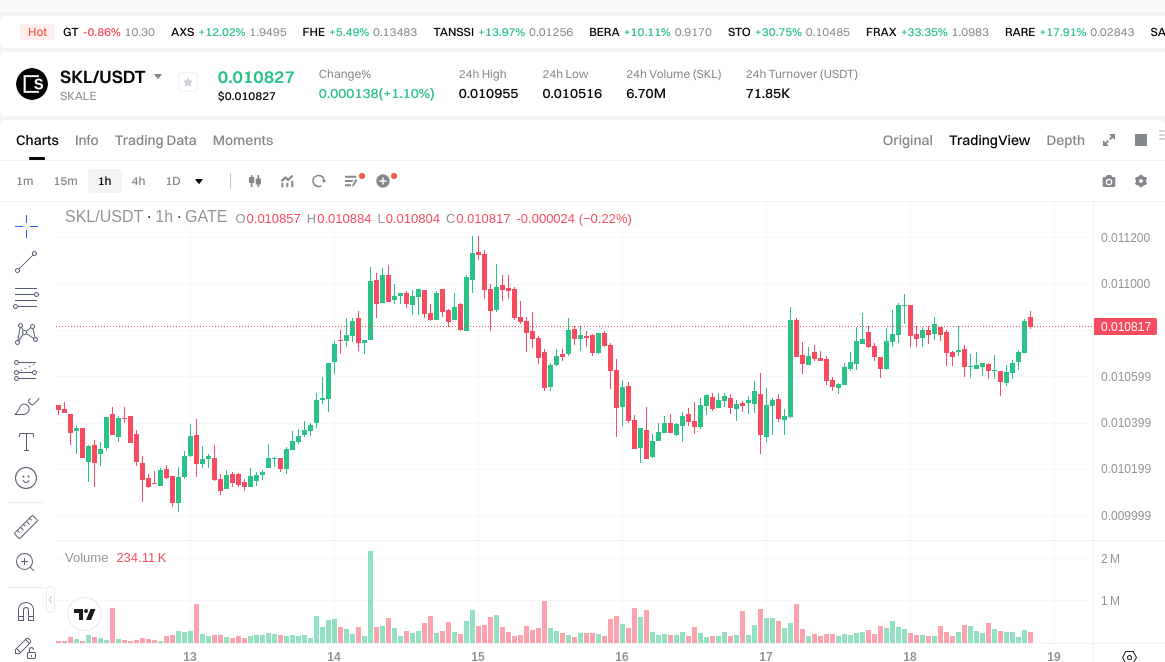
- Recent Period: The token has shown recovery from lower levels, currently trading at 0.010834, reflecting a 1.5% change in the 24-hour period.
Current SKL Investment Market Status (January 2026)
- SKL current price: 0.010834
- Market sentiment: Trading volume stands at 71,379.12 over the past 24 hours
- 24-hour trading activity: Price range between 0.010516 and 0.010955
- Market capitalization: Approximately 65.68 million with a circulating supply of 6.06 billion tokens
Click to view real-time SKL market price
II. Core Factors Influencing Whether SKL is a Good Investment
Supply Mechanism and Scarcity (SKL Investment Scarcity)
- Supply mechanism: SKALE has a fixed maximum supply of 7 billion SKL tokens, with approximately 6.06 billion tokens currently in circulation (86.6% of maximum supply).
- Historical patterns: The circulating supply ratio indicates the majority of tokens have been released into the market, which may affect future supply-side dynamics.
- Investment significance: The predetermined supply cap provides a transparent framework for evaluating scarcity, though the high circulation ratio suggests limited supply-side pressure in the near term.
Institutional Investment and Mainstream Adoption (Institutional Investment in SKL)
- Holder distribution: As of January 2026, SKALE has approximately 30,381 token holders across its network.
- Ecosystem partnerships: SKALE Labs, headquartered in San Francisco, California, collaborates with the NODE Foundation and various global entities to promote network development and adoption.
- Market presence: SKL is listed on 30 exchanges, indicating reasonable liquidity and accessibility for institutional participants.
Macroeconomic Environment's Impact on SKL Investment
- Market positioning: As an infrastructure-focused project addressing Ethereum scalability, SKL's investment appeal may be influenced by broader adoption trends in decentralized applications and blockchain infrastructure.
- Competitive landscape: SKALE operates in the competitive Layer-2 and blockchain scalability sector, where macroeconomic factors affecting technology adoption can influence investment outcomes.
- Risk considerations: The token has experienced notable volatility, with a 78.60% decline over the past year, reflecting sensitivity to broader market conditions.
Technology and Ecosystem Development (Technology & Ecosystem for SKL Investment)
- Core technology: SKALE is an Ethereum-native, EVM-compatible network of app-specific chains that offers zero gas fees and fast finality for decentralized applications.
- Technical advantages: By allowing developers to deploy dedicated, EVM-compatible blockchains, SKALE enables dApps to operate with high throughput and low latency while eliminating end-user gas fees.
- Governance utility: SKL token holders can participate in on-chain governance, voting on network parameters and future developments, which provides stakeholders with influence over the protocol's evolution.
- Ecosystem applications: The platform addresses network congestion on Ethereum and supports DeFi and dApp development through its scalable infrastructure solution.
III. SKL Future Investment Forecast and Price Outlook (Is SKALE(SKL) worth investing in 2026-2031)
Short-term Investment Forecast (2026, short-term SKL investment outlook)
- Conservative forecast: $0.0066 - $0.0108
- Neutral forecast: $0.0108 - $0.0120
- Optimistic forecast: $0.0120 - $0.0133
Based on current market dynamics, SKALE (SKL) demonstrates moderate short-term potential with predicted price ranges varying across different scenarios. The conservative estimate aligns with technical analysis suggesting a base support level, while the optimistic scenario considers potential improvements in network utilization driven by chain gaming and DeFi project demands for modular scalability solutions.
Mid-term Investment Outlook (2027-2029, mid-term SKALE(SKL) investment forecast)
-
Market stage expectation: Transition from consolidation phase to potential adoption acceleration. The period may witness intensified Layer2 competition alongside infrastructure maturation, with SKALE's elastic sidechain architecture potentially attracting developer communities seeking high-throughput environments.
-
Investment return forecast:
- 2027: $0.0083 - $0.0153 (estimated 11% price change from 2026)
- 2028: $0.0093 - $0.0196 (estimated 26% price change from 2026)
- 2029: $0.0155 - $0.0193 (estimated 53% price change from 2026)
-
Key catalysts: Technical protocol upgrades (such as potential SKALE 2.0 improvements targeting higher TPS capacity), expansion of node-as-a-service partnerships with cloud providers, and broader integration of perpetual contract trading pairs on centralized exchanges could enhance derivative market liquidity.
Long-term Investment Outlook (Is SKALE a good long-term investment?)
- Base scenario: $0.0136 - $0.0254 (2031, assuming steady network growth and sustained validator participation in the staking-burning economic model)
- Optimistic scenario: $0.0190 - $0.0300 (2031, conditional on mainstream CEX listing expansion and institutional capital inflows via node service infrastructure)
- Risk scenario: Below $0.0100 (under extreme conditions such as prolonged market downturn, critical security vulnerabilities, or failure to achieve competitive differentiation against rollup-focused scaling solutions)
View SKL long-term investment and price forecast: Price Prediction
2026-01-18 - 2031 Long-term Outlook
- Base scenario: $0.0136 - $0.0190 (corresponding to steady progress and gradual mainstream application improvement)
- Optimistic scenario: $0.0190 - $0.0300 (corresponding to large-scale adoption and favorable market environment)
- Transformative scenario: Above $0.0300 (contingent on breakthrough ecosystem developments and mainstream proliferation)
- 2031-12-31 predicted high: $0.0254 (based on optimistic development assumptions)
Disclaimer: All forecasts are derived from historical data analysis and market modeling. Cryptocurrency markets involve substantial volatility and risk. Price predictions do not constitute investment advice, and actual outcomes may differ significantly from projections. Investors should conduct independent research and consider their risk tolerance before making any investment decisions.
| Year |
Predicted High Price |
Predicted Average Price |
Predicted Low Price |
Price Change |
| 2026 |
0.01330245 |
0.010815 |
0.00659715 |
0 |
| 2027 |
0.01531458075 |
0.012058725 |
0.00832052025 |
11 |
| 2028 |
0.01957191361125 |
0.013686652875 |
0.009306923955 |
26 |
| 2029 |
0.019289968562025 |
0.016629283243125 |
0.015465233416106 |
53 |
| 2030 |
0.019935184751858 |
0.017959625902575 |
0.015086085758163 |
65 |
| 2031 |
0.02538952313847 |
0.018947405327216 |
0.013642131835595 |
74 |
IV. SKALE Investment Strategy and Risk Management (How to invest in SKALE)
Investment Methodology (SKALE investment strategy)
Long-term Holding (HODL SKALE)
For conservative investors seeking steady exposure to Web3 infrastructure projects, long-term holding of SKL tokens may align with a patient investment approach. This strategy typically involves:
- Accumulating tokens during market downturns or consolidation phases
- Holding through multiple market cycles to potentially benefit from network adoption growth
- Monitoring fundamental developments in SKALE Network's ecosystem expansion
Active Trading
Traders employing technical analysis may consider SKL's price movements, which have shown notable volatility. Recent data indicates 24-hour price fluctuations between 0.010516 and 0.010955, suggesting opportunities for short-term trading strategies. Active trading approaches include:
- Swing trading based on support and resistance levels
- Momentum trading during periods of increased volume
- Range trading within established price channels
Risk Management (Risk management for SKALE investment)
Asset Allocation Ratios
- Conservative investors: Consider allocating 1-3% of crypto portfolio to SKL
- Moderate investors: May allocate 3-7% depending on risk tolerance
- Experienced investors: Could allocate 7-15% as part of a diversified Web3 infrastructure strategy
Risk Hedging Approaches
Implementing diversification strategies may help manage exposure:
- Multi-asset portfolio: Combining SKL with established cryptocurrencies and stablecoins
- Sector diversification: Balancing Web3 infrastructure holdings with other blockchain categories
- Hedging tools: Utilizing stop-loss orders and position sizing to manage downside risk
Secure Storage Solutions
Given that SKL is an ERC-20 token on Ethereum (contract address: 0x00c83aecc790e8a4453e5dd3b0b4b3680501a7a7), investors should consider:
- Cold storage: Hardware wallets compatible with Ethereum tokens (Ledger, Trezor)
- Hot wallets: Secure software wallets for active trading (MetaMask, Trust Wallet)
- Exchange custody: Only for amounts intended for immediate trading
V. SKALE Investment Risks and Challenges (Risks of investing in SKALE)
Market Risks
SKL has demonstrated significant price volatility:
- Historical price range: From 0.00941605 to 1.22, representing substantial fluctuation
- One-year performance shows a decline of 78.60%, indicating considerable downside risk
- Current market capitalization of approximately 65.68 million suggests mid-cap volatility characteristics
- 24-hour trading volume of 71,379.12 may indicate liquidity considerations during volatile periods
Regulatory Risks
As a blockchain infrastructure project, SKALE faces evolving regulatory landscapes:
- Jurisdictional uncertainty: Regulatory treatment of utility tokens varies across different countries
- Compliance requirements: Potential changes in securities law interpretations may affect token classification
- Cross-border operations: SKALE Labs' operations in California and global validator network may face multiple regulatory frameworks
Technical Risks
Web3 infrastructure projects encounter specific technical challenges:
- Network security: As an open-source platform, smart contract vulnerabilities could pose risks
- Upgrade execution: Protocol upgrades and network modifications may encounter implementation challenges
- Validator dependency: Network security relies on validator participation and proper node operation
- Integration risks: Interoperability with Ethereum and other blockchain systems introduces technical dependencies
Market Position Risks
SKL represents 0.0019% of the total cryptocurrency market dominance, indicating:
- Limited market presence compared to major blockchain platforms
- Competition from established layer-2 scaling solutions and alternative Web3 platforms
- Adoption challenges in attracting developers and users to the ecosystem
VI. Conclusion: Is SKALE a Good Investment?
Investment Value Summary
SKALE presents characteristics typical of mid-stage Web3 infrastructure projects. With a circulating supply of 6.06 billion tokens (86.6% of total supply) and availability on 30 exchanges, the token demonstrates established market presence. However, the significant year-over-year decline of 78.60% reflects the challenges facing Web3 infrastructure projects in the current market environment.
The project's focus on bringing speed and configurability to blockchain technology addresses recognized scalability challenges, though execution risks and competitive pressures remain considerations for potential investors.
Investor Recommendations
✅ Beginners: Consider dollar-cost averaging with small allocations (1-2% of crypto portfolio) and prioritize secure storage using hardware wallets compatible with Ethereum tokens.
✅ Experienced Investors: May explore swing trading opportunities given the token's volatility patterns, while maintaining diversified positions across multiple Web3 infrastructure projects.
✅ Institutional Investors: Could evaluate strategic allocation as part of a broader Web3 infrastructure thesis, with appropriate due diligence on network development progress and adoption metrics.
⚠️ Disclaimer: Cryptocurrency investments carry substantial risk. This content is for informational purposes only and does not constitute investment advice. Historical performance, including SKL's decline from 1.22 to current levels, does not guarantee future results. Investors should conduct independent research and consult qualified financial advisors before making investment decisions.
VII. FAQ
Q1: Is SKALE (SKL) a good investment for beginners?
SKL may be suitable for beginners with limited exposure (1-2% of portfolio) and a high risk tolerance. As a mid-cap Web3 infrastructure token with a market capitalization of approximately 65.68 million USD, SKALE offers exposure to Ethereum scaling solutions. However, the token's 78.60% year-over-year decline and significant volatility (24-hour ranges between 0.010516 and 0.010955) indicate substantial risk. Beginners should prioritize secure storage using Ethereum-compatible hardware wallets, implement dollar-cost averaging strategies, and thoroughly research the project's technical fundamentals before investing.
Q2: What are the main use cases of SKL token?
SKL serves primarily as a governance and network utility token within the SKALE ecosystem. Token holders can participate in on-chain governance by voting on network parameters and protocol developments, directly influencing the platform's evolution. Additionally, SKL functions within SKALE's staking-burning economic model, where validators stake tokens to secure the network. The token's utility extends to enabling developers to deploy EVM-compatible chains with zero gas fees for end users, supporting decentralized applications across DeFi and gaming sectors.
Q3: How does SKALE's technology differentiate it from other Layer-2 solutions?
SKALE distinguishes itself through its elastic sidechain architecture and app-specific chain approach. Unlike traditional rollup-based Layer-2 solutions, SKALE provides developers with dedicated, EVM-compatible blockchains that offer zero gas fees for end users and fast finality. The platform's modular design allows for configurable blockchain environments tailored to specific application requirements, supporting high throughput and low latency. As an Ethereum-native solution, SKALE maintains compatibility with existing Ethereum tools and infrastructure while addressing network congestion through parallel chain deployment rather than single-chain scaling.
Q4: What price range can investors expect for SKL in 2027-2029?
Conservative mid-term forecasts suggest SKL may trade between $0.0083 and $0.0196 during 2027-2029, representing potential gains of 11% to 126% from current levels. The 2027 projection ranges from $0.0083 to $0.0153 (11% estimated change), 2028 from $0.0093 to $0.0196 (26% estimated change), and 2029 from $0.0155 to $0.0193 (53% estimated change). These projections assume continued network development, expansion of node-as-a-service partnerships, and growing adoption of SKALE's elastic sidechain architecture. However, actual outcomes may vary significantly based on competitive dynamics in the Layer-2 sector, protocol upgrade execution, and broader market conditions.
Q5: What are the biggest risks associated with investing in SKL?
The primary risks include market volatility (evidenced by 78.60% annual decline), technical vulnerabilities inherent in open-source blockchain platforms, and competitive pressure from established Layer-2 solutions. SKALE's limited market dominance (0.0019% of total crypto market) suggests adoption challenges, while its 86.6% circulating supply ratio reduces supply-side scarcity benefits. Regulatory uncertainty surrounding utility token classification across jurisdictions presents additional risk. Network security depends on sustained validator participation, and integration dependencies with Ethereum introduce technical risks. The 24-hour trading volume of 71,379.12 may also indicate liquidity constraints during volatile periods.
Q6: How should investors securely store SKL tokens?
Since SKL is an ERC-20 token on Ethereum (contract address: 0x00c83aecc790e8a4453e5dd3b0b4b3680501a7a7), investors should utilize Ethereum-compatible storage solutions. For long-term holdings, hardware wallets such as Ledger or Trezor provide optimal security through cold storage. Active traders may use secure software wallets like MetaMask or Trust Wallet for hot storage, ensuring strong passwords and two-factor authentication. Exchange custody should be limited to amounts intended for immediate trading, as centralized platforms carry counterparty risk. Investors should verify contract addresses before transactions and maintain backup recovery phrases in secure, offline locations.
Q7: What factors could drive SKL price appreciation in 2026-2031?
Key catalysts for potential price appreciation include protocol upgrades such as SKALE 2.0 targeting higher TPS capacity, expansion of partnerships with cloud providers for node-as-a-service infrastructure, and increased adoption by DeFi and gaming projects requiring modular scalability solutions. Mainstream CEX listing expansion and integration of perpetual contract trading pairs could enhance derivative market liquidity and attract institutional capital. Long-term appreciation to the optimistic 2031 range of $0.0190-$0.0300 would require sustained network growth, successful differentiation from rollup-focused competitors, and broader Web3 infrastructure adoption. However, these scenarios remain conditional on execution and favorable market conditions.
Q8: How does SKALE's token supply structure affect investment potential?
SKALE's fixed maximum supply of 7 billion SKL tokens provides transparency for scarcity evaluation. With approximately 6.06 billion tokens currently circulating (86.6% of maximum supply), the high circulation ratio suggests limited future supply-side pressure from new token releases. This supply structure differs from inflationary models but also means reduced scarcity-driven price appreciation potential compared to tokens with lower circulation ratios. The predetermined supply cap eliminates concerns about unexpected dilution, allowing investors to focus on demand-side factors such as network adoption, validator participation, and ecosystem growth when evaluating long-term investment potential.
* The information is not intended to be and does not constitute financial advice or any other recommendation of any sort offered or endorsed by Gate.