This comprehensive guide evaluates whether Polyhedra Network (ZKJ) represents a sound investment opportunity in 2024-2026. ZKJ, a Zero-Knowledge proof infrastructure provider, has established itself through zkBridge technology, processing over 20 million cross-chain transactions across 25+ blockchains. Currently trading at $0.03555 with a $15.38 million market cap, the token demonstrates significant technological utility but substantial volatility (1-year decline of -98.16%). The article examines ZKJ's technology fundamentals, historical price performance since its March 2024 launch, and provides tiered forecasts through 2031, ranging from conservative to optimistic scenarios. It addresses core investment considerations including supply scarcity, ecosystem expansion, and market risks. Strategic recommendations differentiate approaches for beginners, experienced traders, and institutional investors, emphasizing risk management through portfolio allocation and secure storage solutions. While ZKJ offers infrastr
Introduction: Polyhedra Network (ZKJ) Investment Position and Market Prospects
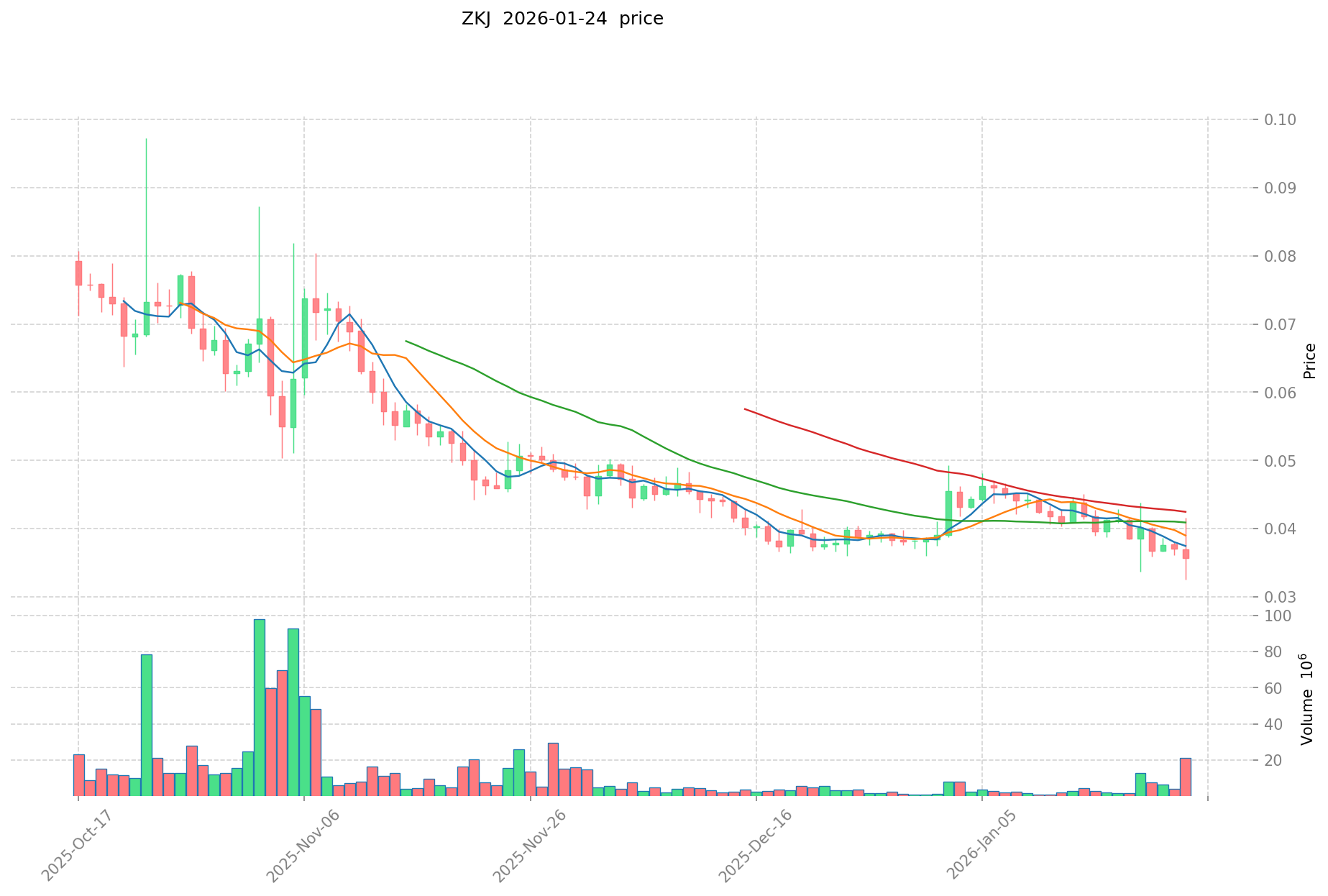
ZKJ is an important asset in the cryptocurrency field. Since its launch in 2024, it has achieved notable progress in the Web3 infrastructure and blockchain interoperability sectors. As of January 24, 2026, Polyhedra Network holds a market capitalization of approximately $15.38 million, with a circulating supply of around 432.61 million tokens, and the current price is maintained at approximately $0.03555. With its positioning as a Zero-Knowledge proof infrastructure provider, ZKJ has gradually become a focal point for investors discussing "Is Polyhedra Network (ZKJ) a good investment?" This article will comprehensively analyze the investment value, historical trends, future price predictions, and investment risks of ZKJ, providing reference for investors.
Polyhedra Network's mission centers on delivering fast Zero-Knowledge proofs to serve as underlying infrastructure for the Web3 ecosystem. The team has developed zkBridge, which facilitates cross-chain transactions. The project has processed over 20 million cross-chain transactions across more than 25 Layer-1 and Layer-2 blockchains. Currently, ZKJ is listed on 18 exchanges and has approximately 44,238 holders. The token operates on both ETH and BSC networks, with a total supply of 1 billion tokens and a circulating ratio of 43.26%. Recent market performance shows price fluctuations, with a 24-hour change of -4.28%, a 7-day change of -15.28%, and a 30-day change of -10.47%.
I. ZKJ Price History Review and Current Investment Value
- 2024: Token Launch in March → Price initially reached elevated levels following its debut on March 19, 2024, with the token trading at launch price of $1
- 2024-2025: Market Adjustment Period → ZKJ price experienced significant volatility, declining from higher price levels to lower trading ranges
- 2025: Extended Market Cycle → Price fluctuated within a range, touching a lower level of $0.02323 in October 2025
Current ZKJ Investment Market Status (January 2026)
- Current ZKJ Price: $0.03555
- Market Sentiment (Fear & Greed Index): Neutral sentiment observed in the broader crypto market
- 24-Hour Trading Volume: $773,619.32
- Market Capitalization: $15,379,324.96
- Circulating Supply: 432,611,110 ZKJ (43.26% of total supply)
- Holder Count: 44,238 addresses
Click to view real-time ZKJ market price
II. Core Factors Affecting Whether ZKJ is a Good Investment (Is Polyhedra Network(ZKJ) a Good Investment)
Supply Mechanism and Scarcity (ZKJ investment scarcity)
- Fixed supply mechanism with 1 billion maximum supply → influences price and investment value
- Current circulating supply of 432.61 million tokens represents 43.26% of total supply → potential supply expansion may affect scarcity dynamics
- Investment significance: scarcity characteristics remain a consideration for long-term investment evaluation
Technology & Ecosystem Development (Technology & Ecosystem for ZKJ investment)
- zkBridge technology: facilitates cross-chain interoperability with over 20 million cross-chain transactions processed → demonstrates technological utility and adoption
- Multi-chain ecosystem expansion: operational across more than 25 Layer-1 and Layer-2 blockchains → broadens network effects and use cases
- Zero-Knowledge proof infrastructure positioning: aims to provide foundational ZK proof services for Web3 ecosystem → potential for long-term value support through infrastructure role
- Cross-chain application scenarios: enhances interoperability solutions for blockchain networks → contributes to investment attractiveness through technical differentiation
III. ZKJ Future Investment Forecast and Price Outlook (Is Polyhedra Network (ZKJ) worth investing in 2026-2031)
Short-term Investment Forecast (2026, short-term ZKJ investment outlook)
- Conservative Forecast: $0.019359 - $0.03585
- Neutral Forecast: $0.03585
- Optimistic Forecast: $0.03585 - $0.05019
Mid-term Investment Outlook (2027-2029, mid-term Polyhedra Network (ZKJ) investment forecast)
-
Market Stage Expectation: The token may experience moderate growth phases as the zkBridge infrastructure continues facilitating cross-chain transactions across Layer-1 and Layer-2 networks, with potential adoption expansion in the Web3 ecosystem.
-
Investment Return Forecast:
- 2027: $0.0314046 - $0.0490428
- 2028: $0.040967946 - $0.048793284
- 2029: $0.04361935464 - $0.05262769962
-
Key Catalysts: Expansion of zkBridge network integrations, development of zero-knowledge proof infrastructure, and increased adoption of cross-chain solutions in the broader blockchain ecosystem.
Long-term Investment Outlook (Is Polyhedra Network a good long-term investment?)
-
Baseline Scenario: $0.035394166725156 - $0.05002002081 (assuming steady development of ZK infrastructure and maintained cross-chain transaction volume)
-
Optimistic Scenario: $0.05002002081 - $0.079491817071252 (assuming accelerated adoption of zero-knowledge protocols and expanded Layer-1/Layer-2 integrations)
-
Risk Scenario: Below $0.035394166725156 (under conditions of intensified competition in the cross-chain infrastructure space or broader market contractions)
View ZKJ long-term investment and price forecast: Price Prediction
2026-2031 Long-term Outlook
-
Baseline Scenario: $0.035394166725156 - $0.05002002081 (corresponding to steady progress and gradual mainstream application growth)
-
Optimistic Scenario: $0.05002002081 - $0.079491817071252 (corresponding to large-scale adoption and favorable market conditions)
-
Transformative Scenario: Above $0.079491817071252 (if the ecosystem achieves breakthrough developments and mainstream adoption)
-
Predicted High Point for December 31, 2031: $0.079491817071252 (based on optimistic development assumptions)
Disclaimer: The information provided is for reference purposes only and does not constitute investment advice. Cryptocurrency markets are highly volatile, and past performance does not guarantee future results. Investors should conduct their own research and consider their risk tolerance before making investment decisions.
| Year |
Predicted High Price |
Predicted Average Price |
Predicted Low Price |
Price Change |
| 2026 |
0.05019 |
0.03585 |
0.019359 |
0 |
| 2027 |
0.0490428 |
0.04302 |
0.0314046 |
21 |
| 2028 |
0.048793284 |
0.0460314 |
0.040967946 |
29 |
| 2029 |
0.05262769962 |
0.047412342 |
0.04361935464 |
33 |
| 2030 |
0.0660264274692 |
0.05002002081 |
0.0470188195614 |
40 |
| 2031 |
0.079491817071252 |
0.0580232241396 |
0.035394166725156 |
63 |
IV. ZKJ Investment Strategy and Risk Management (How to invest in ZKJ)
Investment Methodology (ZKJ investment strategy)
Long-term Holding (HODL ZKJ): This approach may be suitable for conservative investors who believe in the long-term development of zero-knowledge proof infrastructure and blockchain interoperability. Given that Polyhedra Network focuses on providing ZK proof technology as underlying infrastructure for the Web3 ecosystem, investors adopting this strategy typically need to evaluate the project's technological advancement and ecosystem expansion.
Active Trading: This strategy relies on technical analysis and swing trading operations. Investors need to pay attention to ZKJ's price volatility patterns. According to available data, ZKJ has shown notable price fluctuations across different time periods, with a 24-hour change of -4.28%, a 7-day change of -15.28%, and a 30-day change of -10.47%. Active traders can utilize these volatility characteristics for short-term operations, but need to have solid technical analysis capabilities and risk control awareness.
Risk Management (Risk management for ZKJ investment)
Asset Allocation Ratio: Different types of investors should adopt different allocation strategies:
- Conservative investors: It is recommended to allocate a smaller proportion of total assets to ZKJ, typically not exceeding 5%-10% of the crypto portfolio
- Aggressive investors: Can moderately increase allocation ratio, but should still maintain diversification principles
- Professional investors: Can flexibly adjust positions based on market conditions and technical analysis, but should establish strict stop-loss mechanisms
Risk Hedging Solutions: A multi-asset portfolio combined with hedging tools can help reduce overall investment risk. Investors can consider diversifying investments across different types of crypto assets, including established cryptocurrencies and stablecoins, to balance the risks brought by ZKJ's high volatility.
Secure Storage: Given the importance of digital asset security, investors should adopt appropriate storage solutions:
- Cold wallets: Suitable for long-term holding of large amounts of assets, providing higher security
- Hot wallets: Convenient for frequent trading but relatively lower security
- Hardware wallets: Recommended security devices that can provide offline storage while maintaining operational convenience
V. ZKJ Investment Risks and Challenges (Risks of investing in ZKJ)
Market Risks: ZKJ exhibits significant price volatility characteristics. Data shows its 24-hour price range fluctuates between $0.03252 and $0.04159, with a 1-year change reaching -98.16%. This high volatility means investors may face substantial short-term losses. Additionally, with a market capitalization of approximately $15.38 million and a 24-hour trading volume of about $773,619, the relatively smaller market size may lead to liquidity risks and potential price manipulation concerns.
Regulatory Risks: The cryptocurrency industry faces policy uncertainty in different countries and regions. As an infrastructure project providing zero-knowledge proof technology, Polyhedra Network may be affected by regulatory policies related to blockchain technology, cross-chain operations, and digital assets. Changes in regulatory environments across various jurisdictions may impact the project's development and token value.
Technical Risks: As a project focused on zero-knowledge proof technology and cross-chain interoperability, Polyhedra Network faces multiple technical challenges:
- Network security vulnerabilities: Smart contracts and cross-chain bridge technology may have undiscovered security loopholes
- Technology upgrade failures: The continuous evolution of ZK proof technology requires ongoing protocol updates and optimizations, and upgrade failures may affect system stability
- Competition risks: The zero-knowledge proof and cross-chain interoperability fields are experiencing rapid technological iteration, and the emergence of new competing technologies may impact the project's market position
Additionally, the current circulating supply is 432.61 million tokens, accounting for 43.26% of the total supply, with a maximum supply of 1 billion tokens. Future token unlocking and distribution may create selling pressure on the market.
VI. Conclusion: Is ZKJ a Good Investment?
Investment Value Summary: ZKJ, as the native token of Polyhedra Network, is based on zero-knowledge proof technology and focuses on providing blockchain interoperability infrastructure. According to available information, zkBridge has facilitated over 20 million cross-chain transactions and serves more than 25 Layer-1 and Layer-2 blockchains, demonstrating certain technological implementation capabilities. However, investors need to note that ZKJ has experienced substantial price fluctuations, with significant declines across multiple time periods, reflecting considerable market volatility and uncertainty.
Investor Recommendations:
✅ Beginners: Consider dollar-cost averaging combined with secure wallet storage. Given ZKJ's high volatility, beginners should start with small amounts and prioritize learning about zero-knowledge proof technology and blockchain interoperability concepts. Choose reputable exchanges for trading and transfer assets to secure wallets for storage in a timely manner.
✅ Experienced Investors: Can engage in swing trading combined with portfolio allocation. Experienced investors can utilize technical analysis tools to capture short-term price fluctuations of ZKJ while maintaining diversified investment portfolios to reduce single-asset risks. It is recommended to set clear profit-taking and stop-loss points.
✅ Institutional Investors: May consider strategic long-term allocation. Institutional investors can evaluate ZKJ's position in the zero-knowledge proof infrastructure field from a long-term perspective and incorporate it into crypto asset portfolios as part of diversified allocation, while paying attention to the project's technological development progress and ecosystem expansion.
⚠️ Disclaimer: Cryptocurrency investment carries high risks, and market prices may experience significant fluctuations. This article is for reference only and does not constitute investment advice. Investors should conduct thorough research and make prudent decisions based on their own risk tolerance and investment objectives.
VII. FAQ
Q1: What is Polyhedra Network (ZKJ) and what makes it unique in the crypto space?
Polyhedra Network (ZKJ) is a Zero-Knowledge proof infrastructure provider focused on blockchain interoperability solutions. Its uniqueness lies in the zkBridge technology, which has processed over 20 million cross-chain transactions across more than 25 Layer-1 and Layer-2 blockchains. Unlike traditional blockchain projects, ZKJ positions itself as foundational Web3 infrastructure, enabling fast Zero-Knowledge proofs that facilitate seamless cross-chain operations. The project operates on both ETH and BSC networks, with a total supply capped at 1 billion tokens and approximately 44,238 holders as of January 2026.
Q2: How has ZKJ performed historically since its launch?
Since its launch in March 2024 at $1, ZKJ has experienced significant price volatility. The token declined from its launch price to approximately $0.03555 as of January 2026, representing a -98.16% change over approximately one year. The token touched a lower level of $0.02323 in October 2025. Recent performance shows continued volatility with a 24-hour change of -4.28%, a 7-day decline of -15.28%, and a 30-day decrease of -10.47%. This historical performance reflects substantial market corrections and highlights the high-risk nature of early-stage infrastructure tokens.
Q3: What are the key factors that could influence ZKJ's investment value?
Three primary factors influence ZKJ's investment value: First, the supply mechanism with a fixed maximum of 1 billion tokens and current circulating supply of 432.61 million (43.26%) creates scarcity dynamics, though future token unlocking may impact price. Second, technological development of the zkBridge infrastructure and its adoption across Layer-1 and Layer-2 networks demonstrates utility value. Third, ecosystem expansion within the Web3 space and the growing demand for zero-knowledge proof solutions could support long-term value. Additionally, the project's 20 million+ processed cross-chain transactions indicate real-world usage and technical viability.
Q4: What is the price outlook for ZKJ from 2026 to 2031?
Price forecasts for ZKJ vary across different scenarios. For 2026, conservative estimates range from $0.019359 to $0.03585, with neutral predictions around $0.03585. The mid-term outlook (2027-2029) suggests gradual growth, with 2027 ranging from $0.0314046 to $0.0490428, and 2029 reaching $0.04361935464 to $0.05262769962. Long-term projections for 2031 present a baseline scenario of $0.035394166725156 to $0.05002002081, an optimistic scenario reaching $0.079491817071252, and potential downside risk below $0.035394166725156. These forecasts assume continued development of ZK infrastructure and increased adoption, though actual outcomes may vary significantly.
Q5: What investment strategies are appropriate for different types of ZKJ investors?
Investment strategies should align with investor profiles and risk tolerance. Conservative investors may consider long-term holding (HODL) with allocation not exceeding 5%-10% of their crypto portfolio, focusing on the project's infrastructure development potential. Aggressive investors can engage in active trading to capitalize on ZKJ's volatility patterns, utilizing technical analysis while maintaining strict stop-loss mechanisms. Institutional investors might pursue strategic long-term allocation within diversified crypto portfolios, evaluating ZKJ's position in the zero-knowledge proof infrastructure field. All investors should implement proper risk management, including secure storage solutions (hardware wallets for long-term holdings, appropriate hot/cold wallet combinations for active trading) and portfolio diversification.
Q6: What are the primary risks associated with investing in ZKJ?
ZKJ investment carries multiple significant risks. Market risk is substantial, evidenced by high volatility with 24-hour price fluctuations between $0.03252 and $0.04159, and a relatively small market capitalization of approximately $15.38 million that may expose investors to liquidity constraints and manipulation concerns. Regulatory risk exists as cryptocurrency policies evolve globally, potentially affecting cross-chain operations and ZK proof infrastructure projects. Technical risks include potential smart contract vulnerabilities, zkBridge security concerns, technology upgrade failures, and competitive pressure from emerging ZK proof and cross-chain solutions. Additionally, token unlock schedules may create future selling pressure, as only 43.26% of total supply currently circulates.
Q7: Is ZKJ suitable for beginners or should only experienced investors consider it?
ZKJ presents different considerations for various investor experience levels. Beginners can participate but should exercise significant caution due to the token's high volatility and technical complexity. A dollar-cost averaging approach with small initial investments, combined with educational focus on zero-knowledge proof technology and secure wallet management, is recommended. Beginners should prioritize learning over large capital allocation and use reputable exchanges. Experienced investors may find ZKJ more suitable for active trading strategies, utilizing technical analysis to navigate volatility while maintaining diversified portfolios. Institutional investors can evaluate strategic positioning within broader crypto allocations. Regardless of experience level, all investors must recognize the high-risk nature of ZKJ and conduct thorough research before committing capital.
Q8: How does ZKJ's technology compare to other blockchain interoperability solutions?
ZKJ distinguishes itself through specialized zero-knowledge proof infrastructure rather than general interoperability protocols. The zkBridge technology has demonstrated operational scale with over 20 million cross-chain transactions processed across more than 25 blockchains, indicating practical implementation beyond theoretical concepts. Compared to traditional bridge solutions, ZKJ's focus on ZK proofs potentially offers enhanced security and efficiency characteristics. However, the project operates in a competitive landscape with established interoperability platforms and emerging ZK-focused protocols. The technology's long-term competitive advantage depends on continued innovation, security maintenance, adoption expansion, and the ability to integrate with evolving Layer-1 and Layer-2 ecosystems. Investors should evaluate ZKJ's technological differentiation alongside market position and execution capabilities when assessing investment merit.
* The information is not intended to be and does not constitute financial advice or any other recommendation of any sort offered or endorsed by Gate.










