This comprehensive guide evaluates whether Osmosis (OSMO) represents a sound investment opportunity. The analysis examines OSMO's current market position—trading at $0.05505 with a $41.81 million market capitalization—alongside its historical performance and tokenomics structure featuring a 1 billion token maximum supply. The article provides multi-year price forecasts ranging from conservative to optimistic scenarios through 2031, detailing short-term, mid-term, and long-term investment outlooks. Key sections address core investment factors including supply mechanisms, institutional adoption, ecosystem development, and macroeconomic influences. The guide presents actionable investment strategies tailored to beginners, experienced traders, and institutional investors, emphasizing risk management through asset allocation and secure storage. Critical risk factors—including market volatility, regulatory uncertainty, and technical vulnerabilities—receive thorough examination. Detailed FAQ sections address OSMO's
Introduction: Osmosis (OSMO)'s Investment Position and Market Outlook
OSMO is an important asset in the cryptocurrency field. Since its launch in 2021, it has achieved notable development in the decentralized exchange and liquidity protocol sector. As of January 2026, Osmosis holds a market capitalization of approximately $41.81 million, with a circulating supply of about 759.49 million tokens, and the current price is maintained around $0.05505. With its positioning as an advanced AMM protocol built on Cosmos SDK, OSMO has gradually become a focal point for investors discussing "Is Osmosis (OSMO) a good investment?" This article will comprehensively analyze OSMO's investment value, historical trends, future price outlook, and investment risks to provide reference for investors.
I. Osmosis (OSMO) Price History Review and Current Investment Value
- 2021: OSMO launched with an initial price of approximately $1.041 → Early investors experienced significant growth potential
- 2022: Bull market peak → OSMO reached $11.25 on March 4, representing substantial appreciation from launch
- 2025: Market correction phase → Price declined to $0.04890959 on January 1, reflecting broader market challenges
Current OSMO Investment Market Status (January 2026)
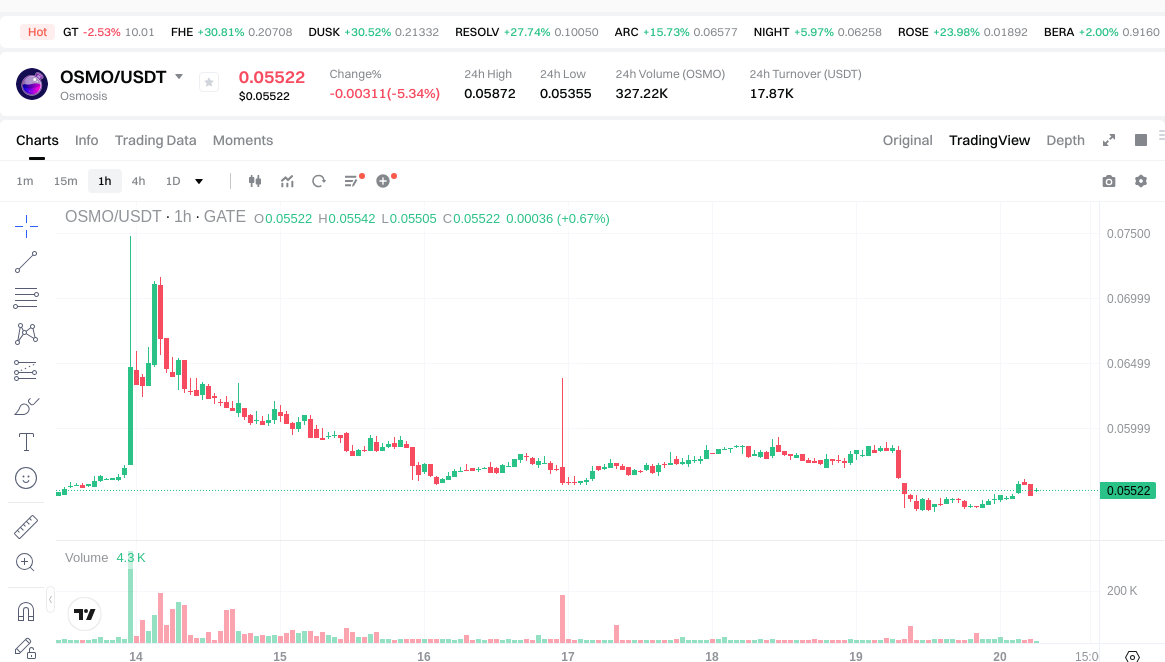
- OSMO current price: $0.05505
- Market sentiment (Fear & Greed Index): Data indicating cautious market conditions
- 24-hour trading volume: $17,844.43633
- Circulating supply: 759,486,300 OSMO (75.95% of total supply)
Click to view real-time OSMO market price
II. Core Factors Influencing Whether OSMO is a Good Investment
Supply Mechanism and Scarcity (OSMO Investment Scarcity)
- Supply structure: Circulating supply stands at 759,486,300 OSMO (representing 75.95% of total supply), with a maximum supply cap of 1,000,000,000 tokens
- The limited maximum supply creates a defined scarcity framework that may influence long-term price dynamics
- Circulating ratio of approximately 76% indicates substantial token distribution, which could affect supply-side pressure
- Investment consideration: The defined supply ceiling represents a structural element that may factor into valuation assessments
Institutional Investment and Mainstream Adoption (Institutional Investment in OSMO)
- Market presence: OSMO is listed on 22 exchanges, indicating a degree of accessibility across trading platforms
- The protocol serves as an advanced AMM (Automated Market Maker) built using Cosmos SDK, positioning it within the interoperable blockchain infrastructure space
- OSMO functions as a governance token, providing token holders with participation mechanisms in protocol decision-making processes
Macroeconomic Environment Impact on OSMO Investment
- As a cryptocurrency asset, OSMO's valuation may be influenced by broader market conditions, monetary policy shifts, and risk appetite trends in digital asset markets
- Price volatility reflects sensitivity to market sentiment, with 24-hour fluctuations ranging from $0.05355 to $0.05872
- Market capitalization of approximately $41.81 million and market dominance of 0.0016% indicate positioning within the mid-to-lower tier of cryptocurrency assets by market value
Technology and Ecosystem Development (Technology & Ecosystem for OSMO Investment)
- Technical foundation: Osmosis protocol enables developers to design, build, and deploy customized AMM solutions using Cosmos SDK infrastructure
- Functionality includes token swaps, liquidity pool management, staking mechanisms, and governance participation features
- The platform's modular architecture supports potential expansion of DeFi applications within the Cosmos ecosystem
- Development activity: Active GitHub repository indicates ongoing technical development efforts
III. OSMO Future Investment Forecast and Price Outlook (Is Osmosis(OSMO) worth investing in 2026-2031)
Short-term Investment Forecast (2026, short-term OSMO investment outlook)
- Conservative Forecast: $0.044096 - $0.05512
- Neutral Forecast: $0.05512 - $0.0614588
- Optimistic Forecast: $0.0614588 - $0.0677976
Mid-term Investment Outlook (2027-2029, mid-term Osmosis(OSMO) investment forecast)
- Market Stage Expectation: The price projection indicates a potential upward trend with gradual adoption of decentralized exchange services and increased market participation.
- Investment Return Forecast:
- 2027: $0.057156684 - $0.077438088
- 2028: $0.04097458196 - $0.086810555
- 2029: $0.044533814715 - $0.111725184285
- Key Catalysts: Market trends suggest that factors such as broader cryptocurrency adoption, enhanced trading activity, and development within the Cosmos ecosystem may influence price movements.
Long-term Investment Outlook (Is OSMO a good long-term investment?)
- Base Scenario: $0.083678451878238 - $0.109166443176375 (assuming steady progress and gradual mainstream application growth)
- Optimistic Scenario: $0.102046892534437 - $0.131640491369424 (assuming large-scale adoption and favorable market conditions)
- Risk Scenario: Below $0.044096 (under extreme market conditions)
Click to view OSMO long-term investment and price prediction: Price Prediction
2026-01-20 - 2031 Long-term Outlook
- Base Scenario: $0.083678451878238 - $0.109166443176375 (corresponding to steady progress and gradual mainstream application enhancement)
- Optimistic Scenario: $0.102046892534437 - $0.131640491369424 (corresponding to large-scale adoption and favorable market environment)
- Transformative Scenario: Above $0.131640491369424 (in case of breakthrough progress in the ecosystem and mainstream popularization)
- 2031-12-31 Predicted High: $0.131640491369424 (based on optimistic development assumptions)
Disclaimer: Price predictions are based on historical data and market analysis models and do not constitute investment advice. Cryptocurrency markets are highly volatile and subject to various risks. Past performance does not guarantee future results.
| Year |
Predicted High Price |
Predicted Average Price |
Predicted Low Price |
Price Change |
| 2026 |
0.0677976 |
0.05512 |
0.044096 |
0 |
| 2027 |
0.077438088 |
0.0614588 |
0.057156684 |
11 |
| 2028 |
0.086810555 |
0.069448444 |
0.04097458196 |
26 |
| 2029 |
0.111725184285 |
0.0781294995 |
0.044533814715 |
41 |
| 2030 |
0.109166443176375 |
0.0949273418925 |
0.088282427960025 |
72 |
| 2031 |
0.131640491369424 |
0.102046892534437 |
0.083678451878238 |
85 |
IV. OSMO Investment Strategy and Risk Management (How to invest in Osmosis)
Investment Methodology (OSMO investment strategy)
Long-term Holding (HODL OSMO): Suitable for conservative investors
Long-term holding represents a passive investment approach for OSMO tokens. This strategy involves purchasing and holding tokens over an extended period, typically measured in years rather than months. Investors adopting this methodology focus on the fundamental value proposition of the Osmosis protocol as an advanced AMM platform built on Cosmos SDK, which enables developers to design and deploy custom automated market makers.
This approach requires patience and conviction in the project's long-term development roadmap. Conservative investors may find this strategy appealing as it reduces the stress associated with short-term price fluctuations and minimizes transaction costs from frequent trading. The governance token nature of OSMO provides holders with participation rights in protocol decision-making, adding utility beyond pure price appreciation.
Active Trading: Relies on technical analysis and swing trading
Active trading strategies involve more frequent buying and selling of OSMO tokens based on technical indicators, chart patterns, and market momentum. Traders employing this methodology typically utilize tools such as moving averages, relative strength index (RSI), support and resistance levels, and volume analysis to identify entry and exit points.
Swing trading, a subset of active trading, focuses on capturing medium-term price movements over days or weeks. Given OSMO's historical price volatility—with a 24-hour change of -5.63% and annual change of -87.9%—active traders may find opportunities in these price swings. However, this approach requires substantial time commitment, technical expertise, and emotional discipline to manage the inherent risks of short-term market movements.
Risk Management (Risk management for OSMO investment)
Asset Allocation Ratios: Conservative / Aggressive / Professional investors
Proper asset allocation forms the foundation of sound risk management. Different investor profiles should consider varying exposure levels to OSMO:
- Conservative investors: May allocate 1-3% of their cryptocurrency portfolio to OSMO, maintaining larger positions in established assets with lower volatility profiles.
- Aggressive investors: Could allocate 5-10% of their portfolio to OSMO, accepting higher risk in exchange for potential returns from the protocol's growth.
- Professional investors: Might implement dynamic allocation strategies ranging from 3-15%, adjusting positions based on market conditions, technical developments, and ecosystem adoption metrics.
These allocation suggestions recognize OSMO's position as a mid-to-lower market cap asset with a market capitalization of approximately $41.81 million and ranking of 586, indicating higher risk compared to top-tier cryptocurrencies.
Risk Hedging Solutions: Multi-asset portfolio + hedging instruments
Diversification across multiple assets serves as a primary risk mitigation strategy. Investors holding OSMO should consider:
- Ecosystem diversification: Holding other Cosmos ecosystem tokens to balance ecosystem-specific risks
- Cross-chain diversification: Maintaining positions in assets from different blockchain ecosystems
- Stablecoin reserves: Keeping a portion of portfolio in stablecoins for liquidity and to capitalize on buying opportunities during market downturns
Hedging instruments, though more complex, may include derivatives positions or options strategies for sophisticated investors seeking downside protection while maintaining upside exposure.
Secure Storage: Hot/cold wallet + hardware wallet recommendations
Secure token storage represents a critical component of risk management:
- Cold wallet storage: Recommended for long-term holdings, keeping private keys completely offline and protected from online threats
- Hot wallet usage: Suitable for smaller amounts needed for active trading or protocol interaction, accepting increased convenience with marginally higher security risk
- Hardware wallet solutions: Physical devices that store private keys offline while enabling transaction signing, offering an optimal balance between security and usability
Investors should implement additional security measures including strong passwords, two-factor authentication, regular software updates, and never sharing private keys or seed phrases.
V. OSMO Investment Risks and Challenges (Risks of investing in Osmosis)
Market Risk: High volatility, price manipulation
OSMO demonstrates significant price volatility, as evidenced by its 24-hour price range between $0.05355 and $0.05872, representing an intraday swing of approximately 9.6%. The annual performance shows a decline of 87.9%, indicating substantial downward price pressure over longer timeframes.
The token's relatively lower market capitalization of $41.81 million and trading volume of $17,844.44 in 24 hours create conditions where large transactions can disproportionately impact price movements. Lower liquidity environments increase susceptibility to price manipulation tactics, including wash trading, spoofing, and coordinated buying or selling activities.
Historical price data reveals extreme volatility, with OSMO reaching a high of $11.25 on March 4, 2022, and a low of $0.04890959 on January 1, 2026—representing a drawdown of over 99% from peak to trough. Such dramatic price movements underscore the speculative nature of the asset and the potential for substantial capital loss.
Regulatory Risk: Policy uncertainty across different countries
Cryptocurrency regulatory frameworks remain in flux globally, creating uncertainty for OSMO token holders. Different jurisdictions maintain varying approaches to digital asset classification, taxation, and permissibility:
- Jurisdictional variations: Some countries have implemented clear regulatory frameworks, while others maintain ambiguous or restrictive stances toward cryptocurrencies
- Classification uncertainty: Questions regarding whether OSMO constitutes a security, commodity, or utility token affect regulatory obligations and permissible activities
- Taxation complexity: Evolving tax treatment of cryptocurrency transactions, staking rewards, and governance participation creates compliance challenges
- Cross-border complications: International transfers and trading activities may trigger multiple jurisdictional requirements
Regulatory developments can materially impact OSMO's accessibility, trading venues, and overall market value. Investors must stay informed about regulatory changes in their jurisdictions and where relevant exchanges operate.
Technical Risk: Network security vulnerabilities, upgrade failures
As a blockchain-based protocol, Osmosis faces inherent technical risks:
- Smart contract vulnerabilities: Bugs or exploitable code in the protocol's smart contracts could result in loss of funds or protocol malfunction
- Network attacks: Potential security threats including 51% attacks, denial-of-service attacks, or validator compromise
- Upgrade complications: Protocol updates and hard forks carry risks of implementation errors, network splits, or unexpected behavior
- Interoperability dependencies: As part of the Cosmos ecosystem utilizing IBC (Inter-Blockchain Communication), issues with connected chains or bridge protocols could affect functionality
- Key management: User errors in private key handling remain a persistent risk factor for token holders
The protocol's reliance on the Cosmos SDK means that underlying infrastructure vulnerabilities could cascade to affect Osmosis. While development teams typically conduct audits and testing, no software system can be guaranteed completely free from defects.
VI. Conclusion: Is Osmosis a Good Investment?
Investment Value Summary: OSMO demonstrates long-term investment potential as a governance token for an advanced AMM protocol within the Cosmos ecosystem, though short-term price movements exhibit substantial volatility.
The Osmosis protocol offers technical innovation by enabling developers to design and deploy custom automated market makers, positioning it as infrastructure for decentralized finance applications. The governance token model provides holders with decision-making participation rights regarding protocol direction and future developments.
However, the token's performance shows significant challenges, with current price of $0.05505 representing a 87.9% decline year-over-year and a 99.5% decrease from its all-time high of $11.25. The circulating supply of 759.49 million tokens represents 75.95% of maximum supply, with a market capitalization ranking of 586 indicating a mid-to-lower tier position among cryptocurrencies.
Investor Recommendations:
✅ Beginners: Dollar-cost averaging + secure wallet storage
New investors should consider systematic periodic purchases rather than lump-sum investments to average entry prices across market cycles. Priority should be given to understanding secure storage practices, utilizing hardware wallets or well-vetted software wallets, and never storing significant amounts on exchanges. Educational focus on the Cosmos ecosystem and AMM protocol mechanics will support informed decision-making.
✅ Experienced investors: Swing trading + portfolio allocation
Investors with technical analysis capabilities may capitalize on OSMO's price volatility through swing trading strategies while maintaining a core long-term position. Portfolio allocation should reflect risk tolerance and overall investment strategy, with OSMO positioned as a higher-risk, potentially higher-reward component within a diversified cryptocurrency portfolio. Active monitoring of protocol developments, ecosystem growth metrics, and competitive positioning should inform allocation adjustments.
✅ Institutional investors: Strategic long-term allocation
Institutional participants may consider OSMO as part of a strategic allocation to decentralized finance infrastructure and the Cosmos ecosystem. Position sizing should account for liquidity constraints given the token's trading volume and market capitalization. Institutional frameworks should incorporate governance participation opportunities, protocol development tracking, and ecosystem partnership developments into investment thesis evaluation.
⚠️ Notice: Cryptocurrency investment carries high risk. This content is for informational purposes only and does not constitute investment advice. Investors should conduct thorough research, understand their risk tolerance, and consider consulting financial professionals before making investment decisions. Past performance does not guarantee future results, and investors may lose some or all of their invested capital.
VII. FAQ
Q1: What makes Osmosis (OSMO) different from other decentralized exchanges?
Osmosis distinguishes itself as an advanced AMM protocol built on Cosmos SDK that enables developers to design, build, and deploy customized automated market makers with flexible parameters. Unlike traditional AMMs with fixed formulas, Osmosis provides modularity and interoperability within the Cosmos ecosystem through IBC (Inter-Blockchain Communication), allowing seamless cross-chain liquidity operations. The protocol's governance structure empowers OSMO token holders to participate in decision-making processes regarding protocol upgrades, parameter adjustments, and ecosystem development directions.
Q2: How volatile is OSMO compared to other cryptocurrency investments?
OSMO demonstrates high volatility characteristic of mid-tier market capitalization cryptocurrencies. Historical data reveals extreme price movements, with the token reaching $11.25 in March 2022 and declining to $0.04890959 by January 2026—representing over 99% drawdown from peak to trough. The 24-hour price fluctuation ranges between $0.05355 and $0.05872, indicating approximately 9.6% intraday volatility. The annual performance shows an 87.9% decline, substantially exceeding the volatility profiles of larger market capitalization assets like Bitcoin or Ethereum.
Q3: What percentage of my portfolio should I allocate to OSMO?
Portfolio allocation to OSMO should reflect individual risk tolerance and investment experience. Conservative investors may consider allocating 1-3% of their cryptocurrency portfolio to OSMO, maintaining larger positions in established assets. Aggressive investors might allocate 5-10%, accepting higher risk for potential growth returns. Professional investors could implement dynamic allocation strategies ranging from 3-15%, adjusting positions based on market conditions and ecosystem developments. Given OSMO's market capitalization ranking of 586 and historical volatility, it should constitute a smaller portion of diversified portfolios rather than a core holding.
Q4: Can I generate passive income by holding OSMO tokens?
OSMO token holders can potentially generate passive income through the protocol's staking mechanism. By staking OSMO tokens, participants contribute to network security and governance while earning staking rewards distributed from transaction fees and inflation mechanisms. Additionally, OSMO holders can provide liquidity to Osmosis pools, earning trading fees and potential liquidity mining incentives. However, staking and liquidity provision involve risks including smart contract vulnerabilities, impermanent loss, and potential slashing penalties for validator misconduct. Investors should thoroughly understand these mechanisms and associated risks before pursuing passive income strategies.
Q5: What are the main risks I should consider before investing in OSMO?
Primary investment risks include market risk with substantial price volatility and potential manipulation due to lower trading volumes; regulatory risk stemming from evolving cryptocurrency policies across jurisdictions that may affect token classification, taxation, and trading accessibility; technical risk involving smart contract vulnerabilities, network security threats, and protocol upgrade complications; and liquidity risk given the relatively modest $17,844.44 in 24-hour trading volume which may impact execution of larger trades. Additionally, ecosystem dependency risks exist as OSMO's value correlates with Cosmos ecosystem development and IBC protocol functionality.
Q6: How does OSMO's token supply structure affect its investment potential?
OSMO maintains a maximum supply cap of 1,000,000,000 tokens with current circulating supply at 759,486,300 tokens (approximately 75.95% of total supply). This defined supply ceiling creates a scarcity framework that may influence long-term valuation dynamics. The relatively high circulating ratio indicates substantial token distribution already in market circulation, which affects supply-side pressure and inflation dynamics. Unlike uncapped supply models, OSMO's maximum supply limit provides structural predictability for long-term supply economics, though the remaining 24% of tokens yet to enter circulation represents potential future dilution that investors should monitor.
Q7: What factors could drive OSMO's price growth in the future?
Potential price catalysts include broader adoption of decentralized exchange services within the Cosmos ecosystem; increased trading activity and total value locked (TVL) on the Osmosis platform; successful protocol upgrades that enhance functionality and user experience; strategic partnerships with other blockchain projects utilizing IBC technology; growing mainstream acceptance of DeFi applications; favorable macroeconomic conditions for risk assets; and technological innovations that differentiate Osmosis from competing AMM protocols. However, these factors represent possibilities rather than certainties, and actual price movements depend on complex market dynamics beyond individual protocol developments.
Q8: Is OSMO suitable for beginners or should I have prior cryptocurrency experience?
While beginners can invest in OSMO, this token presents complexity requiring foundational cryptocurrency knowledge. New investors should first understand basic concepts including wallet security, private key management, blockchain technology fundamentals, and the risks inherent in cryptocurrency markets. The Osmosis protocol's technical nature—involving AMM mechanics, liquidity provision, staking mechanisms, and cross-chain operations—adds layers of complexity beyond simple buy-and-hold strategies. Beginners interested in OSMO should commit to educational investment, start with small allocations using dollar-cost averaging, prioritize secure storage practices, and consider gaining experience with larger, more established cryptocurrencies before significant OSMO allocation.
* The information is not intended to be and does not constitute financial advice or any other recommendation of any sort offered or endorsed by Gate.