This comprehensive comparison analyzes IP (Story Network) and GMX as two distinct decentralized platform investments. IP represents emerging intellectual property tokenization infrastructure on Layer 1 blockchain, while GMX operates as an established decentralized perpetual exchange with proven fee-sharing mechanisms. The article examines historical price trends, tokenomics differences, institutional adoption patterns, and technical ecosystems to guide investment decisions. Current market data shows IP at $3.945 with $16.96M trading volume versus GMX at $8.457 with organic user adoption. Long-term forecasts through 2031 indicate GMX potential of 131% growth versus IP's 64% growth. The analysis provides risk assessment frameworks, allocation strategies for different investor profiles, and addresses regulatory considerations, helping readers determine optimal portfolio positioning between early-stage infrastructure development and established DeFi protocols.
Introduction: Investment Comparison Between IP and GMX
In the cryptocurrency market, the comparison between IP vs GMX has consistently been a topic of interest for investors. The two assets demonstrate notable differences in market cap ranking, application scenarios, and price performance, representing distinct positioning within the crypto asset landscape.
IP (Story Network): Launched in 2025, Story Network has gained market recognition through its specialized focus on intelligent tokenization of intellectual property. As a purpose-built Layer 1 blockchain, it enables programmable monetization of scientific, creative, and brand IPs onchain.
GMX (GMX): Operating as a decentralized perpetual exchange, GMX serves as both a utility and governance token, with token holders accruing 30% of platform-generated fees. The protocol has established itself within the decentralized trading infrastructure sector.
This article will comprehensively analyze the investment value comparison of IP vs GMX through historical price trends, supply mechanisms, institutional adoption, technical ecosystems, and future forecasts, attempting to address the question most concerning to investors:
"Which is the better buy right now?"
I. Historical Price Comparison and Current Market Status
Story Network (IP) and GMX Historical Price Trends
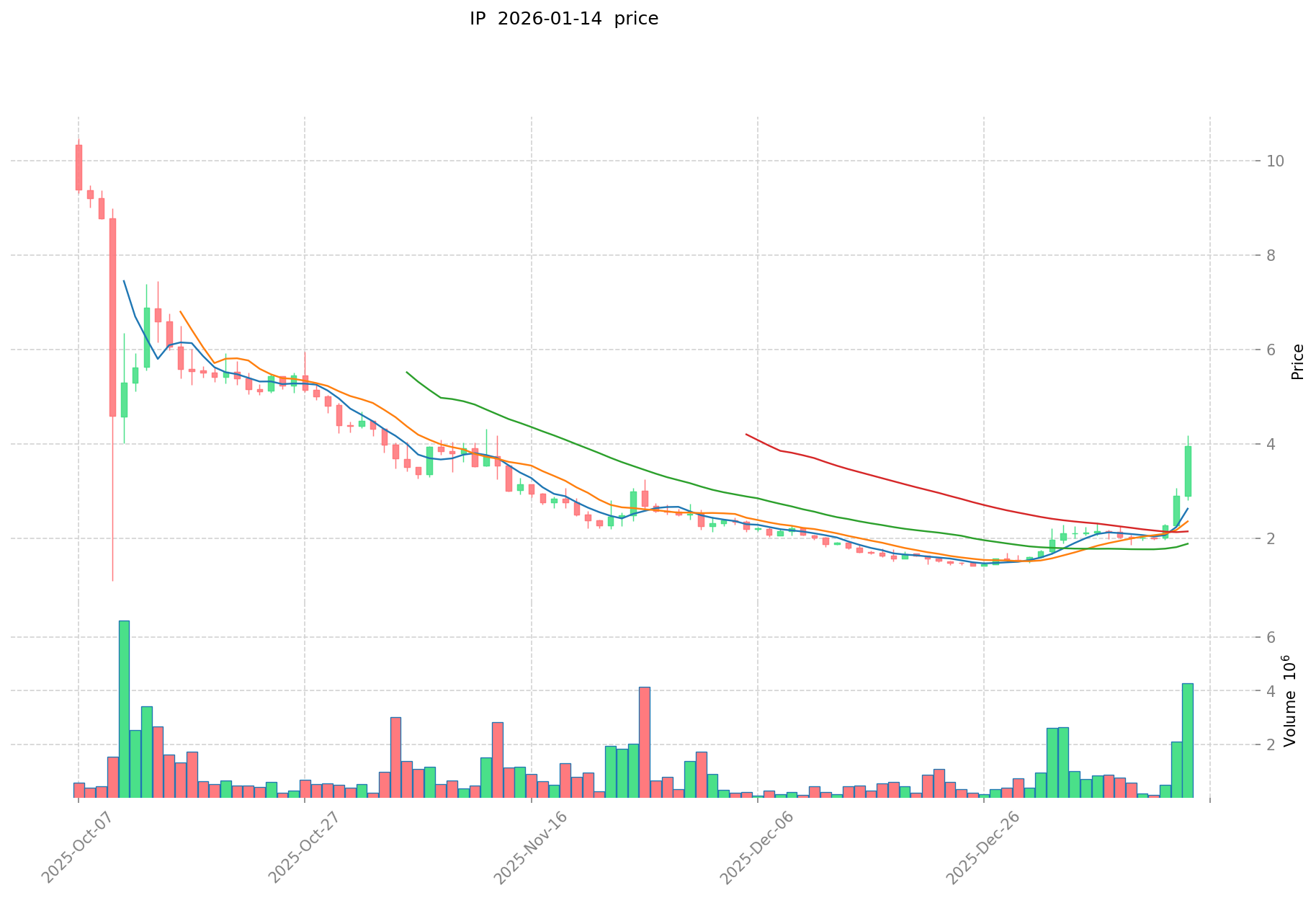
- 2025: Story Network (IP) recorded its peak price at $14.93 on September 21, 2025, followed by a decline to its historical low of $1.1 on October 10, 2025, reflecting significant volatility during this period.
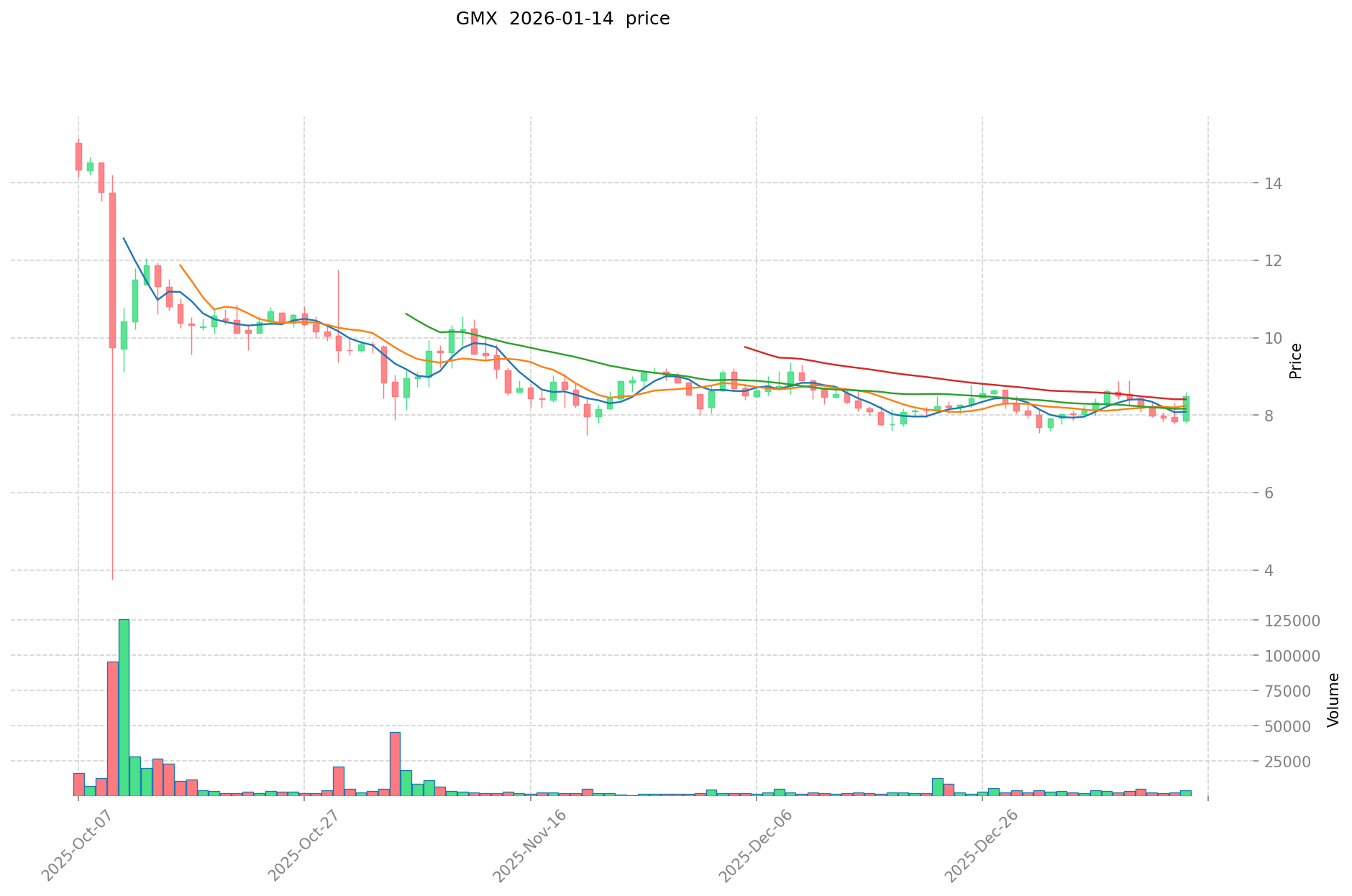
- 2023: GMX reached its historical high of $91.07 on April 18, 2023, but subsequently experienced a sustained downward trend, declining to $6.92 on October 11, 2025.
- Comparative Analysis: During recent market cycles, IP demonstrated price fluctuations ranging from $1.1 to $14.93, while GMX exhibited a broader decline from $91.07 to $6.92, indicating different market dynamics and investor sentiment patterns between the two assets.
Current Market Status (2026-01-14)
- IP Current Price: $3.945
- GMX Current Price: $8.457
- 24-Hour Trading Volume: IP recorded $16,962,233.54 compared to GMX's $37,027.80
- Market Sentiment Index (Fear & Greed Index): 48 (Neutral)
View Real-Time Prices:
II. Core Factors Influencing IP vs GMX Investment Value
Supply Mechanism Comparison (Tokenomics)
- GMX: The protocol implements a fee-sharing mechanism where GMX token holders receive a portion of platform trading fees, creating a value accrual model tied to protocol usage and trading volume.
- IP: The materials indicate exploration of tokenization possibilities for intellectual property assets, potentially enabling fractional ownership and enhanced liquidity for IP-based collateral in lending protocols.
- 📌 Historical Pattern: Supply mechanisms influence price cycles through their impact on token utility, holder incentives, and protocol sustainability, with fee-sharing models demonstrating resilience during market volatility periods.
Institutional Adoption and Market Application
- Institutional Holdings: GMX has attracted attention in the decentralized perpetual futures trading sector, with its organic user growth and product-market fit serving as indicators of sustainable institutional interest.
- Enterprise Adoption: GMX's application in decentralized derivatives trading has shown traction in cross-border trading and hedging activities, while IP tokenization explores new applications in digital asset collateralization and fractional ownership structures.
- Regulatory Landscape: Decentralized exchange protocols face varying regulatory approaches across jurisdictions, with increased scrutiny on derivative products and their compliance frameworks.
Technical Development and Ecosystem Building
- GMX Technical Upgrades: The GMX V2 architecture introduced improved fee mechanisms designed to maintain protocol security and balance between long and short positions, though it faced competitive challenges from emerging perpetual DEX protocols.
- IP Technical Development: The exploration of programmable IP assets focuses on creating more liquid asset classes through tokenization and integration with DeFi lending protocols, enabling new forms of value capture for intellectual property.
- Ecosystem Comparison: GMX's GLP model simplified liquidity provision through single-sided asset deposits, lowering participation barriers and capturing organic user traffic, particularly following centralized exchange security concerns. IP tokenization efforts aim to expand DeFi ecosystem functionality by introducing new collateral types and fractional ownership mechanisms.
Macroeconomic Conditions and Market Cycles
- Performance During Market Volatility: GMX demonstrated resilience during market downturns by maintaining organic trading volume without relying primarily on token incentives, contrasting with protocols dependent on mining rewards that faced sustainability challenges.
- Macroeconomic Policy Impact: User growth and ecosystem expansion have emerged as decisive factors in perpetual DEX competitiveness, with protocol value increasingly derived from system usage frequency and user retention rather than single-token dynamics.
- Market Dynamics: The decentralized derivatives sector continues to balance performance optimization with ecosystem composability, with projects addressing cross-chain asset support and integration challenges to enhance protocol utility and market positioning.
III. 2026-2031 Price Forecast: IP vs GMX
Short-term Forecast (2026)
- IP: Conservative $3.34-$3.97 | Optimistic $3.97-$4.33
- GMX: Conservative $7.09-$8.45 | Optimistic $8.45-$11.99
Mid-term Forecast (2028-2029)
- IP may enter a consolidation phase with projected price range of $3.29-$6.17
- GMX may enter an expansion phase with projected price range of $7.77-$17.83
- Key drivers: institutional capital inflows, ETF developments, ecosystem growth
Long-term Forecast (2030-2031)
- IP: Baseline scenario $3.31-$5.52 | Optimistic scenario $5.52-$7.45
- GMX: Baseline scenario $12.86-$15.88 | Optimistic scenario $15.88-$28.83
View detailed price predictions for IP and GMX
Disclaimer
IP:
| Year |
Predicted High Price |
Predicted Average Price |
Predicted Low Price |
Price Change |
| 2026 |
4.32948 |
3.972 |
3.33648 |
0 |
| 2027 |
5.1054102 |
4.15074 |
3.9016956 |
5 |
| 2028 |
5.09088261 |
4.6280751 |
3.285933321 |
17 |
| 2029 |
6.17153814585 |
4.859478855 |
3.3044456214 |
23 |
| 2030 |
7.44593647557375 |
5.515508500425 |
3.309305100255 |
39 |
| 2031 |
7.388023636319287 |
6.480722487999375 |
4.277276842079587 |
64 |
GMX:
| Year |
Predicted High Price |
Predicted Average Price |
Predicted Low Price |
Price Change |
| 2026 |
11.9919 |
8.445 |
7.0938 |
0 |
| 2027 |
13.692723 |
10.21845 |
9.9118965 |
20 |
| 2028 |
15.900930045 |
11.9555865 |
7.771131225 |
41 |
| 2029 |
17.8281705888 |
13.9282582725 |
7.7998246326 |
64 |
| 2030 |
23.3409752130555 |
15.87821443065 |
12.8613536888265 |
87 |
| 2031 |
28.826104388123542 |
19.60959482185275 |
15.6876758574822 |
131 |
IV. Investment Strategy Comparison: IP vs GMX
Long-term vs Short-term Investment Strategies
- IP: May suit investors focused on emerging intellectual property tokenization infrastructure and early-stage blockchain ecosystems with tolerance for development-phase volatility
- GMX: May suit investors seeking exposure to established decentralized derivatives trading protocols with demonstrated product-market fit and organic user adoption
Risk Management and Asset Allocation
- Conservative Investors: IP 20-30% vs GMX 70-80% allocation considering GMX's established protocol operations and fee-generation mechanisms
- Aggressive Investors: IP 50-60% vs GMX 40-50% allocation reflecting higher risk tolerance for emerging infrastructure projects alongside established DeFi protocols
- Hedging Instruments: Stablecoin reserves for volatility management, derivatives positions for directional hedging, cross-asset portfolio diversification across blockchain infrastructure and DeFi application layers
V. Potential Risk Comparison
Market Risk
- IP: Exposure to early-stage project execution risks, intellectual property tokenization adoption uncertainties, and correlation with broader Layer 1 blockchain sector performance cycles
- GMX: Subject to decentralized exchange competitive dynamics, trading volume fluctuations affecting fee distribution, and perpetual futures market liquidity conditions
Technical Risk
- IP: Network scalability considerations during ecosystem expansion phases, protocol stability during early adoption periods
- GMX: Protocol architecture dependencies on liquidity pool mechanics, smart contract security considerations in derivatives settlement systems
Regulatory Risk
- Divergent regulatory approaches impact both assets differently: IP tokenization faces intellectual property rights frameworks and securities classification considerations across jurisdictions, while GMX encounters derivatives trading regulations and decentralized exchange compliance requirements with varying international enforcement approaches
VI. Conclusion: Which Is the Better Buy?
📌 Investment Value Summary:
- IP Characteristics: Represents early-stage exposure to intellectual property tokenization infrastructure with significant development-phase volatility, demonstrating price ranges from historical low of $1.1 to peak of $14.93 during 2025
- GMX Characteristics: Established decentralized perpetual exchange protocol with fee-sharing mechanism and organic user adoption, showing price trajectory from historical high of $91.07 to current levels with demonstrated protocol utility
✅ Investment Considerations:
- Novice Investors: Consider starting with smaller position sizes in established protocols with demonstrated user adoption and fee-generation mechanisms, allowing familiarity development with decentralized protocol dynamics before exploring early-stage infrastructure projects
- Experienced Investors: May evaluate portfolio diversification across both infrastructure development (IP) and application layer protocols (GMX), balancing exposure to emerging tokenization frameworks with established DeFi trading mechanisms
- Institutional Investors: Assessment may include protocol sustainability metrics, organic adoption indicators, regulatory compliance frameworks, and correlation analysis within broader digital asset portfolio construction
⚠️ Risk Disclosure: Cryptocurrency markets demonstrate substantial volatility characteristics. This analysis does not constitute investment advice. Market participants should conduct independent research and consider individual risk tolerance, investment objectives, and financial circumstances before making allocation decisions.
VII. FAQ
Q1: What is the main difference between IP and GMX in terms of their core functionality?
IP (Story Network) operates as a Layer 1 blockchain specialized in intellectual property tokenization, enabling programmable monetization of scientific, creative, and brand IPs onchain. GMX functions as a decentralized perpetual exchange protocol where token holders receive 30% of platform-generated trading fees. The fundamental distinction lies in their application focus: IP targets IP asset infrastructure development, while GMX serves the decentralized derivatives trading market with established product-market fit and organic user adoption.
Q2: Which asset demonstrates better price stability based on historical performance?
GMX has shown relatively more established price patterns despite experiencing a decline from its historical high of $91.07 (April 2023) to current levels around $8.457. IP exhibited extreme volatility with a price range from $1.1 to $14.93 within 2025 alone. GMX's price movements reflect mature protocol operations and fee-generation mechanisms, while IP's volatility indicates early-stage development characteristics typical of emerging blockchain infrastructure projects.
Q3: How do the tokenomics differ between IP and GMX?
GMX implements a fee-sharing mechanism where token holders receive a portion of platform trading fees, creating direct value accrual tied to protocol usage and trading volume. The GLP model enables single-sided liquidity provision, lowering participation barriers. IP explores tokenization possibilities for intellectual property assets, potentially enabling fractional ownership and enhanced liquidity for IP-based collateral in DeFi lending protocols, representing a fundamentally different value capture mechanism focused on asset tokenization rather than trading fee distribution.
Q4: What are the projected price ranges for IP and GMX by 2031?
According to long-term forecasts, IP projects a baseline scenario of $3.31-$5.52 with an optimistic scenario reaching $5.52-$7.45 by 2031, representing a 64% potential increase from 2026 baseline. GMX forecasts indicate a baseline range of $12.86-$15.88 with optimistic projections of $15.88-$28.83, suggesting a 131% potential increase. These projections reflect GMX's established protocol operations versus IP's emerging infrastructure development phase, though both remain subject to significant market volatility and execution risks.
Q5: Which asset is more suitable for institutional investors?
Institutional investor suitability depends on specific investment mandates and risk parameters. GMX offers exposure to established decentralized derivatives infrastructure with demonstrated organic adoption, fee-generation mechanisms, and protocol sustainability metrics. IP provides early-stage access to intellectual property tokenization infrastructure with higher development-phase volatility but potential exposure to emerging asset class creation. Institutional assessment should include protocol sustainability analysis, regulatory compliance frameworks, organic adoption indicators, and correlation analysis within broader digital asset portfolio construction strategies.
Q6: What are the primary regulatory risks facing IP and GMX?
IP tokenization faces intellectual property rights frameworks and securities classification considerations across multiple jurisdictions, with varying approaches to asset tokenization and fractional ownership structures. GMX encounters derivatives trading regulations and decentralized exchange compliance requirements, including scrutiny on perpetual futures products and their regulatory treatment internationally. Both assets face divergent regulatory approaches with varying enforcement mechanisms, requiring ongoing monitoring of jurisdictional developments and compliance framework evolution in their respective sectors.
Q7: How do trading volumes compare between IP and GMX currently?
As of January 14, 2026, IP recorded a 24-hour trading volume of $16,962,233.54, while GMX showed $37,027.80 in the same period. This significant disparity indicates substantially higher liquidity and market activity for IP compared to GMX. However, trading volume alone does not reflect protocol utility or long-term sustainability, as GMX's value proposition centers on fee-generation from perpetual trading activity rather than spot market token trading volume, representing different liquidity dynamics in their respective market segments.
Q8: What allocation strategy is recommended for different investor profiles?
Conservative investors may consider a 20-30% IP vs 70-80% GMX allocation, favoring GMX's established protocol operations and fee-generation mechanisms. Aggressive investors with higher risk tolerance might evaluate 50-60% IP vs 40-50% GMX allocation, balancing exposure to emerging infrastructure projects alongside established DeFi protocols. All allocations should incorporate stablecoin reserves for volatility management, derivatives positions for directional hedging, and cross-asset portfolio diversification. Individual circumstances, risk tolerance, investment objectives, and time horizons should guide final allocation decisions beyond these general frameworks.
* The information is not intended to be and does not constitute financial advice or any other recommendation of any sort offered or endorsed by Gate.