This comprehensive comparison analyzes DF and KAVA as two leading blockchain platforms, examining their distinct positioning in the cryptocurrency market. DF functions as an open finance ecosystem token supporting fee payments, governance, and derivative synthesis, while KAVA operates as a cross-chain Layer 1 hub for DeFi infrastructure. The article evaluates historical price trends, current market status, tokenomics, institutional adoption, and technical ecosystems, revealing KAVA's superior trading volume ($263,385.88 vs $17,435.54) and liquidity advantages. Long-term price forecasts through 2031 project 85% growth potential for both assets under optimistic scenarios. Investment recommendations differentiate between conservative investors favoring KAVA (60-70% allocation) and aggressive investors considering DF (50-60% allocation), while emphasizing comprehensive risk management strategies for this highly volatile market segment.
Introduction: Investment Comparison Between DF and KAVA
In the cryptocurrency market, the comparison between DF vs KAVA has consistently been a topic that investors cannot overlook. Both exhibit notable differences in market cap ranking, application scenarios, and price performance, while representing distinct positioning within the crypto asset landscape.
DF (DF): Since its launch, DF has gained market recognition by positioning itself as a comprehensive open finance ecosystem platform token, serving multiple functions including fee payment, platform governance, risk management, derivative asset synthesis, and partner incentives within the dForce ecosystem.
KAVA (KAVA): Launched in October 2019, KAVA has been recognized as a cross-chain decentralized finance platform, operating as a decentralized Layer 1 hub that supports cross-chain DeFi applications and services, providing threshold-free permanent financial service infrastructure for product applications and developers.
This article will provide a comprehensive analysis of the investment value comparison between DF vs KAVA, focusing on historical price trends, supply mechanisms, institutional adoption, technical ecosystems, and future projections, attempting to address the question that investors care about most:
"Which is the better buy right now?"
I. Historical Price Comparison and Current Market Status
Historical Price Trends of DF (Coin A) and KAVA (Coin B)
- 2020: DF experienced a significant price movement, reaching an all-time high of $1.5 on June 20, 2020.
- 2021: KAVA was influenced by broader market dynamics, achieving its all-time high of $9.12 on August 30, 2021.
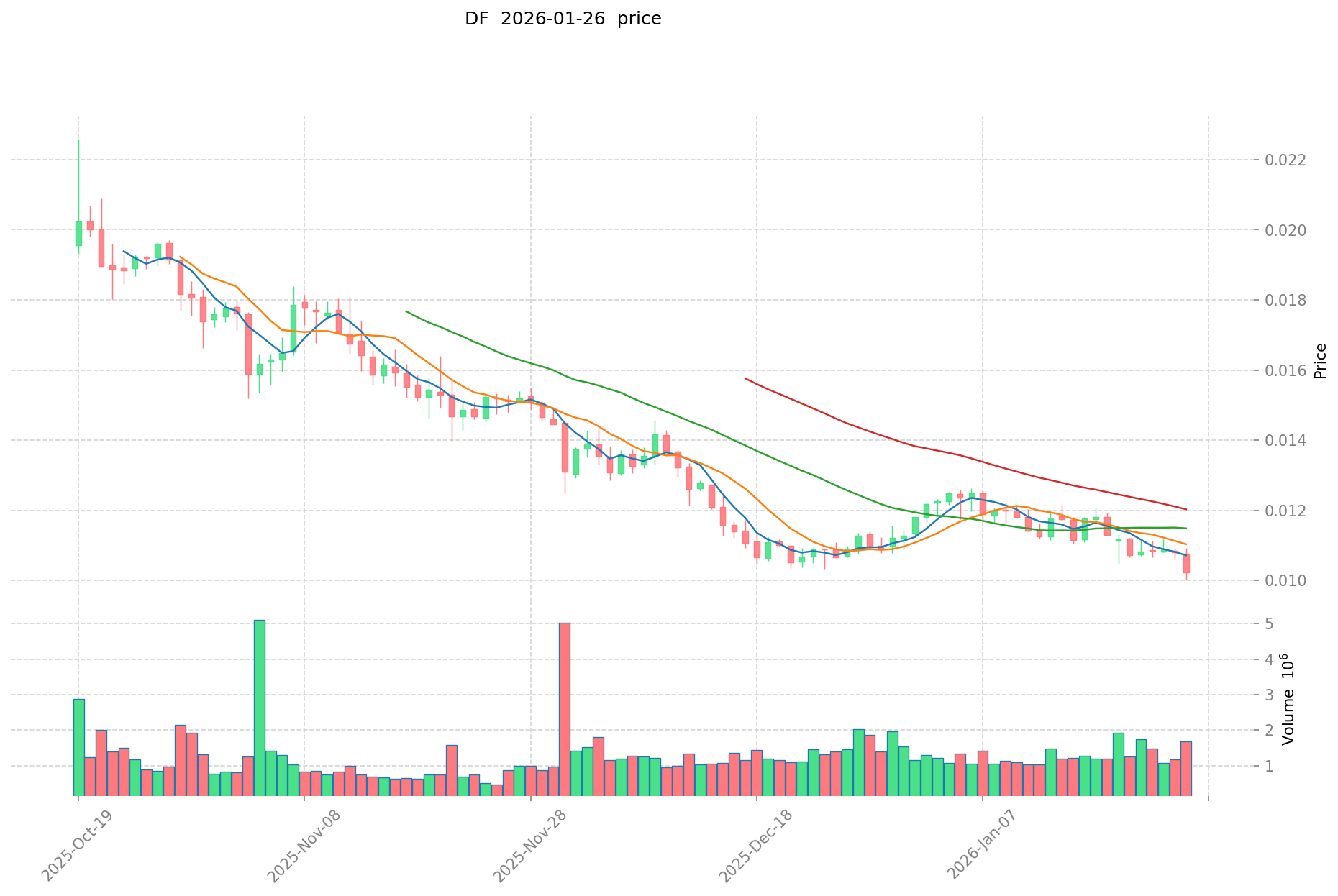
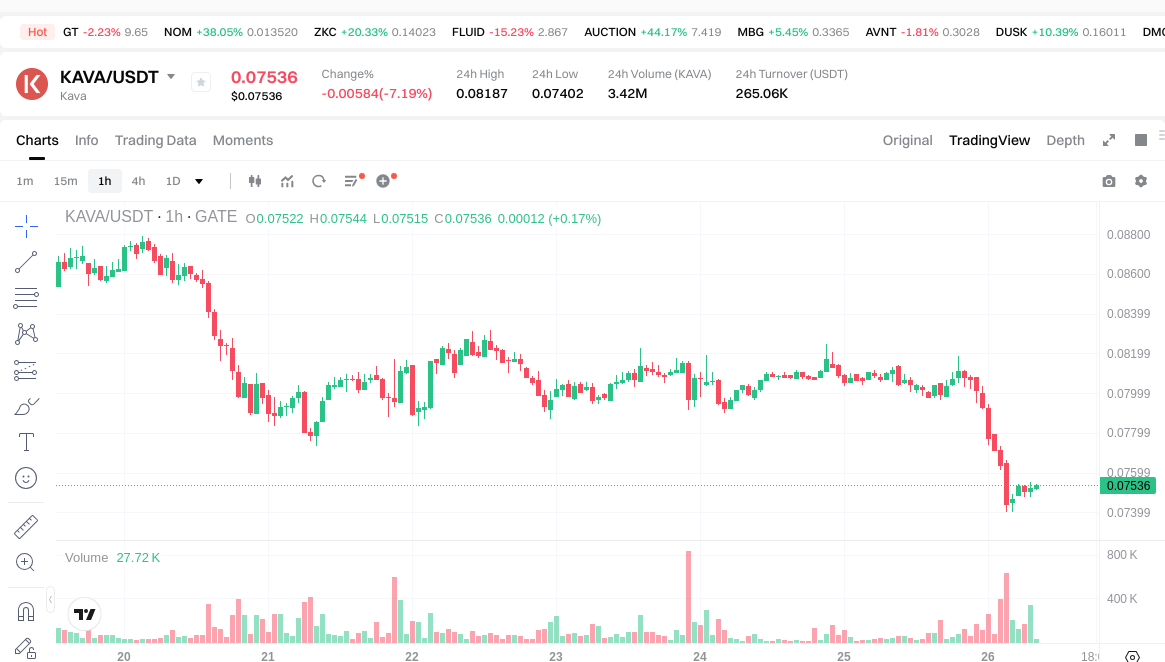
- 2025: DF recorded its all-time low of $0.00935785 on October 11, 2025, while KAVA reached its all-time low of $0.071579 on December 19, 2025.
- Comparative Analysis: During recent market cycles, DF declined from its peak of $1.5 to its current price level, demonstrating substantial volatility. KAVA similarly experienced significant price fluctuations, declining from $9.12 to its current trading range.
Current Market Status (January 26, 2026)
- DF Current Price: $0.01019
- KAVA Current Price: $0.0752
- 24-Hour Trading Volume: DF recorded $17,435.54 compared to KAVA's $263,385.88
- Market Sentiment Index (Fear & Greed Index): 25 (Extreme Fear)
View real-time prices:
II. Core Factors Affecting DF vs KAVA Investment Value
Supply Mechanism Comparison (Tokenomics)
Due to limited available data on the specific supply mechanisms of DF and KAVA, a detailed comparison cannot be provided at this time. Investors are advised to refer to official project documentation for tokenomics details.
Institutional Adoption and Market Applications
Without sufficient data regarding institutional holdings, enterprise adoption patterns, or specific regulatory stances toward DF and KAVA across different jurisdictions, a comprehensive analysis of their market applications cannot be conducted based on the provided materials.
Technical Development and Ecosystem Building
The provided materials do not contain specific information about recent technical upgrades, development roadmaps, or ecosystem activities for either DF or KAVA. Assessment of their respective positions in DeFi, NFT, payment systems, or smart contract implementations requires additional data sources.
Macroeconomic Factors and Market Cycles
An analysis of how DF and KAVA perform under different macroeconomic conditions, including inflationary environments, monetary policy changes, interest rate fluctuations, or geopolitical developments, cannot be substantiated with the current reference materials.
III. 2026-2031 Price Forecast: DF vs KAVA
Short-term Forecast (2026)
- DF: Conservative $0.008976 - $0.0102 | Optimistic $0.0102 - $0.013668
- KAVA: Conservative $0.0557812 - $0.07538 | Optimistic $0.07538 - $0.1032706
Mid-term Forecast (2028-2029)
- DF may enter a moderate growth phase, with projected price range of $0.0102948651 - $0.0185561766 in 2028, potentially reaching $0.01406964897 - $0.018603202527 by 2029
- KAVA may enter an expansion phase, with projected price range of $0.10098225165 - $0.14031218124 in 2028, potentially reaching $0.0776819257956 - $0.1491986193852 by 2029
- Key drivers: institutional capital inflows, ETF developments, ecosystem expansion
Long-term Forecast (2030-2031)
- DF: Baseline scenario $0.00924375937329 - $0.0171180729135 (2030) | Optimistic scenario $0.012484210575815 - $0.020807017626359 (2031)
- KAVA: Baseline scenario $0.107638789084554 - $0.1362516317526 (2030) | Optimistic scenario $0.08100159507692 - $0.168986086281162 (2031)
View detailed price predictions for DF and KAVA
Disclaimer
DF:
| Year |
Predicted High Price |
Predicted Average Price |
Predicted Low Price |
Price Change |
| 2026 |
0.013668 |
0.0102 |
0.008976 |
0 |
| 2027 |
0.01348542 |
0.011934 |
0.00692172 |
17 |
| 2028 |
0.0185561766 |
0.01270971 |
0.0102948651 |
24 |
| 2029 |
0.018603202527 |
0.0156329433 |
0.01406964897 |
53 |
| 2030 |
0.020712868225335 |
0.0171180729135 |
0.00924375937329 |
67 |
| 2031 |
0.020807017626359 |
0.018915470569417 |
0.012484210575815 |
85 |
KAVA:
| Year |
Predicted High Price |
Predicted Average Price |
Predicted Low Price |
Price Change |
| 2026 |
0.1032706 |
0.07538 |
0.0557812 |
0 |
| 2027 |
0.123268914 |
0.0893253 |
0.082179276 |
18 |
| 2028 |
0.14031218124 |
0.106297107 |
0.10098225165 |
41 |
| 2029 |
0.1491986193852 |
0.12330464412 |
0.0776819257956 |
63 |
| 2030 |
0.14306421334023 |
0.1362516317526 |
0.107638789084554 |
80 |
| 2031 |
0.168986086281162 |
0.139657922546415 |
0.08100159507692 |
85 |
IV. Investment Strategy Comparison: DF vs KAVA
Long-term vs Short-term Investment Strategies
- DF: May suit investors focused on DeFi ecosystem participation and long-term platform governance potential, given its role as a comprehensive open finance ecosystem platform token
- KAVA: May appeal to investors interested in cross-chain DeFi infrastructure and Layer 1 development, considering its positioning as a decentralized cross-chain financial service platform
Risk Management and Asset Allocation
- Conservative Investors: DF 30-40% vs KAVA 60-70% allocation consideration, reflecting KAVA's relatively higher market capitalization and trading volume
- Aggressive Investors: DF 50-60% vs KAVA 40-50% allocation consideration, accounting for DF's potentially higher volatility characteristics
- Hedging Tools: Stablecoin allocation, options strategies, cross-asset portfolio diversification
V. Potential Risk Comparison
Market Risks
- DF: Exhibits significant price volatility with historical decline from $1.5 to current levels; 24-hour trading volume of $17,435.54 suggests relatively lower liquidity
- KAVA: Demonstrates substantial price fluctuation with historical decline from $9.12 to current range; 24-hour trading volume of $263,385.88 indicates comparatively higher market activity
Technical Risks
- DF: Scalability considerations and network stability factors remain areas requiring continuous monitoring
- KAVA: Platform security, cross-chain bridge vulnerabilities, and infrastructure reliability warrant ongoing assessment
Regulatory Risks
- Both assets face evolving regulatory landscapes across different jurisdictions, with potential differential impacts based on their respective platform functions and cross-chain operations
VI. Conclusion: Which Is the Better Buy?
📌 Investment Value Summary:
- DF Advantages: Comprehensive DeFi ecosystem integration, multiple utility functions including governance and risk management, relatively lower entry price point
- KAVA Advantages: Established cross-chain infrastructure, higher trading volume indicating stronger liquidity, broader Layer 1 platform positioning
✅ Investment Recommendations:
- Beginner Investors: Consider starting with smaller position sizes in KAVA due to its higher liquidity and established market presence, while maintaining diversified portfolio approach
- Experienced Investors: May evaluate allocation across both assets based on individual risk tolerance, with consideration for DF's ecosystem potential and KAVA's infrastructure positioning
- Institutional Investors: Conduct comprehensive due diligence on both platforms' technical architecture, governance mechanisms, and long-term development roadmaps before capital deployment
⚠️ Risk Disclaimer: The cryptocurrency market exhibits extreme volatility. This analysis does not constitute investment advice. Investors should conduct independent research and consider their financial circumstances before making investment decisions.
VII. FAQ
Q1: What is the main difference between DF and KAVA in terms of their platform functions?
DF serves as a comprehensive open finance ecosystem platform token with multiple functions including fee payment, platform governance, risk management, derivative asset synthesis, and partner incentives within the dForce ecosystem. KAVA operates as a cross-chain decentralized Layer 1 hub that supports cross-chain DeFi applications and services, providing threshold-free permanent financial service infrastructure for product applications and developers. The key distinction lies in DF's focus on integrated DeFi ecosystem operations versus KAVA's emphasis on cross-chain infrastructure and Layer 1 development.
Q2: Which asset currently offers better liquidity based on trading volume?
KAVA demonstrates significantly better liquidity with a 24-hour trading volume of $263,385.88 compared to DF's $17,435.54 as of January 26, 2026. This approximately 15-fold difference in trading volume indicates that KAVA offers substantially easier entry and exit opportunities for investors, reduced slippage during transactions, and generally more stable price discovery mechanisms in the current market environment.
Q3: What were the historical peak prices for DF and KAVA, and when did they occur?
DF reached its all-time high of $1.5 on June 20, 2020, while KAVA achieved its all-time high of $9.12 on August 30, 2021. Both assets have experienced substantial declines from their peak values, with DF currently trading at $0.01019 (approximately 99.3% below its peak) and KAVA at $0.0752 (approximately 99.2% below its peak), reflecting the broader market corrections and volatility cycles in the cryptocurrency sector.
Q4: What is the projected price range for both assets by 2031?
According to the long-term forecast, DF is projected to reach a price range of $0.012484210575815 to $0.020807017626359 by 2031 under the optimistic scenario, representing an approximately 85% increase from current levels. KAVA's projected range for 2031 is $0.08100159507692 to $0.168986086281162 under the optimistic scenario, also representing approximately 85% growth. However, these projections are subject to significant uncertainty and depend on multiple market and technological factors.
Q5: Which asset is more suitable for conservative investors?
KAVA may be more suitable for conservative investors based on several factors: higher trading volume indicating better liquidity ($263,385.88 vs $17,435.54), established cross-chain infrastructure positioning, and relatively stronger market presence. The suggested conservative allocation is 60-70% KAVA versus 30-40% DF, reflecting KAVA's comparatively lower liquidity risk and more established market position, though both assets remain highly volatile and require careful risk management.
Q6: What are the current market sentiment conditions affecting both assets?
Both DF and KAVA are currently trading under extreme fear market conditions, with the Fear & Greed Index at 25 as of January 26, 2026. This extreme fear sentiment typically indicates heightened risk aversion among market participants, potentially presenting opportunities for contrarian investors while simultaneously signaling elevated downside risks. Historical patterns suggest that extreme sentiment readings often precede significant market movements, though the direction and timing remain uncertain.
Q7: What are the primary risks investors should consider when comparing DF vs KAVA?
The primary risks include: (1) Market risks—both assets exhibit extreme price volatility with historical declines exceeding 99% from their peaks; (2) Liquidity risks—DF's significantly lower trading volume may result in higher transaction costs and slippage; (3) Technical risks—platform security, scalability concerns, and for KAVA specifically, cross-chain bridge vulnerabilities; (4) Regulatory risks—evolving regulatory frameworks across different jurisdictions may impact both platforms differently based on their operational structures. Investors should conduct comprehensive due diligence and only allocate capital they can afford to lose entirely.
Q8: How do the short-term price forecasts for 2026 compare between DF and KAVA?
For 2026, DF's price forecast ranges from a conservative $0.008976-$0.0102 to an optimistic $0.0102-$0.013668, representing potential upside of approximately 34% from current levels under the optimistic scenario. KAVA's 2026 forecast ranges from a conservative $0.0557812-$0.07538 to an optimistic $0.07538-$0.1032706, representing potential upside of approximately 37% under the optimistic scenario. Both forecasts suggest moderate short-term growth potential, though investors should recognize that actual performance may deviate significantly from these projections due to market volatility and unforeseen events.
* The information is not intended to be and does not constitute financial advice or any other recommendation of any sort offered or endorsed by Gate.