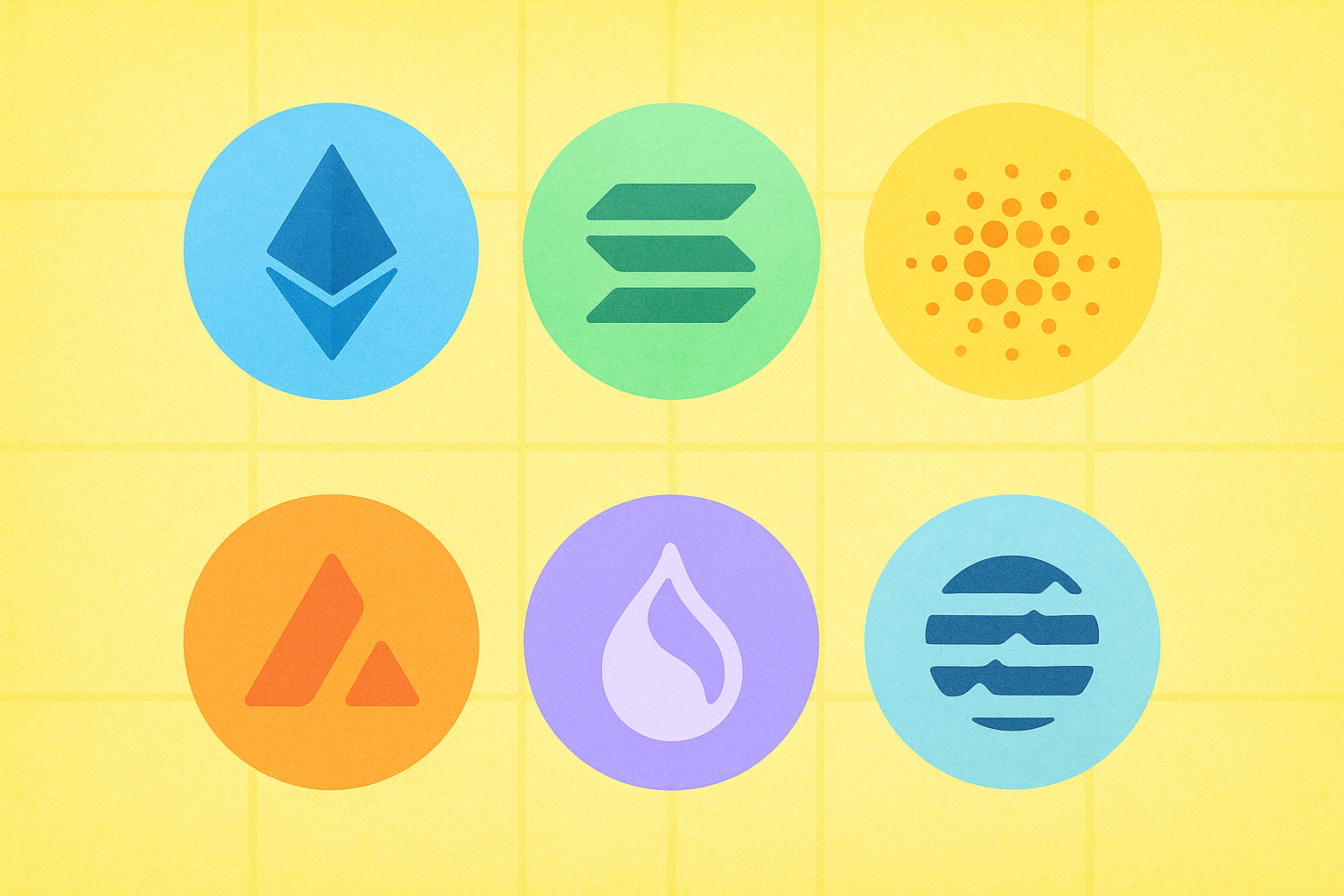
Compares transaction throughput, gas costs, and application scenarios for leading Layer 1 blockchains, including Ethereum, Solana, Cardano, Avalanche, Sui, and Aptos. Also provides details on available trading pairs at Japanese exchanges and staking options. This is a must-read selection guide for investors and developers evaluating Layer 1 chains.
What Is a Layer 1 Blockchain?
A Layer 1 blockchain is a standalone blockchain network that processes transactions and executes smart contracts independently. As the foundational layer of blockchain technology, it provides the core infrastructure on which various applications and services are built.
Prominent examples of Layer 1 blockchains include Bitcoin, Ethereum, and Solana. Each network utilizes its own consensus mechanism and technical architecture, optimized for specific uses and goals. Layer 1 chains are distinguished by their high security and decentralization. Because they operate independently, they are less reliant on external components and offer robust security.
However, Layer 1 chains face scalability challenges as transaction volumes rise, which can result in network congestion and higher fees. To address this, solutions such as Layer 2 protocols have been introduced—Ethereum, for example, employs Layer 2 solutions to boost throughput and lower transaction costs. Layer 2 technologies supplement Layer 1 by enabling faster and more affordable transactions while reducing the operating load on the base network.
Analytics firm CoinGecko reports that native tokens for Layer 1 blockchains have seen substantial growth in recent years. Major assets like BTC and ETH have reached new all-time highs, while other tokens have surged in niche markets. This growth is fueled by rising demand across diverse sectors such as DeFi, NFT, and blockchain gaming.
When evaluating investments or considering development on a Layer 1 blockchain, it is critical to assess its security, scalability, and ecosystem growth potential holistically. It is essential to carefully analyze each network’s technical features, developer community activity, and real-world use cases.
Key Specs Comparison Table: Major Layer 1 Projects Listed on Japanese Exchanges
The table below summarizes TPS (transactions per second), gas fees (transaction fees), main use cases, and listing status on Japanese exchanges for each project. This allows a quick comparison of performance and characteristics across leading Layer 1 blockchains.
| Project (Token) |
Consensus / Technology |
Performance (Approx. TPS) |
Transaction Fee (Gas) |
Main Use Cases / Sectors |
Status on Japanese Exchanges |
| Ethereum (ETH) |
PoS (Casper), EVM |
Approx. 15–30 TPS (L1); thousands of TPS possible with L2 |
Several dollars to tens of dollars (highly variable); e.g., approx. $0.61 (about ¥90) |
General-purpose (DeFi, NFT, and more) |
Listed on nearly all major exchanges |
| Solana (SOL) |
PoH + PoS (TowerBFT), Sealevel parallel execution |
Measured: 3,000–4,000 TPS; Theoretical: 65,000 TPS |
Extremely low (<1¢); e.g., approx. $0.00038/tx |
High-speed apps: DeFi, NFT, gaming |
GMO Coin, bitFlyer, and several other exchanges |
| Cardano (ADA) |
PoS (Ouroboros), EUTXO model |
Tens of TPS (expandable with Hydra in the future) |
Low to medium (a few to several dozen yen); e.g., about $0.1/tx (approx. 0.34 ADA) |
Academically oriented DeFi, NFT, ID authentication |
Early listing on bitFlyer and other major exchanges |
| Avalanche (AVAX) |
PoS (Avalanche consensus), multi-chain model |
Peak measured: approx. 405 TPS; theoretical: 4,500+ TPS |
Low (a few yen), less expensive than Ethereum |
DeFi, NFT, gaming, enterprise (subnets) |
Listed on several domestic exchanges |
| Sui (SUI) |
DPoS + parallel execution, Move language |
Up to approx. 300,000 TPS (test); practical: several thousand TPS |
Very low (<$0.01); e.g., approx. $0.0023/tx |
Gaming, NFT (dynamic assets), high-speed DeFi |
Listed on several domestic exchanges |
| Aptos (APT) |
PoS (improved BFT), parallel processing (Block-STM) |
Several thousand to over 10,000 TPS (actual: 13.3k TPS) |
Very low (<$0.01); e.g., approx. $0.005/tx |
DeFi, gaming, social (Move language security) |
Listed on several domestic exchanges |
*TPS indicates both theoretical maximum and observed network values. Gas fees are recent approximate averages. Exchange rate: $1 ≈ ¥130.
This comparison shows that each Layer 1 chain offers a different technical approach and performance profile. Ethereum stands out for its versatility and mature ecosystem, but it faces challenges with processing speed and transaction fees. In contrast, newer chains like Solana and Sui deliver high throughput and low fees, though their ecosystems are less established than Ethereum’s. When investing or developing, it is essential to understand these distinctions and choose solutions that match your objectives.
* The information is not intended to be and does not constitute financial advice or any other recommendation of any sort offered or endorsed by Gate.