This comprehensive investment guide compares BABY and DYDX, two distinct decentralized exchange tokens with different value propositions. BABY, launched in 2025, offers innovative Bitcoin staking infrastructure with high volatility and growth potential, currently priced at $0.01767. DYDX, established since 2021, provides decentralized derivatives trading on Layer 2 with greater liquidity and stability, trading at $0.177. The article analyzes historical price trends, supply mechanisms, institutional adoption, and technological ecosystems to help investors make informed decisions. Through 2026-2031 price forecasts and tailored investment strategies for different risk profiles, readers gain clarity on portfolio allocation: conservative investors should favor DYDX at 70-80% allocation, while aggressive investors can pursue balanced exposure. Risk assessments highlight BABY's network maturity concerns versus DYDX's Layer 2 scalability challenges, enabling investors to select tokens aligned with their objectives an
Introduction: Investment Comparison Between BABY and DYDX
In the cryptocurrency market, the comparison between BABY vs DYDX has consistently been a topic of interest among investors. Both assets demonstrate notable differences in market capitalization ranking, application scenarios, and price performance, representing distinct positioning within the crypto asset landscape.
BABY (Babylon): Launched in 2025, it has gained market recognition through its innovative native Bitcoin staking mechanism, enabling direct staking operations on the Bitcoin blockchain without intermediaries.
DYDX (dYdX): Operating since 2021, it has established itself as a decentralized derivatives trading protocol, providing perpetual contract trading services on Layer 2 blockchain infrastructure.
This article will comprehensively analyze the investment value comparison between BABY vs DYDX through historical price trends, supply mechanisms, institutional adoption, technological ecosystem, and future outlook, attempting to address investors' most pressing question:
"Which is the better buy right now?"
I. Historical Price Comparison and Current Market Status
Historical Price Trends of BABY (Coin A) and DYDX (Coin B)
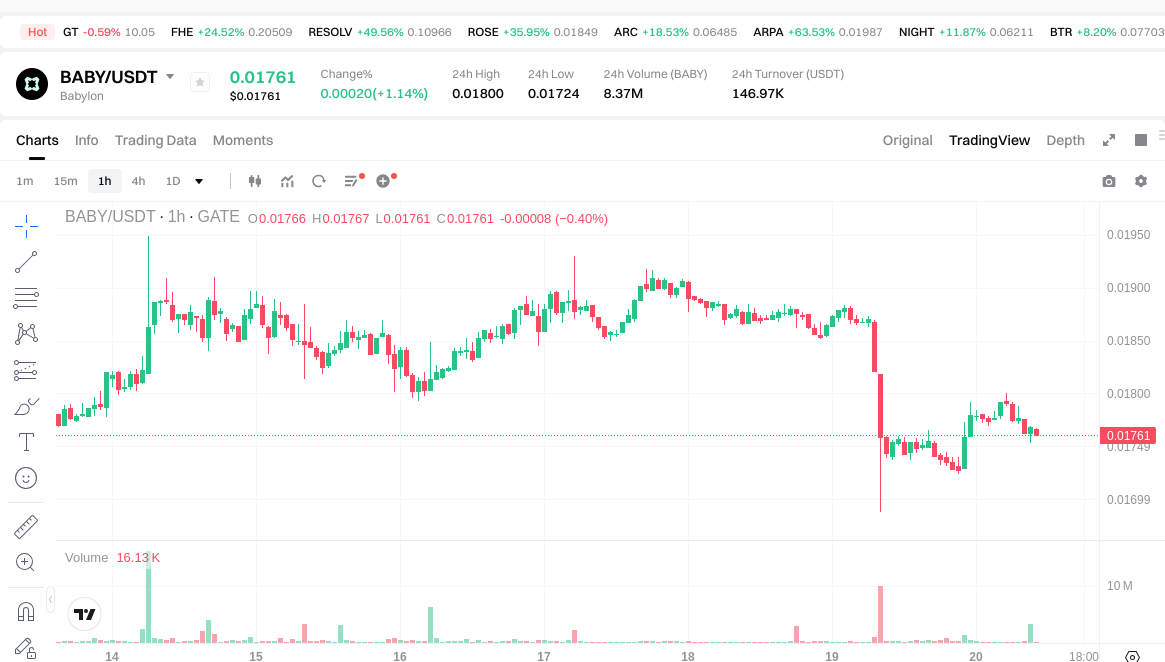
- 2025: BABY experienced notable volatility, with its price reaching a historical high of $0.17201 on April 10, 2025, before declining to a historical low of $0.00935 on October 10, 2025.
- 2024: DYDX reached its all-time high of $4.52 on March 8, 2024, demonstrating significant market strength during that period.
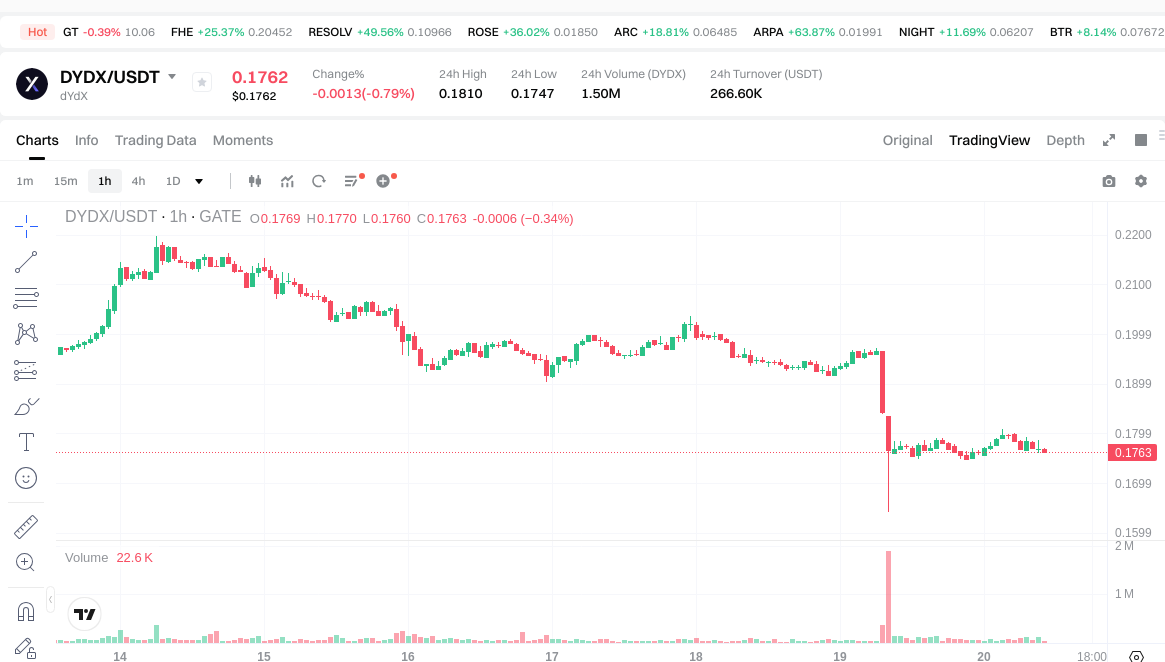
- 2025: DYDX faced considerable downward pressure, recording its all-time low of $0.126201 on October 11, 2025.
- Comparative Analysis: During the recent market cycle, BABY declined from its peak of $0.17201 to its low of $0.00935, representing substantial volatility. Meanwhile, DYDX experienced a decline from $4.52 to $0.126201, showing a more extended downward trajectory over a longer timeframe.
Current Market Status (January 20, 2026)
- BABY Current Price: $0.01767
- DYDX Current Price: $0.177
- 24-Hour Trading Volume: BABY recorded $147,047.97 compared to DYDX's $270,586.33
- 24-Hour Price Change: BABY increased by 1.66%, while DYDX decreased by 0.33%
- Market Sentiment Index (Fear & Greed Index): 32 (Fear)
View real-time prices:
- Check BABY current price Market Price
- Check DYDX current price Market Price
II. Core Factors Affecting BABY vs DYDX Investment Value
Supply Mechanism Comparison (Tokenomics)
Due to limited available data on the specific supply mechanisms of BABY and DYDX, a detailed comparison cannot be provided at this time. Generally, supply mechanisms such as fixed supply models, deflationary designs, or halving events can influence token scarcity and potentially impact price dynamics over different market cycles.
Institutional Adoption and Market Application
Institutional Holdings: Information regarding institutional preference between BABY and DYDX is not available in the provided materials.
Enterprise Adoption: Data on the application of BABY or DYDX in cross-border payments, settlement systems, or investment portfolios is not available.
National Policies: Specific regulatory stances from different countries toward BABY and DYDX are not covered in the reference materials.
Technology Development and Ecosystem Building
Without detailed information on recent technical upgrades or development roadmaps for BABY and DYDX, a comparative analysis cannot be conducted. Typically, factors such as DeFi integration, NFT support, payment infrastructure, and smart contract implementation contribute to the overall ecosystem strength of digital assets.
Macroeconomic Environment and Market Cycles
Performance in Inflationary Environments: Data comparing the anti-inflation properties of BABY versus DYDX is not available.
Macroeconomic Monetary Policy: The specific impacts of interest rate changes and U.S. dollar index fluctuations on BABY and DYDX are not documented in the provided materials.
Geopolitical Factors: Information regarding how cross-border transaction demand or international situations affect these two assets is not available.
III. 2026-2031 Price Forecast: BABY vs DYDX
Short-term Forecast (2026)
- BABY: Conservative $0.0151 - $0.0176 | Optimistic $0.0176 - $0.0188
- DYDX: Conservative $0.1199 - $0.1763 | Optimistic $0.1763 - $0.1869
Mid-term Forecast (2028-2029)
- BABY may enter a gradual growth phase, with estimated prices ranging from $0.0147 to $0.0317
- DYDX may enter an expansion phase, with estimated prices ranging from $0.1444 to $0.3037
- Key drivers: institutional capital inflows, ETF developments, ecosystem expansion
Long-term Forecast (2030-2031)
- BABY: Baseline scenario $0.0181 - $0.0266 | Optimistic scenario $0.0262 - $0.0415
- DYDX: Baseline scenario $0.1818 - $0.2635 | Optimistic scenario $0.2665 - $0.4672
View detailed price predictions for BABY and DYDX
Disclaimer
BABY:
| Year |
Predicted High Price |
Predicted Average Price |
Predicted Low Price |
Price Change |
| 2026 |
0.0188427 |
0.01761 |
0.0151446 |
0 |
| 2027 |
0.0238765185 |
0.01822635 |
0.017132769 |
3 |
| 2028 |
0.02189349162 |
0.02105143425 |
0.014736003975 |
19 |
| 2029 |
0.0317792451438 |
0.021472462935 |
0.01309820239035 |
21 |
| 2030 |
0.033016059008856 |
0.0266258540394 |
0.018105580746792 |
50 |
| 2031 |
0.041451129568537 |
0.029820956524128 |
0.026242441741232 |
68 |
DYDX:
| Year |
Predicted High Price |
Predicted Average Price |
Predicted Low Price |
Price Change |
| 2026 |
0.186878 |
0.1763 |
0.119884 |
0 |
| 2027 |
0.20337968 |
0.181589 |
0.14890298 |
2 |
| 2028 |
0.2540793288 |
0.19248434 |
0.144363255 |
8 |
| 2029 |
0.303663294784 |
0.2232818344 |
0.183091104208 |
26 |
| 2030 |
0.36359213913696 |
0.263472564592 |
0.18179606956848 |
48 |
| 2031 |
0.467163204278075 |
0.31353235186448 |
0.266502499084808 |
77 |
IV. Investment Strategy Comparison: BABY vs DYDX
Long-term vs Short-term Investment Strategies
- BABY: May appeal to investors focused on emerging Bitcoin staking infrastructure and newer protocol development, particularly those with higher risk tolerance for volatility
- DYDX: May suit investors interested in decentralized derivatives trading platforms and established Layer 2 ecosystem participation
Risk Management and Asset Allocation
- Conservative Investors: BABY: 20-30% vs DYDX: 70-80%
- Aggressive Investors: BABY: 50-60% vs DYDX: 40-50%
- Hedging Tools: Stablecoin allocation, options strategies, cross-asset portfolio diversification
V. Potential Risk Comparison
Market Risks
- BABY: Exhibited substantial price volatility with a decline from $0.17201 to $0.00935 during 2025, indicating higher susceptibility to market fluctuations and lower liquidity as reflected in its 24-hour trading volume of $147,047.97
- DYDX: Experienced an extended downward trend from $4.52 in March 2024 to $0.126201 in October 2025, demonstrating sensitivity to broader market cycles and derivatives trading sector dynamics, with current 24-hour volume of $270,586.33
Technical Risks
- BABY: As a newer protocol launched in 2025, potential concerns may include network maturity, staking mechanism stability, and ecosystem development challenges
- DYDX: Considerations may include Layer 2 scalability limitations, smart contract vulnerabilities in derivatives protocols, and infrastructure dependencies
Regulatory Risks
- Both assets face evolving global regulatory frameworks affecting cryptocurrency trading, staking mechanisms, and derivatives platforms, with potential differential impacts based on their respective operational models and jurisdictions
VI. Conclusion: Which Is the Better Buy?
📌 Investment Value Summary:
- BABY Advantages: Innovative Bitcoin staking mechanism, early-stage growth potential, recent positive momentum with 1.66% gain in 24 hours
- DYDX Advantages: Established operational history since 2021, positioned in the decentralized derivatives sector, higher trading volume indicating better liquidity
✅ Investment Recommendations:
- Novice Investors: Consider starting with DYDX due to its longer operational track record and higher liquidity, while allocating a smaller portion to BABY for diversification
- Experienced Investors: May evaluate balanced exposure based on risk tolerance, with potential for higher BABY allocation if seeking growth opportunities and comfortable with volatility
- Institutional Investors: Conduct thorough due diligence on both assets' technical infrastructure, regulatory compliance, and liquidity profiles before determining allocation strategies
⚠️ Risk Warning: The cryptocurrency market exhibits extreme volatility. This article does not constitute investment advice. The current market sentiment index of 32 indicates a fear environment. Investors should conduct independent research and consider their financial situation before making investment decisions.
VII. FAQ
Q1: What are the main differences between BABY and DYDX in terms of their core functions?
BABY focuses on Bitcoin staking infrastructure, while DYDX operates as a decentralized derivatives trading platform. BABY, launched in 2025, enables native Bitcoin staking directly on the blockchain without intermediaries, targeting investors interested in Bitcoin ecosystem innovation. DYDX, operational since 2021, provides perpetual contract trading services on Layer 2 infrastructure, serving traders seeking decentralized derivatives exposure with established operational history.
Q2: Which asset has shown better price stability historically?
Neither asset demonstrates strong price stability, but DYDX has exhibited relatively less extreme volatility. BABY experienced a dramatic decline from $0.17201 to $0.00935 within 2025, representing a significantly compressed timeframe for major price movement. DYDX's decline from $4.52 to $0.126201 occurred over a longer period (March 2024 to October 2025), suggesting a more extended downward trajectory rather than acute volatility, though both assets remain highly susceptible to market fluctuations.
Q3: How do the current trading volumes compare between BABY and DYDX?
DYDX demonstrates superior liquidity with nearly double the trading volume of BABY. As of January 20, 2026, DYDX recorded a 24-hour trading volume of $270,586.33 compared to BABY's $147,047.97. This higher volume indicates better market depth, potentially easier entry and exit positions, and reduced slippage risk for traders, making DYDX more suitable for investors prioritizing liquidity in their asset selection criteria.
Q4: What are the projected price ranges for both assets by 2030?
By 2030, BABY is projected to range from $0.0181 to $0.0266 in baseline scenarios and $0.0262 to $0.0415 in optimistic scenarios. DYDX is forecasted to range from $0.1818 to $0.2635 in baseline scenarios and $0.2665 to $0.4672 in optimistic scenarios. These projections suggest DYDX may maintain its higher absolute price positioning, while both assets show potential for growth driven by institutional adoption, ecosystem expansion, and broader market developments over the mid-to-long term horizon.
Q5: Which asset is more suitable for risk-averse investors?
DYDX appears more suitable for risk-averse investors based on several factors. The asset has a longer operational track record since 2021, demonstrating protocol sustainability and market acceptance. DYDX also exhibits higher trading volume ($270,586.33 vs $147,047.97), providing better liquidity for position management. Conservative portfolio allocation recommendations suggest 70-80% DYDX versus 20-30% BABY, reflecting lower risk assessment. However, all cryptocurrency investments carry substantial risk, and the current Fear & Greed Index of 32 indicates an overall fearful market environment.
Q6: What are the primary risks specific to each asset?
BABY faces risks associated with newer protocol maturity, including potential network stability issues, untested staking mechanism performance under stress conditions, and early-stage ecosystem development challenges. Its extreme price volatility in 2025 also indicates higher market risk exposure. DYDX confronts risks related to Layer 2 scalability limitations, smart contract vulnerabilities inherent in derivatives protocols, competitive pressures in the decentralized trading sector, and dependency on underlying blockchain infrastructure. Both assets remain subject to evolving regulatory frameworks affecting cryptocurrency operations.
Q7: How should investors approach portfolio allocation between BABY and DYDX?
Portfolio allocation should align with individual risk tolerance and investment objectives. Conservative investors might consider 70-80% DYDX and 20-30% BABY allocation, prioritizing the more established asset with higher liquidity. Aggressive investors could pursue 40-50% DYDX and 50-60% BABY distribution, accepting higher volatility for potential growth opportunities. Novice investors should begin with DYDX's proven track record while maintaining limited BABY exposure for diversification. All allocation strategies should incorporate risk management tools including stablecoin reserves, options hedging, and regular portfolio rebalancing based on market conditions.
Q8: What key factors should investors monitor when evaluating these assets going forward?
Investors should monitor several critical factors: trading volume trends as indicators of liquidity and market interest; ecosystem development milestones including partnerships, technical upgrades, and user adoption metrics; regulatory developments affecting staking mechanisms and derivatives trading platforms; macroeconomic conditions including interest rate policies and institutional capital flows; and competitive landscape changes within their respective sectors. Additionally, tracking the Fear & Greed Index and broader cryptocurrency market sentiment provides context for timing investment decisions and adjusting portfolio allocation strategies accordingly.
* The information is not intended to be and does not constitute financial advice or any other recommendation of any sort offered or endorsed by Gate.