This comprehensive comparison examines AGLD versus APT as two distinct rising blockchain assets on Gate. AGLD, a community-driven governance token from the 2021 Loot Project NFT ecosystem, and APT, a high-performance Layer 1 blockchain launched in 2022 utilizing Move programming language, represent fundamentally different investment propositions. The article analyzes historical price trends, current market status, tokenomics, institutional adoption, and technical ecosystems to address investor concerns. APT demonstrates superior liquidity ($2.44M daily volume) compared to AGLD ($37K volume), with both experiencing significant corrections from all-time highs. Investment forecasts through 2031 suggest APT maintaining higher valuations while AGLD offers speculative growth potential. The analysis provides tailored allocation strategies for conservative (APT 70-80%, AGLD 20-30%) and aggressive investors, examines market risks including volatility and regulatory uncertainties, and delivers actionable recommendation
Introduction: Investment Comparison Between AGLD and APT
In the cryptocurrency market, the comparison between AGLD vs APT has consistently been a topic of interest for investors. The two differ significantly in market cap ranking, application scenarios, and price performance, representing distinct crypto asset positioning.
Adventure Gold (AGLD): Launched in 2021, this community-driven governance token emerged from the Loot Project, a chain-based NFT initiative featuring randomly generated adventurer equipment. AGLD serves as the governance mechanism for the Loot ecosystem, where each Loot NFT holder could claim 10,000 AGLD tokens.
Aptos (APT): Introduced in 2022, this independent high-performance Proof-of-Stake Layer 1 blockchain has positioned itself as a secure and scalable infrastructure. Utilizing the Move programming language and Move virtual machine, Aptos focuses on optimizing blockchain application development.
This article will comprehensively analyze the investment value comparison of AGLD vs APT through historical price trends, supply mechanisms, institutional adoption, technological ecosystems, and future projections, attempting to address investors' most pressing question:
"Which is the better buy right now?"
I. Historical Price Comparison and Current Market Status
Historical Price Trends of AGLD (Coin A) and APT (Coin B)
- 2021: AGLD experienced significant price volatility following its launch, reaching a peak of $7.7 on September 3, 2021, driven by the community-driven Loot Project NFT initiative and airdrop distribution to Loot holders.
- 2022: AGLD recorded its lowest price point of $0.208231 on November 10, 2022, amid broader market downturns.
- 2023: APT reached its peak price of $19.92 on January 26, 2023, following its mainnet launch in October 2022 and growing interest in its high-performance PoS Layer 1 architecture utilizing Move programming language.
- 2024-2025: APT declined to its recorded low of $1.42 on December 19, 2025.
- Comparative Analysis: During the market cycle from 2021 to present, AGLD declined from $7.7 to $0.208231, representing a significant correction, while APT experienced a decline from $19.92 to $1.42 after its initial price discovery phase.
Current Market Status (January 22, 2026)
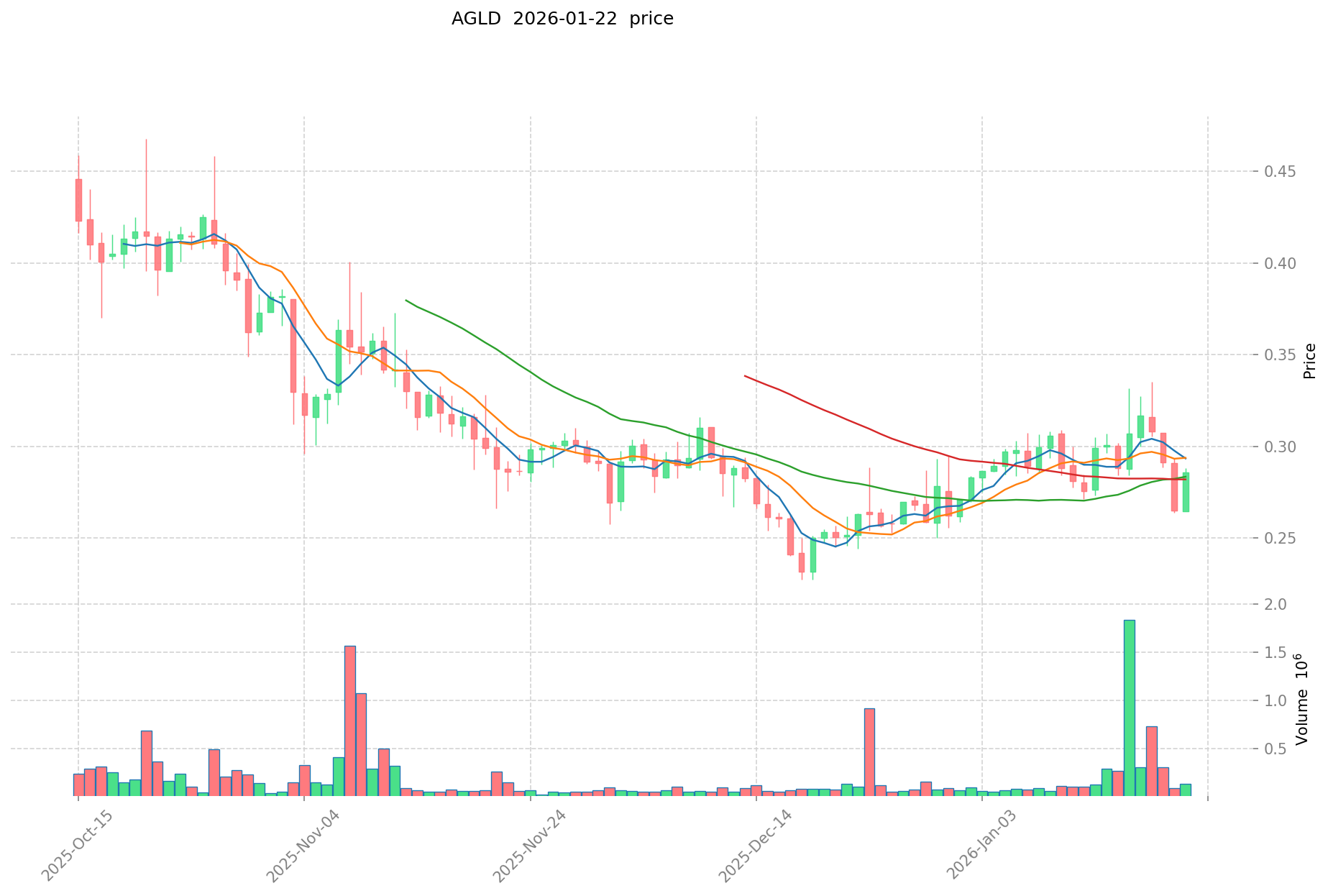
- AGLD Current Price: $0.287
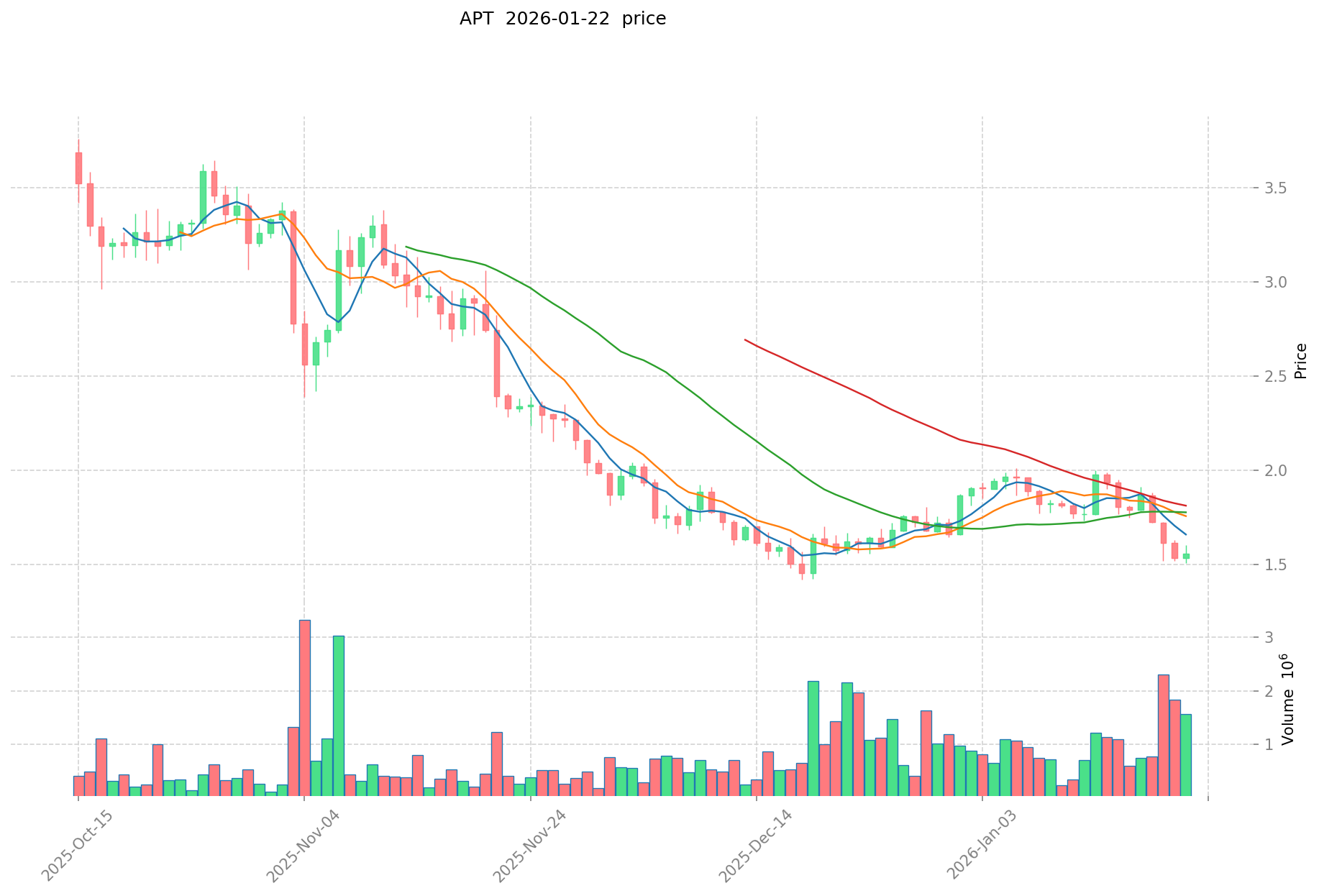
- APT Current Price: $1.5601
- 24-Hour Trading Volume: AGLD $37,097.62 vs APT $2,442,375.17
- Market Sentiment Index (Fear & Greed Index): 24 (Extreme Fear)
View Real-Time Prices:
II. Core Factors Affecting AGLD vs APT Investment Value
Supply Mechanism Comparison (Tokenomics)
Due to limited available data on the specific supply mechanisms of AGLD and APT, a comprehensive comparison cannot be provided at this time. Generally speaking, tokenomics including total supply, emission schedules, and circulation patterns play significant roles in shaping long-term value trajectories of digital assets.
Institutional Adoption and Market Application
Without sufficient data regarding institutional holdings and enterprise-level adoption for AGLD and APT, detailed analysis of their comparative positions in cross-border payments, settlement systems, or investment portfolios cannot be substantiated. Institutional interest typically correlates with liquidity depth and regulatory clarity in respective jurisdictions.
Technical Development and Ecosystem Building
Comprehensive information about recent technical upgrades, development roadmaps, and ecosystem expansion for both AGLD and APT is currently unavailable. The maturity of DeFi infrastructure, NFT integration, payment applications, and smart contract implementations generally serve as important indicators of long-term viability and adoption potential.
Macroeconomic Environment and Market Cycles
The relationship between macroeconomic conditions and the performance of AGLD versus APT requires more granular data for meaningful analysis. Factors such as inflation dynamics, monetary policy shifts, interest rate movements, and the US Dollar Index typically influence crypto asset valuations through various transmission channels. Geopolitical developments affecting cross-border transaction demand may also play a role in relative performance, though specific impacts on these two assets cannot be determined from available materials.
III. 2026-2031 Price Forecast: AGLD vs APT
Short-term Forecast (2026)
- AGLD: Conservative $0.22-$0.29 | Optimistic $0.29-$0.30
- APT: Conservative $0.87-$1.56 | Optimistic $1.56-$1.89
Mid-term Forecast (2028-2029)
- AGLD may enter a gradual growth phase, with estimated prices ranging from $0.29 to $0.51
- APT may enter a steady expansion phase, with estimated prices ranging from $1.55 to $2.46
- Key drivers: institutional capital inflows, ETF developments, ecosystem expansion
Long-term Forecast (2030-2031)
- AGLD: Baseline scenario $0.25-$0.48 | Optimistic scenario $0.48-$0.57
- APT: Baseline scenario $1.24-$2.50 | Optimistic scenario $2.50-$3.20
View detailed price predictions for AGLD and APT
Disclaimer
AGLD:
| Year |
Predicted High Price |
Predicted Average Price |
Predicted Low Price |
Price Change |
| 2026 |
0.302715 |
0.2883 |
0.224874 |
0 |
| 2027 |
0.3427887 |
0.2955075 |
0.1536639 |
2 |
| 2028 |
0.440424378 |
0.3191481 |
0.28723329 |
11 |
| 2029 |
0.51271142265 |
0.379786239 |
0.3418076151 |
32 |
| 2030 |
0.50426117883225 |
0.446248830825 |
0.249899345262 |
55 |
| 2031 |
0.57030600579435 |
0.475255004828625 |
0.323173403283465 |
65 |
APT:
| Year |
Predicted High Price |
Predicted Average Price |
Predicted Low Price |
Price Change |
| 2026 |
1.885543 |
1.5583 |
0.872648 |
0 |
| 2027 |
1.808017575 |
1.7219215 |
1.17090662 |
10 |
| 2028 |
2.01206527275 |
1.7649695375 |
1.553173193 |
13 |
| 2029 |
2.4550726266625 |
1.888517405125 |
1.5485842722025 |
21 |
| 2030 |
2.823333520661875 |
2.17179501589375 |
1.237923159059437 |
39 |
| 2031 |
3.1968822633956 |
2.497564268277812 |
2.272783484132809 |
60 |
IV. Investment Strategy Comparison: AGLD vs APT
Long-term vs Short-term Investment Strategies
- AGLD: May be suitable for investors interested in community-driven NFT ecosystems and governance token mechanisms, with a focus on the Loot Project's long-term development trajectory
- APT: May appeal to investors seeking exposure to high-performance Layer 1 blockchain infrastructure utilizing Move programming language, with emphasis on scalability and developer ecosystem growth
Risk Management and Asset Allocation
- Conservative Investors: AGLD 20-30% vs APT 70-80%
- Aggressive Investors: AGLD 40-50% vs APT 50-60%
- Hedging Tools: stablecoin allocation, options strategies, cross-asset portfolio diversification
V. Potential Risk Comparison
Market Risk
- AGLD: Higher volatility characteristics due to smaller market capitalization and lower trading volumes ($37,097.62 in 24-hour volume), with price movements potentially influenced by NFT market sentiment and Loot ecosystem developments
- APT: Moderate volatility with larger trading volumes ($2,442,375.17 in 24-hour volume), subject to broader Layer 1 blockchain competitive dynamics and institutional adoption patterns
Technical Risk
- AGLD: Ecosystem dependency on Loot Project infrastructure and community governance mechanisms
- APT: Network performance optimization challenges, potential security considerations related to Move virtual machine implementation
Regulatory Risk
- Global regulatory frameworks may impact both assets differently, with NFT-related tokens potentially facing distinct classification challenges compared to Layer 1 infrastructure protocols, while cross-border transaction regulations and securities law interpretations could affect adoption trajectories
VI. Conclusion: Which Is the Better Buy?
📌 Investment Value Summary:
- AGLD Advantages: community-driven governance model, connection to NFT ecosystem innovation, historical distribution mechanism through Loot NFT holder airdrops
- APT Advantages: high-performance Layer 1 infrastructure positioning, utilization of Move programming language and virtual machine, focus on secure and scalable blockchain architecture
✅ Investment Recommendations:
- New Investors: Consider dollar-cost averaging approach with emphasis on APT for relatively higher liquidity and established infrastructure positioning, while limiting AGLD exposure to speculative allocation
- Experienced Investors: Evaluate portfolio diversification across both assets based on risk tolerance, with tactical allocation adjustments during market cycle phases
- Institutional Investors: Conduct comprehensive due diligence on technical architecture, regulatory compliance frameworks, and long-term ecosystem sustainability metrics before position establishment
⚠️ Risk Disclosure: Cryptocurrency markets exhibit high volatility characteristics. This content does not constitute investment advice.
VII. FAQ
Q1: What is the main difference between AGLD and APT in terms of their fundamental use cases?
AGLD is a community-driven governance token for the Loot Project NFT ecosystem, while APT is a Layer 1 blockchain infrastructure token. AGLD emerged in 2021 as the governance mechanism for the Loot ecosystem, where each Loot NFT holder could claim 10,000 AGLD tokens, positioning it primarily within the NFT and gaming sectors. In contrast, APT launched in 2022 as a high-performance Proof-of-Stake blockchain utilizing the Move programming language, designed to provide secure and scalable infrastructure for broader blockchain applications including DeFi, smart contracts, and enterprise solutions.
Q2: Which asset has better liquidity based on current market data?
APT demonstrates significantly superior liquidity compared to AGLD. As of January 22, 2026, APT recorded a 24-hour trading volume of $2,442,375.17, which is approximately 66 times higher than AGLD's volume of $37,097.62. This substantial difference in trading activity indicates that APT offers better entry and exit opportunities for investors, reduced slippage on larger transactions, and generally lower execution risk during position adjustments.
Q3: How do the historical price performances of AGLD and APT compare?
Both assets have experienced significant corrections from their respective all-time highs, but with different trajectories. AGLD peaked at $7.7 on September 3, 2021, shortly after launch, and subsequently declined to $0.208231 by November 10, 2022, representing a decline of approximately 97%. APT reached its highest price of $19.92 on January 26, 2023, following its October 2022 mainnet launch, before declining to $1.42 on December 19, 2025, representing a decline of approximately 93%. Currently (January 22, 2026), AGLD trades at $0.287 while APT trades at $1.5601.
Q4: What are the projected price ranges for AGLD and APT in 2030?
According to forecasting models, AGLD is projected to trade between $0.25-$0.48 in the baseline scenario and $0.48-$0.57 in the optimistic scenario for 2030. APT shows higher projected valuations, with baseline estimates ranging from $1.24-$2.50 and optimistic scenarios reaching $2.50-$3.20 for the same period. These projections suggest that APT maintains a higher absolute price level, though investors should note that percentage gains relative to current prices require separate calculation and that all cryptocurrency price forecasts carry substantial uncertainty.
Q5: What portfolio allocation strategy is recommended for conservative versus aggressive investors?
For conservative investors seeking lower risk exposure, a recommended allocation would be 20-30% AGLD and 70-80% APT, emphasizing the more liquid and established infrastructure token. Aggressive investors with higher risk tolerance might consider 40-50% AGLD and 50-60% APT to capture potential upside from AGLD's smaller market capitalization and community-driven growth potential. Both strategies should incorporate hedging tools such as stablecoin reserves, options strategies for downside protection, and cross-asset portfolio diversification to manage volatility inherent in cryptocurrency markets.
Q6: What are the primary risk factors differentiating AGLD and APT investments?
AGLD carries higher market risk due to its smaller market capitalization and significantly lower trading volumes, making it more susceptible to price manipulation and volatility spikes tied to NFT market sentiment and Loot Project developments. APT faces moderate volatility but encounters different technical risks related to Layer 1 blockchain competition, network performance optimization challenges, and potential security considerations within its Move virtual machine implementation. Both assets face regulatory uncertainty, though AGLD may encounter distinct classification challenges as an NFT-related governance token compared to APT's infrastructure protocol positioning.
Q7: How does the current market sentiment affect investment decisions between AGLD and APT?
As of January 22, 2026, the Fear & Greed Index registers at 24, indicating "Extreme Fear" in the cryptocurrency market. This sentiment typically presents potential accumulation opportunities for long-term investors through dollar-cost averaging strategies, though it also signals increased downside risk and potential for further corrections. In such environments, APT's higher liquidity may provide better risk management capabilities through easier position adjustments, while AGLD's lower liquidity could result in more pronounced price dislocations during panic selling phases. Investors should consider maintaining higher stablecoin reserves during extreme fear periods to capitalize on potential value opportunities while managing exposure to continued downside volatility.
* The information is not intended to be and does not constitute financial advice or any other recommendation of any sort offered or endorsed by Gate.