Numa entrevista recente e aprofundada, Jensen Huang apresentou uma perspetiva marcante: a computação está a mudar de um “custo” para um “produto” que gera valor de forma direta.
Embora este conceito possa parecer abstrato, aborda uma questão fundamental — qual é o fator central de produção na era da inteligência artificial?
Enquanto fundador da NVIDIA, Huang tem uma visão privilegiada. Não fala do crescimento de utilizadores na camada de aplicação, nem da escala de parâmetros na camada de modelo. Redefine, sim, algo essencial: se a computação está a tornar-se uma unidade económica transacionável.
De centro de custos a motor de produção
Na era da internet, os centros de dados tinham um papel único.
Armazenavam dados, processavam pedidos e suportavam aplicações — funcionavam essencialmente como parte dos custos das empresas. Quer fosse computação em nuvem ou SaaS, o objetivo era “otimizar a estrutura de custos”, sem gerar diretamente produtos comercializáveis.
A IA alterou esta dinâmica. À medida que os modelos começaram a gerar texto, imagens, código e a executar tarefas complexas, cada computação passou a ser mais do que consumo de recursos — tornou-se “produção de resultados”. Estes resultados podem ser consumidos por utilizadores ou ter valor direto.
Assim, os centros de dados deixaram de ser apenas centros de custos; operam agora como fábricas. Os inputs são eletricidade, chips e modelos; os outputs são conteúdos, decisões e até ações automatizadas. Todos estes outputs estão agregados sob um conceito — Token.
Token: a menor unidade de produção na era da IA
Neste contexto, Token não se refere a tokens de criptomoeda, mas sim à unidade básica de medição nos sistemas de IA. Ao colocar uma questão a um modelo, consome Tokens; quando o modelo gera uma resposta, está a “produzir” Tokens. O preço da API assenta fundamentalmente no consumo de Tokens.
Pode parecer um detalhe técnico, mas a verdadeira mudança é: pela primeira vez, a computação pode ser medida, valorizada e transacionada em unidades precisas.
Historicamente, isto representa um marco crucial. Na era industrial, a eletricidade tornou-se infraestrutura porque podia ser medida (quilowatt-hora); na era da internet, largura de banda e armazenamento foram comercializados porque podiam ser faturados.
Agora, a IA transformou a própria “inteligência” num recurso mensurável. Token não é apenas um conceito técnico — está a emergir como uma nova “unidade económica”.
Porque a potência de computação será consumida como eletricidade
Huang fez uma previsão arrojada na entrevista: no futuro, o investimento em computação poderá representar uma parte muito maior da economia.
A lógica por trás disto é semelhante ao desenvolvimento da eletricidade.
Quando a eletricidade surgiu, era apenas um custo industrial. Com a eletrificação, praticamente todas as indústrias passaram a depender da eletricidade, que se tornou um recurso fundamental e indispensável.
A IA pode estar a seguir o mesmo caminho. À medida que mais tarefas são realizadas por IA — escrita, programação, design, análise, tomada de decisões — a essência destas atividades é o consumo de potência de computação e Tokens.
Isto cria uma nova estrutura de consumo:
-
As empresas já não compram apenas software; estão a “adquirir inteligência”
-
Os utilizadores já não usam apenas ferramentas; estão a “consumir computação”
-
A atividade económica gira cada vez mais em torno da potência de computação
Este é o conceito de “potência de computação como eletricidade”.
O verdadeiro ponto de viragem: os custos de inferência estão a explodir
Muitos veem os custos da IA como “treinar modelos”, mas Huang enfatizou uma mudança nesta entrevista: a inferência está a tornar-se o principal motor de custos. A IA inicial era mais uma ferramenta passiva — perguntava, respondia, a computação era discreta. Agora, a IA está a evoluir para um sistema em funcionamento contínuo. Especialmente com o surgimento dos Agents, a situação mudou drasticamente:
-
Uma tarefa já não é apenas uma chamada única, mas várias rondas de inferência
-
Um sistema pode executar várias IA simultaneamente
-
A IA pode chamar autonomamente outras IA
Isto significa que a computação passou de “consumo por utilização” para “queima contínua”. Huang foi direto: “Pensar é caro.”
Quando a IA começa a “pensar”, a procura por potência de computação não cresce de forma linear — cresce exponencialmente.
Do crescimento de utilizadores ao crescimento de Agents
Se a lógica de crescimento da era da internet era o “número de utilizadores”, na era da IA pode passar a ser o “número de Agents”. Esta mudança é facilmente ignorada, mas é crucial. Os utilizadores são finitos, mas os Agents podem ser replicados.
Um assistente de IA pode servir várias tarefas em simultâneo; um sistema pode executar milhares de Agents ao mesmo tempo; um Agent pode até gerar novos Agents. Isto conduz a um novo modelo de crescimento: a procura por potência de computação já não é determinada por pessoas, mas pelo “número de máquinas”. E o crescimento das máquinas não tem um limite natural.
Quem lucra? Uma cadeia industrial clara
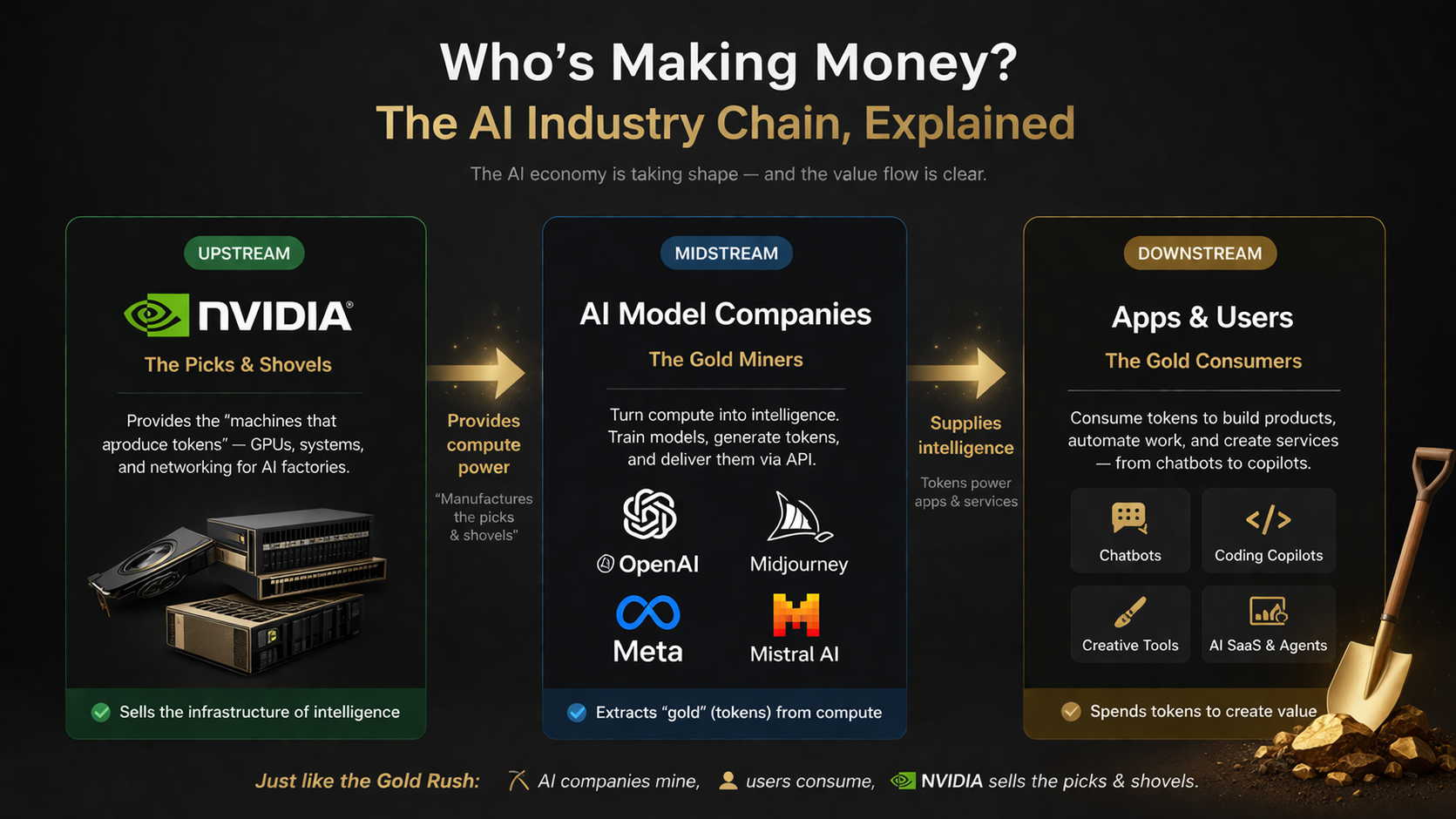
Neste modelo, toda a cadeia industrial da IA é muito clara.
Num extremo estão as empresas de modelos, que convertem potência de computação em Tokens e fornecem-nos aos utilizadores. No outro extremo está a camada de aplicação, responsável por consumir esses Tokens e construir produtos e serviços. A montante estão empresas como a NVIDIA, que fornecem as “máquinas que produzem Tokens”.
Este cenário faz lembrar a época da corrida ao ouro:
-
As empresas de IA estão a “extrair ouro”
-
Os utilizadores estão a “consumir ouro”
-
A NVIDIA está a “vender pás”
Enquanto houver procura por “ouro”, vender pás continuará a ser um negócio sólido.
A variável ignorada: energia, não chips
Muitos acreditam que o principal entrave para a IA são os chips, mas Huang apresentou uma perspetiva mais interessante nesta entrevista: o verdadeiro constrangimento pode ser a energia.
No entanto, a sua visão não é que “falta eletricidade”, mas sim que a “utilização é ineficiente”.
As redes elétricas tradicionais são dimensionadas para picos extremos e ficam ociosas grande parte do tempo. Os centros de dados de IA têm uma vantagem — podem ajustar-se dinamicamente.
Por exemplo, podem reduzir o desempenho, adiar tarefas ou deslocar cargas de trabalho, sem impactar o sistema global. Isto significa que os sistemas de potência de computação podem ser mais flexíveis do que os sistemas elétricos. Essa flexibilidade será um fator-chave na competição futura.
Uma mudança próxima da revolução industrial
Juntando estas pistas, revela-se uma visão mais ampla.
-
O Token transforma a computação numa mercadoria
-
As fábricas de IA conferem atributos produtivos aos centros de dados
-
Os custos de inferência impulsionam o consumo contínuo de potência de computação
-
Os Agents expandem a procura sem limites
Estas mudanças combinam-se para criar não apenas uma atualização técnica, mas uma reconstrução do modelo produtivo. Se a internet transformou o fluxo de informação, a IA está a transformar o “processo produtivo em si”. Por isso, Huang utiliza linguagem evocativa da industrialização para descrever a IA.
Porque, na sua definição, a IA não é apenas software — é um novo sistema de produção.
Conclusão
Quando a computação pode ser medida, valorizada e transacionada; quando os centros de dados operam como fábricas, a entregar valor de forma contínua; quando a potência de computação é consumida como eletricidade — tudo isto aponta numa direção: a IA está a evoluir de ferramenta para infraestrutura. Quando uma tecnologia se torna infraestrutura, as mudanças não são incrementais, mas estruturais.
Deste ponto de vista, o verdadeiro significado da entrevista pode não estar em prever o futuro, mas em oferecer um juízo: podemos já estar no ponto de partida da “industrialização da IA”.