This article explores the comparison between Mintlayer (ML) and Quant (QNT) in the finance world, focusing on their investment value. It highlights differences in historical price trends, supply mechanisms, and institutional adoption. The analysis is tailored for both new and experienced investors looking for strategic asset allocation and risk management insights. Readers will understand market risks, technical developments, and regulatory factors affecting both ML and QNT investments. Ideal for those interested in DeFi ecosystems and enterprise blockchain solutions, this comprehensive guide provides actionable investment advice based on current market conditions.
Introduction: ML vs QNT Investment Comparison
In the cryptocurrency market, the comparison between Mintlayer (ML) and Quant (QNT) has been an unavoidable topic for investors. The two not only show significant differences in market cap ranking, application scenarios, and price performance, but also represent different positioning in the crypto asset space.
Mintlayer (ML): Since its launch, it has gained market recognition for its role as a layer 2 protocol allowing users to build a decentralized finance ecosystem using native Bitcoin through atomic swaps.
Quant (QNT): Introduced in 2018, it has been hailed as a technology provider enabling trusted digital interaction, recognized for solving interoperability through the creation of a global blockchain operating system, Overledger.
This article will provide a comprehensive analysis of the investment value comparison between ML and QNT, focusing on historical price trends, supply mechanisms, institutional adoption, technological ecosystems, and future predictions, attempting to answer the question investors are most concerned about:
"Which is the better buy right now?"
I. Price History Comparison and Current Market Status
ML (Coin A) and QNT (Coin B) Historical Price Trends
- 2024: ML reached its all-time high of $0.99989 on January 11, 2024.
- 2021: QNT hit its all-time high of $427.42 on September 11, 2021.
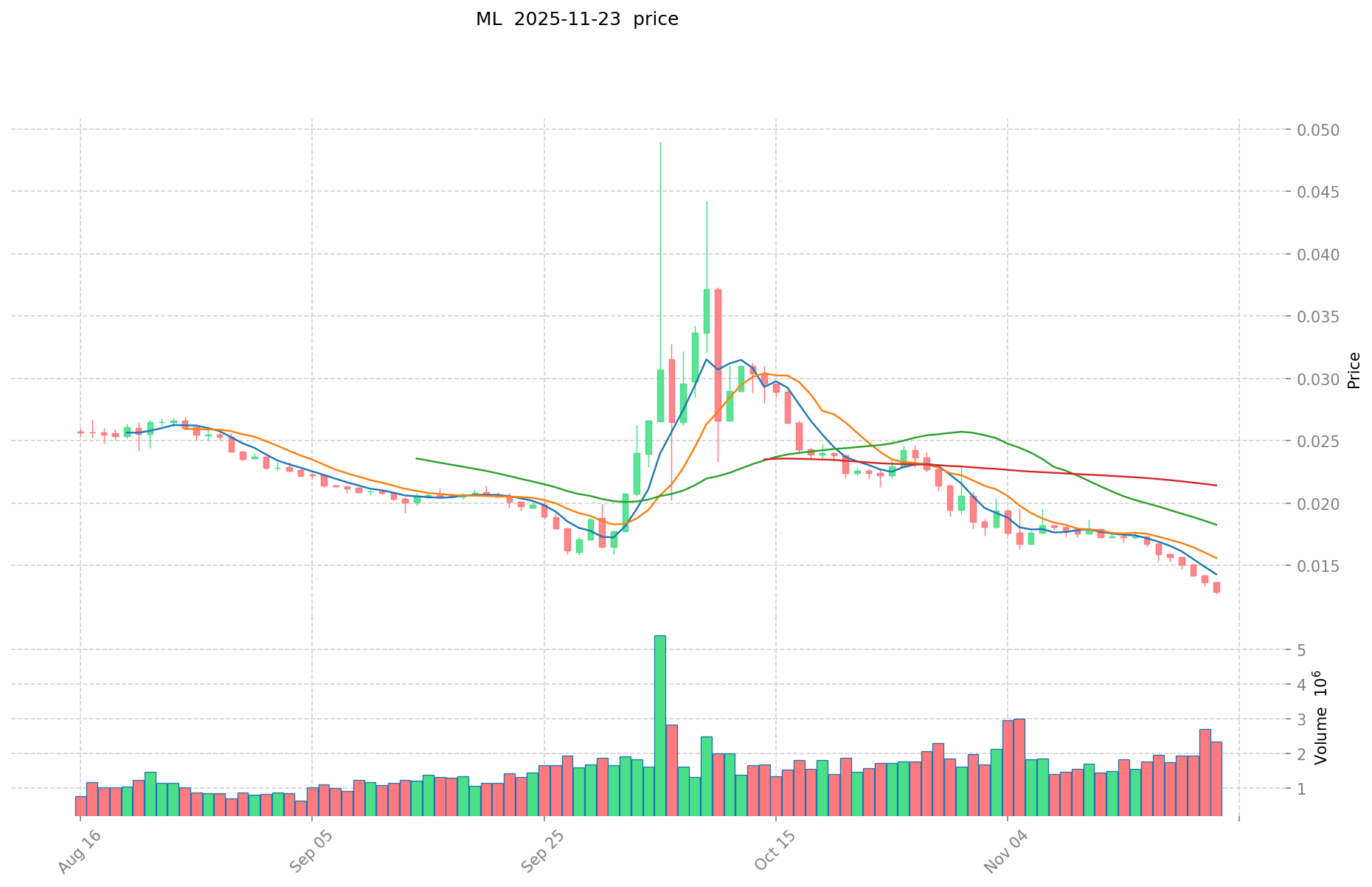
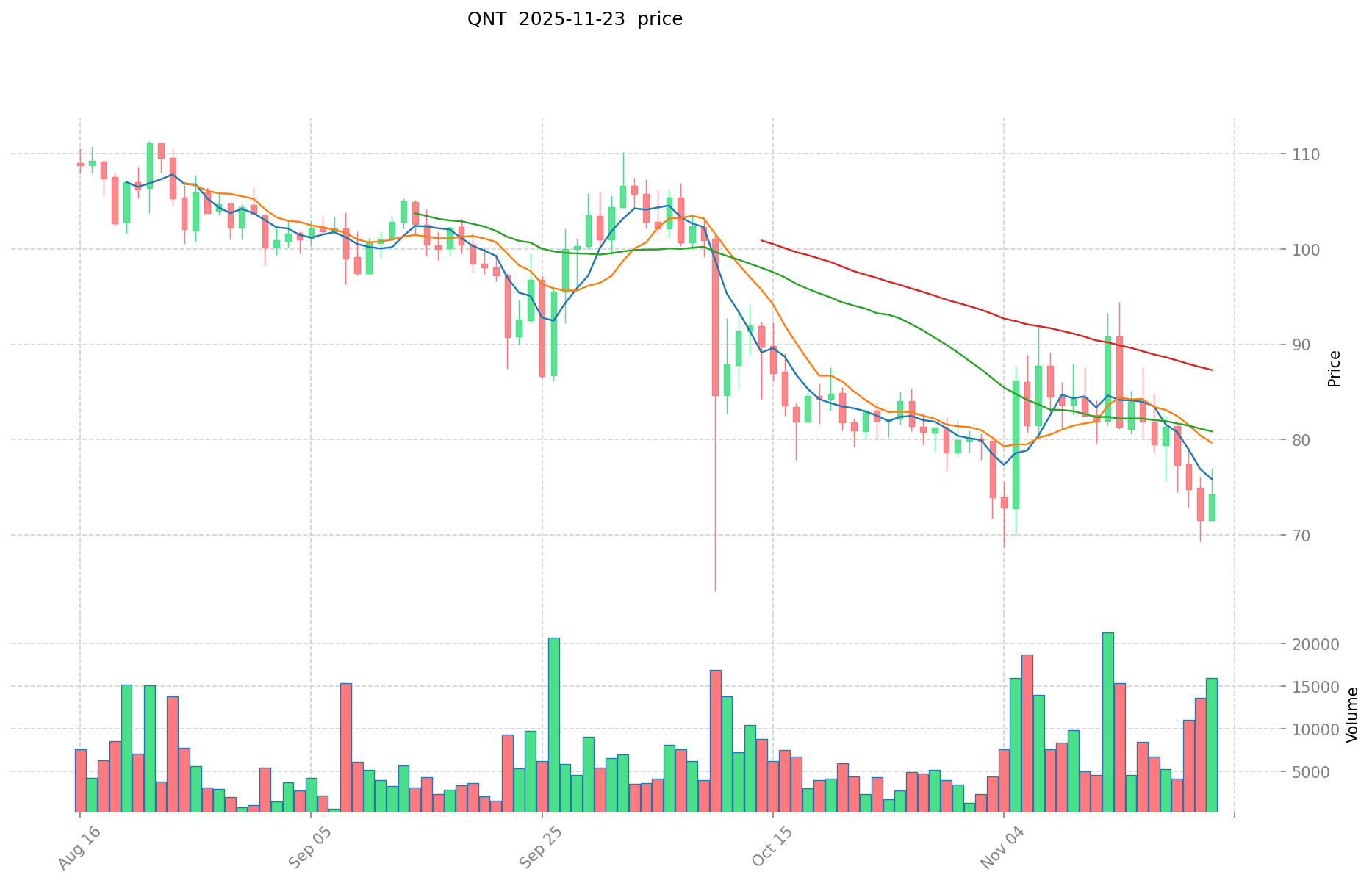
- Comparative analysis: In the recent market cycle, ML has dropped from its high of $0.99989 to a low of $0.0122, while QNT has fallen from its peak of $427.42 to current levels around $78.52.
Current Market Situation (2025-11-24)
- ML current price: $0.01299
- QNT current price: $78.52
- 24-hour trading volume: ML $31,000.04 vs QNT $1,271,240.55
- Market Sentiment Index (Fear & Greed Index): 13 (Extreme Fear)
Click to view real-time prices:
- View ML current price Market Price
- View QNT current price Market Price
II. Core Factors Affecting ML vs QNT Investment Value
Supply Mechanism Comparison (Tokenomics)
- ML (MakerDAO): Utilizes a dual-token system with DAI stablecoin pegged to USD and MKR token that governs the protocol. MKR is burned during system operation, creating a deflationary model.
- QNT (Quant): Fixed maximum supply of 14.6 million tokens, with approximately 12 million currently in circulation, creating natural scarcity.
- 📌 Historical pattern: Fixed supply tokens like QNT tend to demonstrate stronger price appreciation during bull markets, while MakerDAO's deflationary mechanism helps maintain value during market downturns.
Institutional Adoption and Market Applications
- Institutional holdings: QNT appears to have stronger institutional interest, particularly from financial institutions exploring blockchain interoperability solutions.
- Enterprise adoption: QNT has notable integration with enterprise blockchain solutions through its Overledger technology, while ML/MakerDAO has established itself as a cornerstone of DeFi lending and stablecoin infrastructure.
- Regulatory attitudes: Both projects have generally positive regulatory reception, with MakerDAO's DAI stablecoin facing increased regulatory scrutiny in some jurisdictions while Quant's enterprise-focused approach aligns well with compliance frameworks.
Technical Development and Ecosystem Building
- ML technical upgrades: Continuous improvements to the MakerDAO protocol, including enhanced collateral types, risk parameters, and governance mechanisms.
- QNT technical development: Ongoing development of the Overledger network and expansion of interoperability capabilities across different blockchain ecosystems.
- Ecosystem comparison: MakerDAO has deeper DeFi integration with widespread DAI adoption across lending platforms, while QNT focuses more on enterprise blockchain connectivity and interoperability solutions rather than consumer DeFi applications.
Macroeconomic Factors and Market Cycles
- Inflation performance: MakerDAO's DAI stablecoin provides inflation protection by design, while QNT's fixed supply model potentially positions it as a digital store of value.
- Monetary policy impact: Interest rate changes typically affect MakerDAO's lending ecosystem directly, while QNT may be more influenced by enterprise blockchain adoption cycles than monetary policy.
- Geopolitical factors: Cross-border payment disruptions tend to highlight the value proposition of both protocols - MakerDAO for stable value transfer and Quant for facilitating interoperability between different financial systems.
III. 2025-2030 Price Prediction: ML vs QNT
Short-term Prediction (2025)
- ML: Conservative $0.0081837 - $0.01299 | Optimistic $0.01299 - $0.0192252
- QNT: Conservative $47.7325 - $78.25 | Optimistic $78.25 - $104.0725
Mid-term Prediction (2027)
- ML may enter a growth phase, with estimated price range $0.01509765348 - $0.02007490188
- QNT may enter a bullish market, with estimated price range $69.720124 - $117.65270925
- Key drivers: Institutional capital inflow, ETF, ecosystem development
Long-term Prediction (2030)
- ML: Base scenario $0.019074640154769 - $0.024454666865089 | Optimistic scenario $0.024454666865089 - $0.025188306871042
- QNT: Base scenario $90.346578664966 - $153.1297943474 | Optimistic scenario $153.1297943474 - $197.537434708146
View detailed price predictions for ML and QNT
Disclaimer: The information provided is for informational purposes only and should not be considered as financial advice. Cryptocurrency markets are highly volatile and unpredictable. Always conduct your own research before making any investment decisions.
ML:
| 年份 |
预测最高价 |
预测平均价格 |
预测最低价 |
涨跌幅 |
| 2025 |
0.0192252 |
0.01299 |
0.0081837 |
0 |
| 2026 |
0.017074056 |
0.0161076 |
0.011597472 |
24 |
| 2027 |
0.02007490188 |
0.016590828 |
0.01509765348 |
27 |
| 2028 |
0.0236493957726 |
0.01833286494 |
0.011916362211 |
41 |
| 2029 |
0.027918203373879 |
0.0209911303563 |
0.010705476481713 |
61 |
| 2030 |
0.025188306871042 |
0.024454666865089 |
0.019074640154769 |
88 |
QNT:
| 年份 |
预测最高价 |
预测平均价格 |
预测最低价 |
涨跌幅 |
| 2025 |
104.0725 |
78.25 |
47.7325 |
0 |
| 2026 |
126.7141375 |
91.16125 |
56.519975 |
16 |
| 2027 |
117.65270925 |
108.93769375 |
69.720124 |
38 |
| 2028 |
167.67689822 |
113.2952015 |
81.57254508 |
44 |
| 2029 |
165.7735388348 |
140.48604986 |
109.5791188908 |
78 |
| 2030 |
197.537434708146 |
153.1297943474 |
90.346578664966 |
95 |
IV. Investment Strategy Comparison: ML vs QNT
Long-term vs Short-term Investment Strategies
- ML: Suitable for investors focused on DeFi ecosystem potential and stablecoin infrastructure
- QNT: Suitable for investors interested in enterprise blockchain adoption and interoperability solutions
Risk Management and Asset Allocation
- Conservative investors: ML: 30% vs QNT: 70%
- Aggressive investors: ML: 60% vs QNT: 40%
- Hedging tools: Stablecoin allocation, options, cross-currency portfolios
V. Potential Risk Comparison
Market Risks
- ML: Volatility in DeFi market, competition from other stablecoins
- QNT: Dependency on enterprise blockchain adoption rates
Technical Risks
- ML: Scalability, network stability, smart contract vulnerabilities
- QNT: Interoperability challenges, potential security flaws in Overledger network
Regulatory Risks
- Global regulatory policies may have different impacts on both assets, with ML facing potential scrutiny in stablecoin regulations and QNT navigating enterprise compliance frameworks
VI. Conclusion: Which Is the Better Buy?
📌 Investment Value Summary:
- ML advantages: Established position in DeFi, deflationary tokenomics, stablecoin infrastructure
- QNT advantages: Strong institutional interest, fixed supply, enterprise blockchain focus
✅ Investment Advice:
- New investors: Consider a balanced approach with a slight bias towards QNT due to its enterprise adoption potential
- Experienced investors: Explore opportunities in both assets, with allocation based on risk tolerance and market outlook
- Institutional investors: QNT may offer more alignment with traditional finance integration, while ML provides exposure to the growing DeFi sector
⚠️ Risk Warning: The cryptocurrency market is highly volatile, and this article does not constitute investment advice.
None
VII. FAQ
Q1: What are the key differences between ML and QNT in terms of their market focus?
A: ML focuses on the DeFi ecosystem and stablecoin infrastructure, while QNT targets enterprise blockchain adoption and interoperability solutions.
Q2: How do the supply mechanisms of ML and QNT differ?
A: ML utilizes a dual-token system with a deflationary model for MKR, while QNT has a fixed maximum supply of 14.6 million tokens, creating natural scarcity.
Q3: Which asset has shown stronger institutional interest?
A: QNT appears to have stronger institutional interest, particularly from financial institutions exploring blockchain interoperability solutions.
Q4: How do ML and QNT compare in terms of price performance since their all-time highs?
A: ML has dropped from its high of $0.99989 to $0.01299, while QNT has fallen from $427.42 to $78.52.
Q5: What are the primary risk factors for each asset?
A: ML faces risks related to DeFi market volatility and stablecoin competition, while QNT's risks are tied to enterprise blockchain adoption rates and interoperability challenges.
Q6: How might regulatory factors impact ML and QNT differently?
A: ML may face increased scrutiny due to stablecoin regulations, while QNT's enterprise focus may align better with existing compliance frameworks.
Q7: What allocation strategy is suggested for conservative investors?
A: Conservative investors might consider allocating 30% to ML and 70% to QNT.
Q8: Which asset might be more suitable for long-term investment?
A: Both assets have long-term potential, but QNT may be more suitable for those interested in enterprise blockchain adoption, while ML is better for those focused on DeFi ecosystem growth.
* The information is not intended to be and does not constitute financial advice or any other recommendation of any sort offered or endorsed by Gate.