The article explores the comparative investment value of Centrifuge (CFG) and Zilliqa (ZIL) in the cryptocurrency market. It analyzes historical price trends, supply mechanisms, institutional adoption, and technical developments. It provides insights into investment strategies, addressing risks, and suitability for different types of investors. Key questions tackled include the strengths and potential of each token for strategic allocation. The content is structured to give a concise yet comprehensive overview, aiding investors in making informed decisions about these emerging cryptocurrencies. Visit Gate for real-time prices and predictions.
Introduction: CFG vs ZIL Investment Comparison
In the cryptocurrency market, the comparison between Centrifuge (CFG) and Zilliqa (ZIL) has been an unavoidable topic for investors. The two not only differ significantly in market cap ranking, application scenarios, and price performance, but also represent different positioning in the crypto asset space.
Centrifuge (CFG): Since its launch, it has gained market recognition for its decentralized asset financing protocol that connects real-world assets to DeFi.
Zilliqa (ZIL): Introduced in 2018, it has been hailed as a high-throughput public blockchain platform, aiming to solve the scalability issues of current blockchain technologies.
This article will comprehensively analyze the investment value comparison between CFG and ZIL, focusing on historical price trends, supply mechanisms, institutional adoption, technological ecosystems, and future predictions, attempting to answer the question investors are most concerned about:
"Which is the better buy right now?"
I. Price History Comparison and Current Market Status
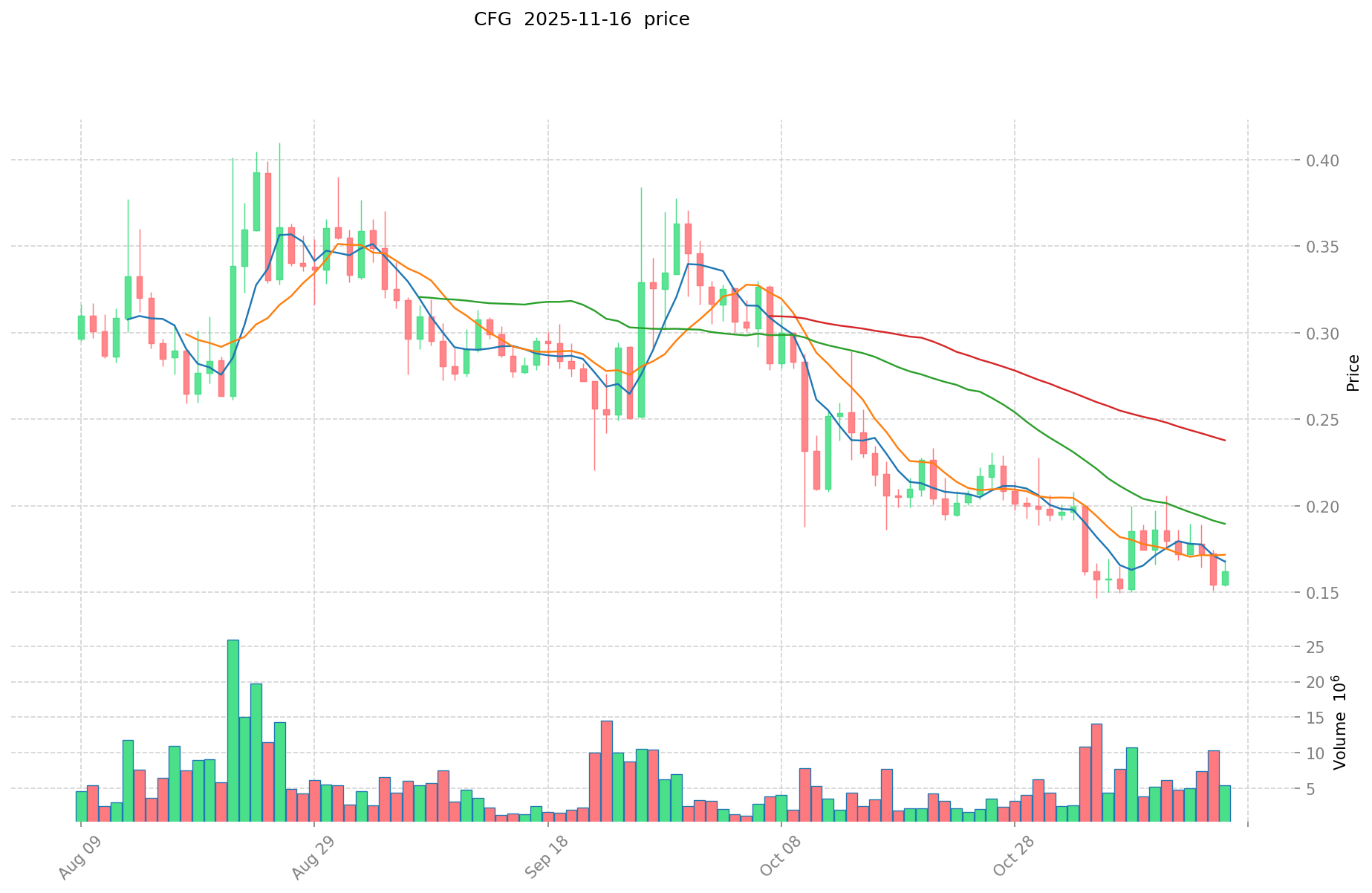
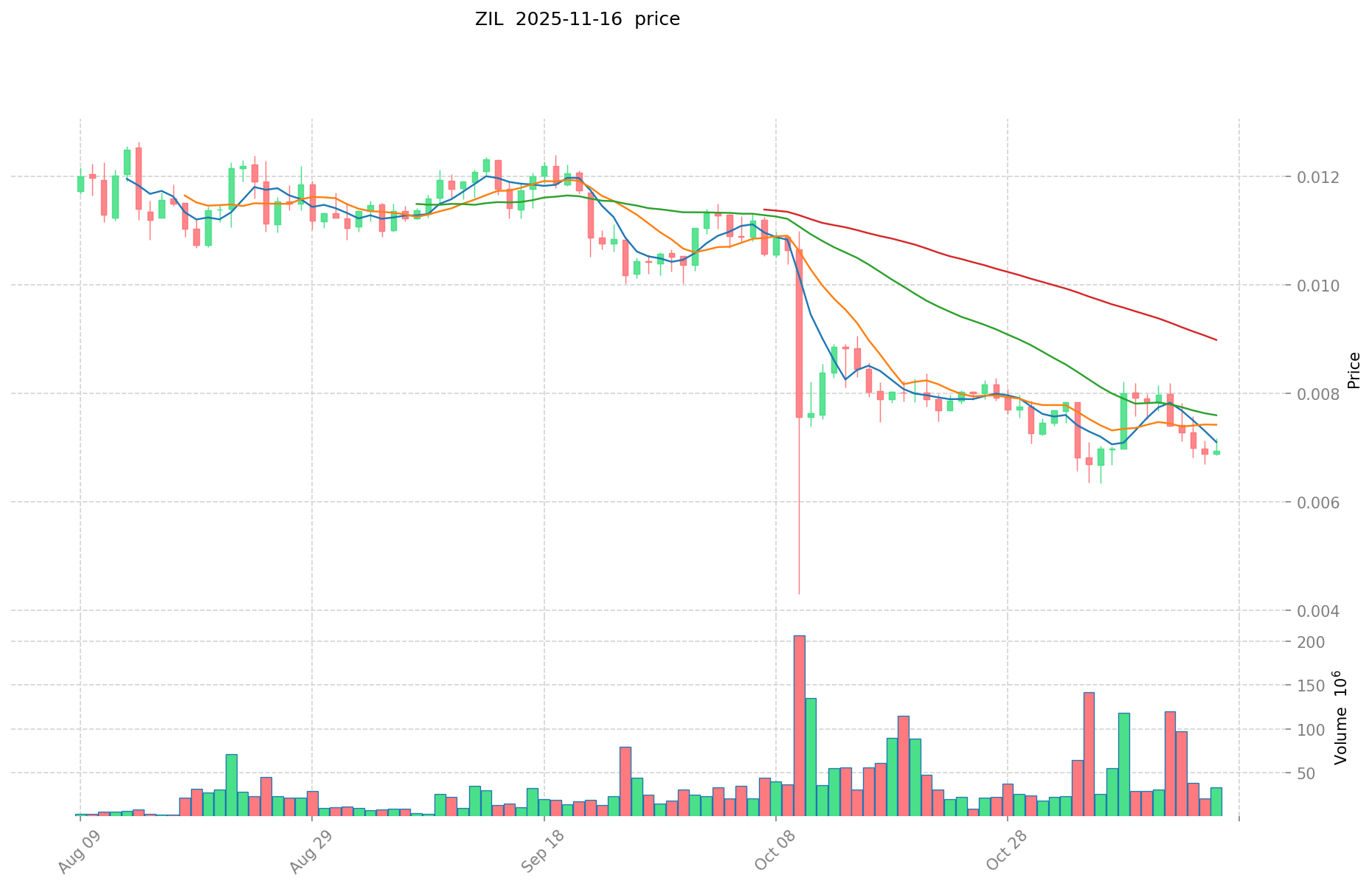
CFG (Coin A) and ZIL (Coin B) Historical Price Trends
- 2021: CFG reached its all-time high of $2.19 on October 15, 2021.
- 2021: ZIL hit its all-time high of $0.255376 on May 7, 2021.
- Comparative analysis: In the market cycle since their all-time highs, CFG has dropped from $2.19 to a current price of $0.15414, while ZIL has fallen from $0.255376 to $0.006744.
Current Market Situation (2025-11-17)
- CFG current price: $0.15414
- ZIL current price: $0.006744
- 24-hour trading volume: CFG $569,255.45 vs ZIL $188,949.97
- Market Sentiment Index (Fear & Greed Index): 10 (Extreme Fear)
Click to view real-time prices:
- View CFG current price Market Price
- View ZIL current price Market Price
II. Core Factors Affecting CFG vs ZIL Investment Value
Supply Mechanism Comparison (Tokenomics)
- CFG: Fixed maximum supply of 1 billion tokens with deflationary mechanisms through buybacks and burns
- ZIL: Maximum supply of 21 billion tokens with staking rewards and network fee burning mechanisms
- 📌 Historical pattern: Deflationary mechanisms in CFG have typically created stronger price support during market corrections, while ZIL's larger supply has historically resulted in more gradual price movements.
Institutional Adoption and Market Applications
- Institutional holdings: CFG has gained more institutional interest through Centrifuge's strategic partnerships with financial institutions
- Enterprise adoption: CFG is leading in the real-world asset tokenization space, while ZIL focuses more on decentralized applications and smart contract use cases
- Regulatory attitudes: Both tokens have maintained relatively positive regulatory positions, with CFG's focus on regulated financial assets potentially offering a compliance advantage
Technical Development and Ecosystem Building
- CFG technical upgrades: Integration with Polkadot ecosystem, RWA tokenization infrastructure enhancements
- ZIL technical development: Zilliqa's sharding technology, Scilla smart contract language, and ZilBridge interoperability solutions
- Ecosystem comparison: CFG has stronger DeFi infrastructure for real-world assets, while ZIL offers a broader range of general dApps, gaming applications, and NFT platforms
Macroeconomic Factors and Market Cycles
- Inflation environment performance: CFG's connection to real-world assets provides stronger inflation hedging properties
- Macroeconomic monetary policy: Both tokens are affected by broader crypto market trends, but CFG's RWA focus may provide more stability during high interest rate environments
- Geopolitical factors: CFG's focus on traditional finance integration could benefit from increased institutional crypto adoption during uncertain geopolitical conditions
III. 2025-2030 Price Prediction: CFG vs ZIL
Short-term Prediction (2025)
- CFG: Conservative $0.1089 - $0.1534 | Optimistic $0.1534 - $0.1810
- ZIL: Conservative $0.0044 - $0.0067 | Optimistic $0.0067 - $0.0075
Mid-term Prediction (2027)
- CFG may enter a growth phase, with prices estimated at $0.1605 - $0.2593
- ZIL may enter a stable phase, with prices estimated at $0.0061 - $0.0077
- Key drivers: Institutional fund inflows, ETF, ecosystem development
Long-term Prediction (2030)
- CFG: Base scenario $0.2149 - $0.2944 | Optimistic scenario $0.2944 - $0.3709
- ZIL: Base scenario $0.0072 - $0.0094 | Optimistic scenario $0.0094 - $0.0122
View detailed price predictions for CFG and ZIL
Disclaimer
CFG:
| 年份 |
预测最高价 |
预测平均价格 |
预测最低价 |
涨跌幅 |
| 2025 |
0.1810474 |
0.15343 |
0.1089353 |
0 |
| 2026 |
0.185634957 |
0.1672387 |
0.118739477 |
8 |
| 2027 |
0.259362137895 |
0.1764368285 |
0.160557513935 |
14 |
| 2028 |
0.294164302316625 |
0.2178994831975 |
0.1917515452138 |
41 |
| 2029 |
0.332841460584181 |
0.256031892757062 |
0.135696903161243 |
66 |
| 2030 |
0.370990212604983 |
0.294436676670621 |
0.214938773969553 |
91 |
ZIL:
| 年份 |
预测最高价 |
预测平均价格 |
预测最低价 |
涨跌幅 |
| 2025 |
0.0075768 |
0.006765 |
0.0044649 |
0 |
| 2026 |
0.007601154 |
0.0071709 |
0.006095265 |
5 |
| 2027 |
0.00775532835 |
0.007386027 |
0.00613040241 |
8 |
| 2028 |
0.008176331889 |
0.007570677675 |
0.0046938201585 |
11 |
| 2029 |
0.01110164174262 |
0.007873504782 |
0.00582639353868 |
15 |
| 2030 |
0.012238969508379 |
0.00948757326231 |
0.007210555679355 |
39 |
IV. Investment Strategy Comparison: CFG vs ZIL
Long-term vs Short-term Investment Strategies
- CFG: Suitable for investors focusing on real-world asset tokenization and DeFi integration
- ZIL: Suitable for investors interested in high-throughput blockchain platforms and general dApp ecosystems
Risk Management and Asset Allocation
- Conservative investors: CFG: 60% vs ZIL: 40%
- Aggressive investors: CFG: 70% vs ZIL: 30%
- Hedging tools: Stablecoin allocation, options, cross-token portfolios
V. Potential Risk Comparison
Market Risks
- CFG: Volatility in real-world asset markets could affect token value
- ZIL: Susceptibility to broader cryptocurrency market trends
Technical Risks
- CFG: Scalability, network stability
- ZIL: Mining centralization, security vulnerabilities
Regulatory Risks
- Global regulatory policies may have differing impacts on both tokens, with CFG potentially facing more scrutiny due to its focus on traditional finance integration
VI. Conclusion: Which Is the Better Buy?
📌 Investment Value Summary:
- CFG advantages: Strong positioning in real-world asset tokenization, institutional partnerships, potential inflation hedge
- ZIL advantages: High-throughput blockchain technology, broader dApp ecosystem, gaming and NFT applications
✅ Investment Advice:
- New investors: Consider a balanced approach, leaning towards CFG for its real-world asset backing
- Experienced investors: Explore a strategic allocation favoring CFG, with ZIL as a diversification option
- Institutional investors: Focus on CFG for its potential in bridging traditional finance with DeFi
⚠️ Risk Warning: The cryptocurrency market is highly volatile, and this article does not constitute investment advice.
None
VII. FAQ
Q1: What are the main differences between CFG and ZIL in terms of their focus and use cases?
A: CFG focuses on decentralized asset financing and connecting real-world assets to DeFi, while ZIL is a high-throughput public blockchain platform aiming to solve scalability issues.
Q2: How do the supply mechanisms of CFG and ZIL differ?
A: CFG has a fixed maximum supply of 1 billion tokens with deflationary mechanisms, while ZIL has a maximum supply of 21 billion tokens with staking rewards and network fee burning mechanisms.
Q3: Which token has shown better price performance since their all-time highs?
A: Both tokens have experienced significant drops since their all-time highs, with CFG falling from $2.19 to $0.15414, and ZIL dropping from $0.255376 to $0.006744.
Q4: How does institutional adoption compare between CFG and ZIL?
A: CFG has gained more institutional interest through strategic partnerships with financial institutions, while ZIL focuses more on decentralized applications and smart contract use cases.
Q5: What are the key technical developments for each token?
A: CFG is integrating with the Polkadot ecosystem and enhancing RWA tokenization infrastructure, while ZIL is developing sharding technology, the Scilla smart contract language, and ZilBridge interoperability solutions.
Q6: How do the long-term price predictions for 2030 compare between CFG and ZIL?
A: For 2030, CFG's base scenario predicts $0.2149 - $0.2944, with an optimistic scenario of $0.2944 - $0.3709. ZIL's base scenario predicts $0.0072 - $0.0094, with an optimistic scenario of $0.0094 - $0.0122.
Q7: What are the recommended investment strategies for CFG and ZIL?
A: Conservative investors might consider allocating 60% to CFG and 40% to ZIL, while aggressive investors might opt for 70% CFG and 30% ZIL. New investors are advised to lean towards CFG for its real-world asset backing.
Q8: What are the main potential risks for each token?
A: CFG faces risks related to volatility in real-world asset markets, scalability, and network stability. ZIL's risks include susceptibility to broader cryptocurrency market trends, mining centralization, and potential security vulnerabilities.
* The information is not intended to be and does not constitute financial advice or any other recommendation of any sort offered or endorsed by Gate.