This article provides an in-depth comparison of CELO and STX, two prominent Layer-1 blockchain platforms with distinct positioning in the Web3 ecosystem. CELO focuses on mobile-first financial inclusion with payment infrastructure for underbanked populations, while STX operates as a Bitcoin Layer-2 solution enabling smart contracts through proof-of-transfer consensus. The analysis examines historical price trends, tokenomics mechanisms, institutional adoption patterns, and technical ecosystems for both projects. Current market data shows CELO trading at $0.1388 versus STX at $0.3646 (January 2026). Price forecasts for 2026-2031 indicate STX stronger upside potential reaching $1.04 by 2031 compared to CELO's $0.32. The article evaluates investment strategies across different investor profiles, discusses macroeconomic influences, analyzes regulatory risks, and provides comprehensive risk management frameworks for portfolio allocation between these two distinct blockchain infrastructure projects.
Introduction: Investment Comparison Between CELO and STX
In the cryptocurrency market, the comparison between CELO vs STX has consistently been a topic investors cannot overlook. The two differ significantly in market capitalization ranking, application scenarios, and price performance, representing distinct positioning in the crypto asset landscape.
CELO: Launched in 2020, it has gained market recognition through its focus on financial inclusion and mobile-first accessibility, aiming to make financial tools available to anyone with a mobile phone.
STX (Stacks): Introduced in 2019, it has been positioned as a decentralized internet infrastructure, enabling users to better control their data while making content censorship more difficult, and is among the notable projects in the blockchain browser space.
This article will provide a comprehensive analysis of the investment value comparison between CELO vs STX, examining historical price trends, supply mechanisms, institutional adoption, technological ecosystems, and future predictions, attempting to answer the question investors care about most:
"Which is the better buy right now?"
I. Historical Price Comparison and Current Market Status
CELO (Coin A) and STX (Coin B) Historical Price Trends
- 2021: CELO experienced significant price movement, reaching a historical high of $9.82 on August 30, 2021, during the broader cryptocurrency market bull run.
- 2021: STX achieved its historical peak of $3.86 on April 1, 2024, driven by increased adoption of Bitcoin Layer-2 solutions and smart contract functionality.
- Comparative Analysis: During the 2021-2026 market cycle, CELO declined from its peak of $9.82 to a low of $0.109096 recorded on January 1, 2026, representing a decrease of approximately 98.9%. In contrast, STX declined from its high of $3.86 to a low of $0.04559639 on March 13, 2020, showing substantial volatility across different market periods.
Current Market Status (January 18, 2026)
- CELO Current Price: $0.1388
- STX Current Price: $0.3646
- 24-Hour Trading Volume: CELO $342,611.999892 vs STX $219,514.801096
- Market Sentiment Index (Fear & Greed Index): 50 (Neutral)
Click to view real-time prices:
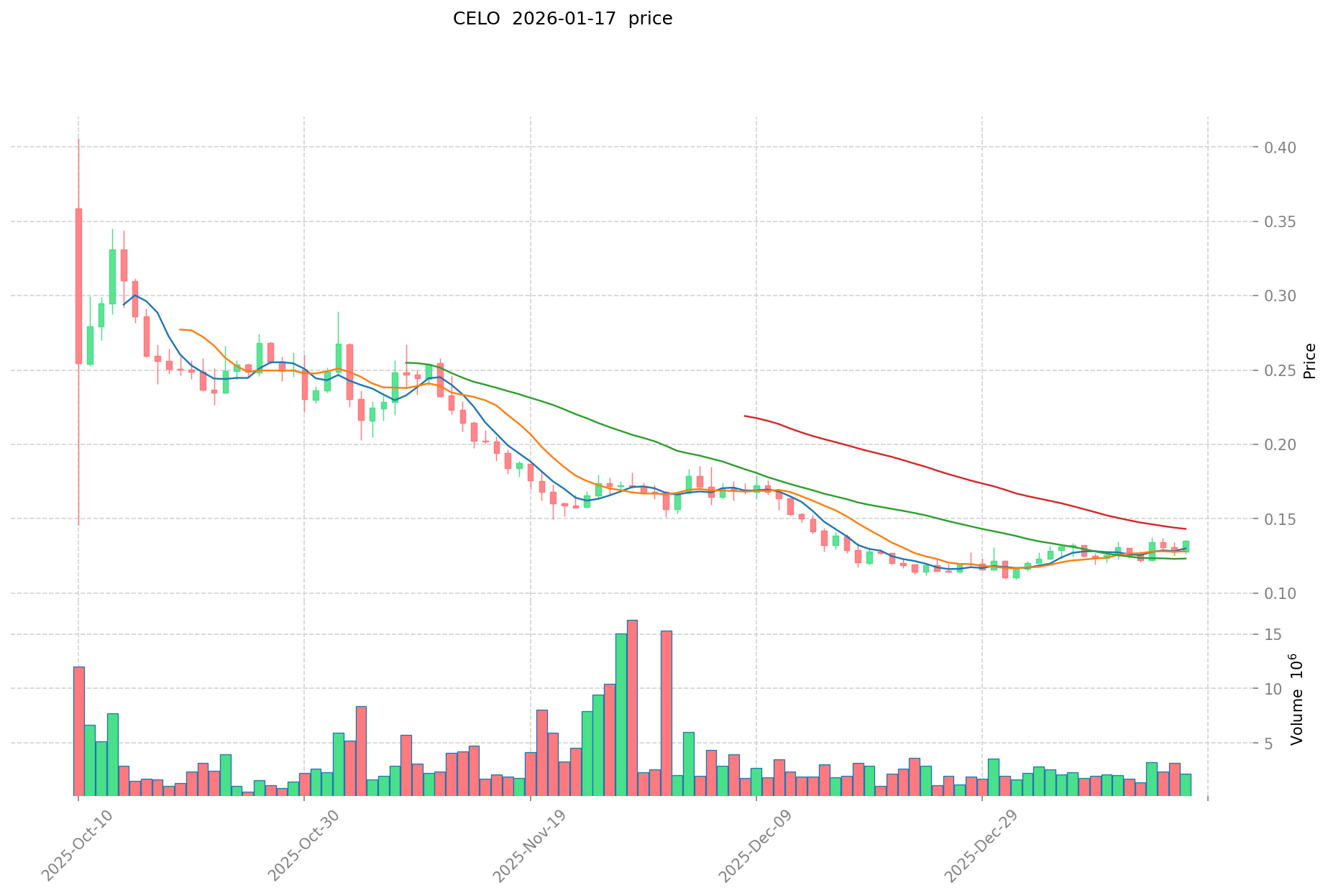
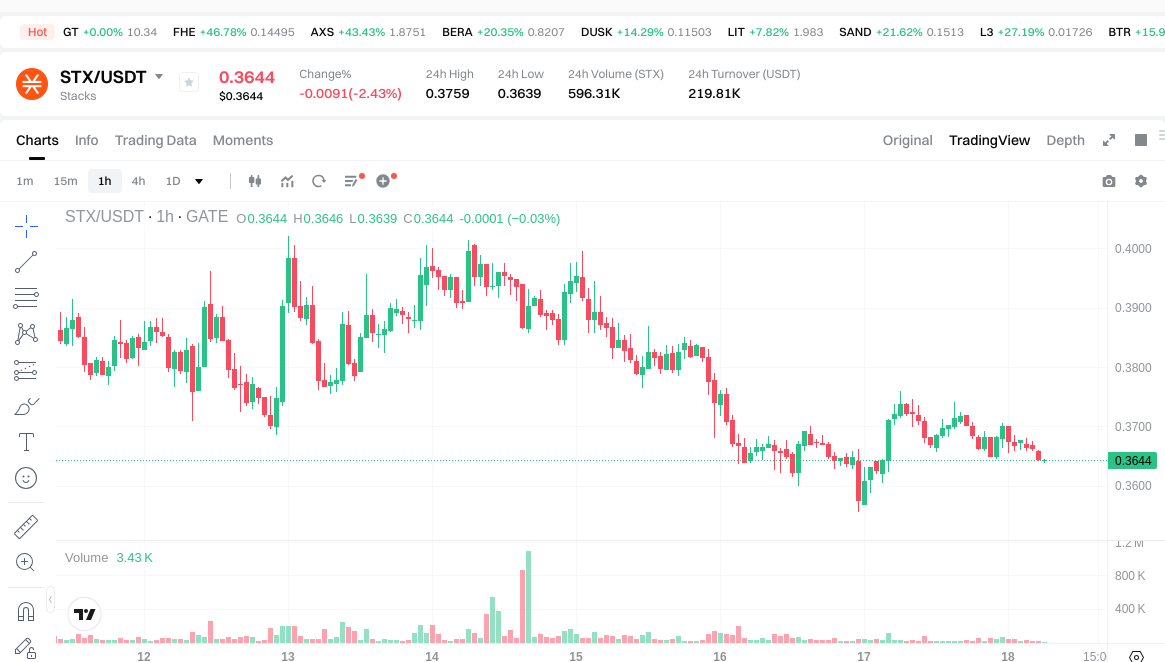
II. Core Factors Influencing CELO vs STX Investment Value
Supply Mechanism Comparison (Tokenomics)
-
CELO: Operates as a Layer-1 blockchain with a dynamic supply mechanism designed to support its dual-token model, where CELO serves as the native governance and staking token. The protocol employs algorithmic adjustments to maintain stablecoin pegs within its ecosystem, with token issuance tied to network validation and governance participation.
-
STX: Functions under a modified proof-of-transfer (PoX) consensus mechanism that connects to Bitcoin's security model. STX has a capped supply with distribution through mining rewards and stacking incentives, where holders can earn Bitcoin rewards by participating in consensus, creating a deflationary pressure through token lock-up mechanisms.
-
📌 Historical Pattern: Supply dynamics in both projects demonstrate how tokenomics design influences price cycles—CELO's inflation-adjusted model aims for stability in payment applications, while STX's Bitcoin-linked reward system creates periodic accumulation phases tied to broader Bitcoin market cycles.
Institutional Adoption and Market Application
-
Institutional Holdings: Both projects target different institutional segments. CELO focuses on mobile-first financial infrastructure with partnerships aimed at emerging market financial institutions, while STX appeals to institutions seeking Bitcoin ecosystem exposure without direct Bitcoin holdings.
-
Enterprise Adoption: CELO positions itself in mobile payment infrastructure and decentralized finance applications targeting financial inclusion, particularly in regions with limited traditional banking access. STX serves as a smart contract layer for Bitcoin, enabling DeFi applications, NFTs, and Web3 functionalities that leverage Bitcoin's security while expanding its utility beyond simple value transfer.
-
National Policies: Regulatory approaches vary by jurisdiction. Mobile payment-focused blockchains like CELO face scrutiny under payment service regulations, while Bitcoin-adjacent projects like STX may benefit from favorable Bitcoin regulatory frameworks in certain markets while facing uncertainty in others regarding their classification as separate digital assets.
Technical Development and Ecosystem Construction
-
CELO Technical Evolution: The platform emphasizes mobile-optimized blockchain infrastructure with lightweight client capabilities and phone number-based identity systems. Development focuses on scalability improvements and cross-chain interoperability to facilitate mobile payment applications and stablecoin adoption.
-
STX Technical Progress: Stacks continues developing its Clarity smart contract language and improving its connection to Bitcoin through upgrades that enhance transaction speed and reduce costs while maintaining Bitcoin finality. The platform works on expanding its capability to unlock Bitcoin's utility for DeFi and NFT applications.
-
Ecosystem Comparison: CELO's ecosystem centers on mobile-first DeFi applications, payment solutions, and stablecoin infrastructure targeting financial inclusion. STX ecosystem development focuses on Bitcoin DeFi protocols, NFT marketplaces, and Web3 applications that extend Bitcoin's functionality into smart contract territories, offering distinct value propositions within different market segments.
Macroeconomic and Market Cycles
-
Performance in Inflationary Environments: Both assets exhibit different characteristics during inflationary periods. As Layer-1 blockchain tokens, their performance tends to correlate with broader risk asset trends rather than serving as direct inflation hedges. However, STX's connection to Bitcoin may provide indirect exposure to Bitcoin's narrative as a hedge against currency devaluation.
-
Macroeconomic Monetary Policy: Interest rate changes and dollar index movements impact both assets through their influence on risk appetite in crypto markets. Higher rates typically pressure growth-oriented blockchain projects like both CELO and STX as investors rotate toward yield-bearing traditional assets. Dollar strength generally creates headwinds for crypto asset valuations denominated in USD.
-
Geopolitical Factors: Cross-border payment demand and international circumstances affect both projects differently. CELO's mobile payment focus positions it to benefit from increased remittance flows and financial inclusion initiatives in emerging markets. STX may gain from situations where Bitcoin adoption increases due to currency instability or capital control concerns, as its ecosystem provides additional utility layers for Bitcoin holders.
III. 2026-2031 Price Forecast: CELO vs STX
Short-term Forecast (2026)
- CELO: Conservative range between $0.1257 and $0.1381 | Optimistic range around $0.1671
- STX: Conservative range between $0.3421 and $0.3639 | Optimistic range around $0.4585
Mid-term Forecast (2028-2029)
- CELO may enter a consolidation phase, with projected prices ranging from $0.0982 to $0.1862
- STX may enter a growth phase, with projected prices ranging from $0.4320 to $0.7340
- Key drivers: institutional capital inflows, ETF developments, ecosystem expansion
Long-term Forecast (2031)
- CELO: Base scenario between $0.2050 and $0.2158 | Optimistic scenario around $0.3194
- STX: Base scenario between $0.5020 and $0.7276 | Optimistic scenario around $1.0405
View detailed price predictions for CELO and STX
Disclaimer
CELO:
| Year |
Predicted High Price |
Predicted Average Price |
Predicted Low Price |
Price Change |
| 2026 |
0.167101 |
0.1381 |
0.125671 |
0 |
| 2027 |
0.17701658 |
0.1526005 |
0.0915603 |
9 |
| 2028 |
0.1796413086 |
0.16480854 |
0.1598642838 |
18 |
| 2029 |
0.186002918244 |
0.1722249243 |
0.098168206851 |
24 |
| 2030 |
0.25255062899352 |
0.179113921272 |
0.17194936442112 |
29 |
| 2031 |
0.319431767196484 |
0.21583227513276 |
0.205040661376122 |
55 |
STX:
| Year |
Predicted High Price |
Predicted Average Price |
Predicted Low Price |
Price Change |
| 2026 |
0.458514 |
0.3639 |
0.342066 |
0 |
| 2027 |
0.60447429 |
0.411207 |
0.30018111 |
12 |
| 2028 |
0.53323267725 |
0.507840645 |
0.4367429547 |
39 |
| 2029 |
0.73395669218625 |
0.520536661125 |
0.43204542873375 |
42 |
| 2030 |
0.827965613185425 |
0.627246676655625 |
0.326168271860925 |
72 |
| 2031 |
1.04047678723635 |
0.727606144920525 |
0.502048239995162 |
99 |
IV. Investment Strategy Comparison: CELO vs STX
Long-term vs Short-term Investment Strategies
-
CELO: Suitable for investors focused on mobile payment infrastructure and financial inclusion narratives, particularly those seeking exposure to emerging market digital payment solutions and stablecoin ecosystem development. The project's mobile-first approach positions it for long-term adoption in regions with growing smartphone penetration but limited traditional banking access.
-
STX: Suitable for investors seeking Bitcoin ecosystem exposure with smart contract functionality, particularly those interested in Bitcoin DeFi development and Web3 applications built on Bitcoin's security model. The proof-of-transfer mechanism offering Bitcoin rewards may appeal to investors looking for Bitcoin accumulation through staking mechanisms.
Risk Management and Asset Allocation
-
Conservative Investors: CELO 30% vs STX 70% allocation may be considered, with STX receiving higher weighting due to its connection to Bitcoin's established security model and its positioning within the more mature Bitcoin ecosystem.
-
Aggressive Investors: CELO 50% vs STX 50% balanced allocation could provide diversified exposure to both mobile payment infrastructure and Bitcoin Layer-2 development, capturing different growth narratives within blockchain technology adoption.
-
Hedging Tools: Stablecoin reserves for opportunistic rebalancing, options strategies for downside protection during volatility periods, and cross-asset combinations with established cryptocurrencies to manage concentration risk in smaller-cap Layer-1 and Layer-2 projects.
V. Potential Risk Comparison
Market Risk
-
CELO: Subject to broader Layer-1 blockchain competition risk, with market performance dependent on mobile payment adoption rates and stablecoin regulatory developments. Price volatility may increase during periods of reduced risk appetite in crypto markets, particularly affecting smaller market cap Layer-1 protocols.
-
STX: Exposed to Bitcoin market correlation risk, where significant Bitcoin price movements typically influence STX valuation. Additionally faces competition from other Bitcoin Layer-2 solutions and smart contract platforms seeking to expand Bitcoin's utility beyond store of value functionality.
Technical Risk
-
CELO: Scalability challenges related to maintaining performance as mobile user adoption increases, network stability concerns during high-transaction periods, and potential technical hurdles in cross-chain interoperability implementations that are central to its ecosystem strategy.
-
STX: Technical dependencies on Bitcoin network stability and security, potential complications in maintaining efficient proof-of-transfer consensus mechanisms, and development complexity in bridging Bitcoin's UTXO model with smart contract functionality while preserving security guarantees.
Regulatory Risk
- Global regulatory frameworks present different challenges for each project. CELO's focus on mobile payments and stablecoin infrastructure may face increased scrutiny under payment service regulations and stablecoin-specific legislation being developed across multiple jurisdictions. STX's classification and its relationship to Bitcoin may create regulatory uncertainty, though certain jurisdictions with favorable Bitcoin policies could provide supportive environments. Both projects face evolving securities law interpretations and varying approaches to blockchain technology regulation across different markets.
VI. Conclusion: Which Is the Better Buy?
📌 Investment Value Summary:
-
CELO Advantages: Mobile-first infrastructure positioning in growing emerging markets, focus on financial inclusion addresses underserved populations, stablecoin ecosystem development aligned with digital payment trends, and partnership potential with institutions targeting mobile payment solutions.
-
STX Advantages: Connection to Bitcoin's established security model and network effects, smart contract functionality expanding Bitcoin's utility beyond simple value transfer, proof-of-transfer mechanism offering Bitcoin rewards to participants, and positioning within the Bitcoin DeFi narrative as Layer-2 solutions gain attention.
✅ Investment Recommendations:
-
Novice Investors: Consider starting with smaller allocations to understand volatility characteristics and ecosystem development progress before increasing exposure. Focus on understanding fundamental differences between mobile payment infrastructure projects and Bitcoin Layer-2 solutions to align investments with personal conviction in specific narratives.
-
Experienced Investors: May evaluate tactical allocation adjustments based on development milestone achievements, ecosystem growth metrics, and broader market cycle positioning. Consider both projects' distinct value propositions within different blockchain infrastructure categories for portfolio diversification purposes.
-
Institutional Investors: Could assess strategic allocations based on thesis alignment with either mobile payment infrastructure development or Bitcoin ecosystem expansion narratives. Due diligence on regulatory compliance frameworks, technical audit results, and ecosystem partnership developments may inform position sizing decisions.
⚠️ Risk Disclosure: Cryptocurrency markets exhibit significant volatility characteristics. This content does not constitute investment advice.
VII. FAQ
Q1: What are the main differences between CELO and STX in terms of their core technology?
CELO is a mobile-first Layer-1 blockchain focused on financial inclusion with phone number-based identity systems and stablecoin infrastructure, while STX operates as a Bitcoin Layer-2 solution using proof-of-transfer consensus to enable smart contracts on Bitcoin's security model. CELO emphasizes lightweight mobile clients and payment accessibility for underbanked populations, whereas STX leverages its Clarity smart contract language to unlock Bitcoin's utility for DeFi and Web3 applications while maintaining connection to Bitcoin's established network.
Q2: Which project has better price performance potential in the 2026-2031 period?
Based on current projections, STX shows stronger upside potential with forecasted prices ranging from $0.46-$0.73 by 2029 and potentially reaching $1.04 by 2031, compared to CELO's projections of $0.10-$0.19 by 2029 and $0.32 by 2031. However, price performance depends on multiple factors including ecosystem development, institutional adoption rates, and broader market cycles affecting Layer-1 blockchain platforms versus Bitcoin Layer-2 solutions.
Q3: How do CELO and STX generate value for token holders?
CELO generates value through its dual-token model supporting stablecoin pegs, governance participation, and network validation staking rewards within its mobile payment ecosystem. STX creates value through its proof-of-transfer mechanism where token holders can "stack" their STX to earn Bitcoin rewards by participating in consensus, effectively allowing Bitcoin accumulation while contributing to network security, plus utility in accessing DeFi applications built on its Bitcoin Layer-2 infrastructure.
Q4: What regulatory risks should investors consider for each project?
CELO faces regulatory scrutiny primarily under payment service regulations and emerging stablecoin-specific legislation across multiple jurisdictions due to its focus on mobile payments and financial infrastructure. STX encounters regulatory uncertainty regarding its classification relative to Bitcoin and varying approaches to Layer-2 solutions, though it may benefit in jurisdictions with favorable Bitcoin regulatory frameworks while facing potential securities law interpretations in others.
Q5: Which allocation strategy is recommended for different investor profiles?
Conservative investors might consider a 30% CELO / 70% STX allocation, weighting STX higher due to its Bitcoin ecosystem connection and established security model. Aggressive investors could adopt a balanced 50% CELO / 50% STX split to capture both mobile payment infrastructure and Bitcoin Layer-2 growth narratives. All investors should maintain stablecoin reserves for rebalancing opportunities and consider hedging tools like options strategies to manage downside risk during volatile periods.
Q6: How do macroeconomic factors affect CELO vs STX differently?
Both assets correlate with broader risk appetite in crypto markets during monetary policy shifts, but STX's Bitcoin connection may provide indirect exposure to Bitcoin's inflation hedge narrative during currency devaluation concerns. CELO's mobile payment focus positions it to benefit from increased remittance flows and financial inclusion initiatives in emerging markets during periods of cross-border payment demand growth, while STX may gain from situations where capital controls or currency instability drive Bitcoin adoption.
* The information is not intended to be and does not constitute financial advice or any other recommendation of any sort offered or endorsed by Gate.